Harvard Kennedy School of Government, Cambridge, Massachusetts (M.A.).
Massachusetts General Hospital and Harvard Medical School, Boston, Massachusetts (F.C.S.).
Ann Intern Med. 2021 Apr;174(4):484-492. doi: 10.7326/M20-6141. Epub 2020 Dec 21.
The paucity of public health messages that directly address communities of color might contribute to racial and ethnic disparities in knowledge and behavior related to coronavirus disease 2019 (COVID-19).
To determine whether physician-delivered prevention messages affect knowledge and information-seeking behavior of Black and Latinx individuals and whether this differs according to the race/ethnicity of the physician and tailored content.
Randomized controlled trial. (Registration: ClinicalTrials.gov, NCT04371419; American Economic Association RCT Registry, AEARCTR-0005789).
United States, 13 May 2020 to 26 May 2020.
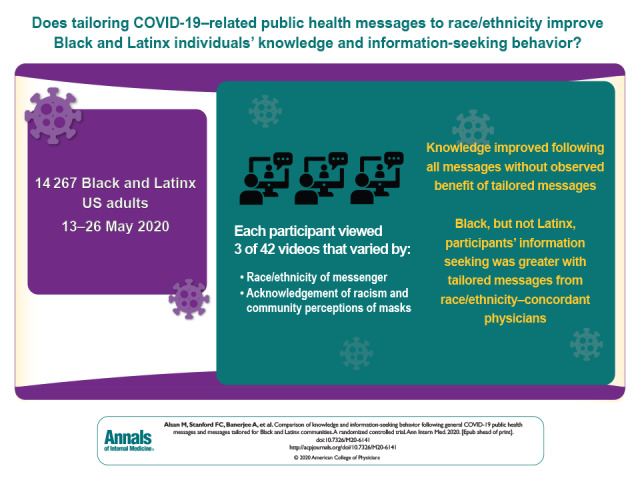
14 267 self-identified Black or Latinx adults recruited via Lucid survey platform.
Participants viewed 3 video messages regarding COVID-19 that varied by physician race/ethnicity, acknowledgment of racism/inequality, and community perceptions of mask wearing.
Knowledge gaps (number of errors on 7 facts on COVID-19 symptoms and prevention) and information-seeking behavior (number of web links demanded out of 10 proposed).
7174 Black (61.3%) and 4520 Latinx (38.7%) participants were included in the analysis. The intervention reduced the knowledge gap incidence from 0.085 to 0.065 (incidence rate ratio [IRR], 0.737 [95% CI, 0.600 to 0.874]) but did not significantly change information-seeking incidence. For Black participants, messages from race/ethnicity-concordant physicians increased information-seeking incidence from 0.329 (for discordant physicians) to 0.357 (IRR, 1.085 [CI, 1.026 to 1.145]).
Participants' behavior was not directly observed, outcomes were measured immediately postintervention in May 2020, and online recruitment may not be representative.
Physician-delivered messages increased knowledge of COVID-19 symptoms and prevention methods for Black and Latinx respondents. The desire for additional information increased with race-concordant messages for Black but not Latinx respondents. Other tailoring of the content did not make a significant difference.
National Science Foundation; Massachusetts General Hospital; and National Institutes of Health, National Institute of Diabetes and Digestive and Kidney Diseases.
公共卫生信息中直接针对有色人种社区的内容较少,这可能导致与 2019 年冠状病毒病(COVID-19)相关的知识和行为方面存在种族和民族差异。
确定医生提供的预防信息是否会影响黑人和拉丁裔个体的知识和信息寻求行为,以及这种影响是否因医生的种族/族裔和量身定制的内容而有所不同。
随机对照试验。(注册:ClinicalTrials.gov,NCT04371419;美国经济协会 RCT 注册处,AEARCTR-0005789)。
美国,2020 年 5 月 13 日至 26 日。
通过 Lucid 调查平台招募的 14267 名自认为是黑人和拉丁裔的成年人。
参与者观看了 3 个关于 COVID-19 的视频信息,这些信息因医生的种族/族裔、对种族主义/不平等的承认以及社区对戴口罩的看法而有所不同。
知识差距(7 个关于 COVID-19 症状和预防的事实的错误数量)和信息寻求行为(10 个提议的网络链接中要求的数量)。
纳入分析的有 7174 名黑(61.3%)和 4520 名拉丁裔(38.7%)参与者。干预措施将知识差距的发生率从 0.085 降低到 0.065(发病率比 [IRR],0.737 [95%CI,0.600 至 0.874]),但并未显著改变信息寻求的发生率。对于黑人参与者,来自种族/族裔一致的医生的信息增加了信息寻求的发生率,从 0.329(对于不一致的医生)增加到 0.357(IRR,1.085 [CI,1.026 至 1.145])。
参与者的行为未被直接观察到,结果于 2020 年 5 月干预后立即测量,在线招募可能不具有代表性。
医生提供的信息增加了黑人和拉丁裔受访者对 COVID-19 症状和预防方法的了解。对于黑人受访者,与种族一致的信息增加了他们对更多信息的需求,但对于拉丁裔受访者则没有。对内容的其他定制没有产生显著差异。
美国国家科学基金会;马萨诸塞州总医院;美国国立卫生研究院,国家糖尿病、消化和肾脏疾病研究所。