Department of Cardiac Surgery, University Hospital Munich, Ludwig-Maximilian-University, Munich, Germany.
Institute for Medical Information Processing, Biometry and Epidemiology, Ludwig-Maximilian-University, Munich, Germany.
Interact Cardiovasc Thorac Surg. 2021 Apr 19;32(4):607-615. doi: 10.1093/icvts/ivaa312.
Venoarterial extracorporeal life support (ECLS) has emerged as a potentially life-saving treatment option in therapy-refractory cardiocirculatory failure, but longer-term outcome is poorly defined. Here, we present a comprehensive follow-up analysis covering all major organ systems.
From February 2012 to December 2016, 180 patients were treated with ECLS for therapy-refractory cardiogenic shock or cardiac arrest. The 30-day survival was 43.9%, and 30-day survivors (n = 79) underwent follow-up analysis with the assessment of medium-term survival, quality of life, neuropsychological, cardiopulmonary and end-organ status.
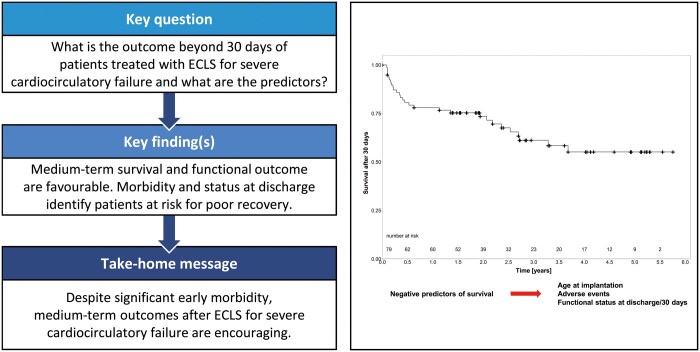
After a median of 1.9 (1.1-3.6) years (182.4 patient years), 45 of the 79 patients (57.0%) were alive, 35.4% had died and 7.6% were lost to follow-up. Follow-up survival estimates were 78.0% at 1, 61.2% at 3 and 55.1% at 5 years. NYHA class at follow-up was ≤II for 83.3%. The median creatinine was 1.1 (1.0-1.4) mg/dl, and the median bilirubin was 0.8 (0.5-1.0) mg/dl. No patient required dialysis. Overall, 94.4% were free from moderate or severe disability, although 11.1% needed care. Full re-integration into social life was reported by 58.3%, and 39.4% were working. Quality of life was favourable for mental components, but a subset showed deficits in physical aspects. While age was the only peri-implantation parameter significantly predicting medium-term survival, adverse events and functional status at discharge or 30 days were strong predictors.
This study demonstrates positive medium-term outcome with high rates of independence in daily life and self-care but a subset of 10-20% suffered from sustained impairments. Our results indicate that peri-implantation parameters lack predictive power but downstream morbidity and functional status at discharge or 30 days can help identify patients at risk for poor recovery.
体外膜肺氧合(ECLS)已成为治疗难治性心循环衰竭的潜在救生治疗选择,但长期结果定义较差。在这里,我们提供了一项全面的随访分析,涵盖了所有主要的器官系统。
从 2012 年 2 月至 2016 年 12 月,180 名患者因治疗难治性心源性休克或心脏骤停接受了 ECLS 治疗。30 天生存率为 43.9%,30 天幸存者(n=79)接受了随访分析,评估了中期生存率、生活质量、神经心理学、心肺和终末器官状态。
中位数为 1.9(1.1-3.6)年后(182.4 个患者年),79 名患者中有 45 名(57.0%)存活,35.4%死亡,7.6%失访。随访生存估计为 1 年时为 78.0%,3 年时为 61.2%,5 年时为 55.1%。随访时 NYHA 分级≤II 级为 83.3%。中位数肌酐为 1.1(1.0-1.4)mg/dl,中位数胆红素为 0.8(0.5-1.0)mg/dl。无患者需要透析。总体而言,94.4%的患者无中度或重度残疾,尽管 11.1%的患者需要护理。58.3%的患者完全重新融入社会生活,39.4%的患者工作。生活质量在心理方面较好,但一部分患者在身体方面存在缺陷。尽管年龄是唯一与植入物相关的参数,显著预测了中期生存率,但出院或 30 天时的不良事件和功能状态是强有力的预测因素。
这项研究表明,具有较高的日常生活独立性和自理能力的中期结果呈阳性,但有 10-20%的患者持续存在损伤。我们的结果表明,植入物相关参数缺乏预测能力,但出院或 30 天时的下游发病率和功能状态可以帮助识别预后不良的患者。