Behavioral Science Unit, Extension and Training Division, National Institute of Nutrition (ICMR), Hyderabad, India.
Department of Nutrition and Carolina Population Center, University of North Carolina at Chapel Hill, Chapel Hill, North Carolina, USA.
Matern Child Nutr. 2020 Dec;16 Suppl 3(Suppl 3):e13066. doi: 10.1111/mcn.13066.
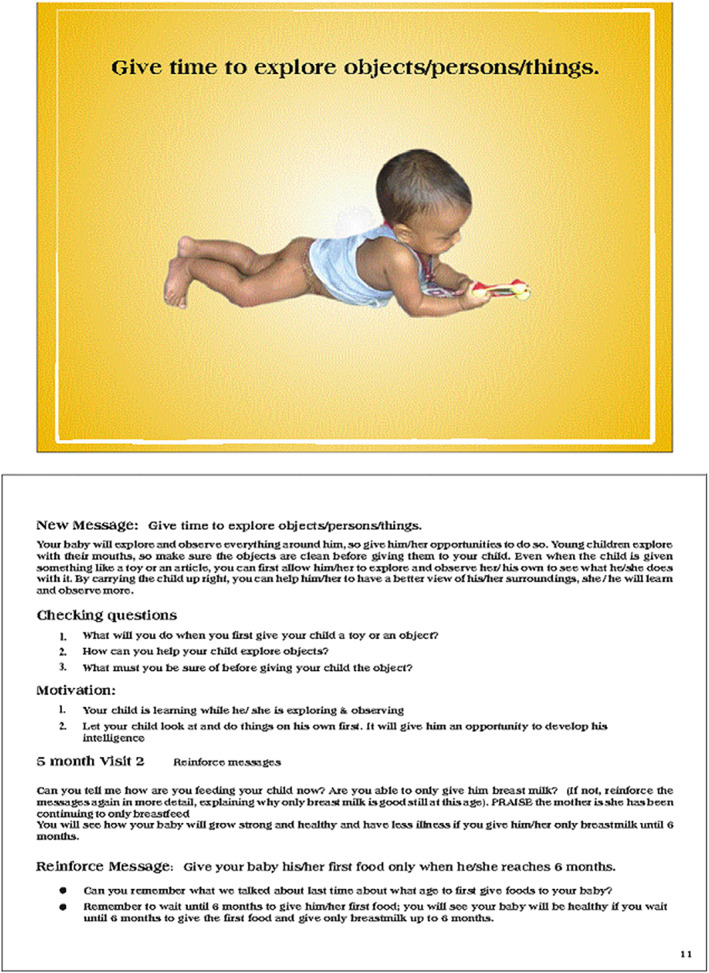
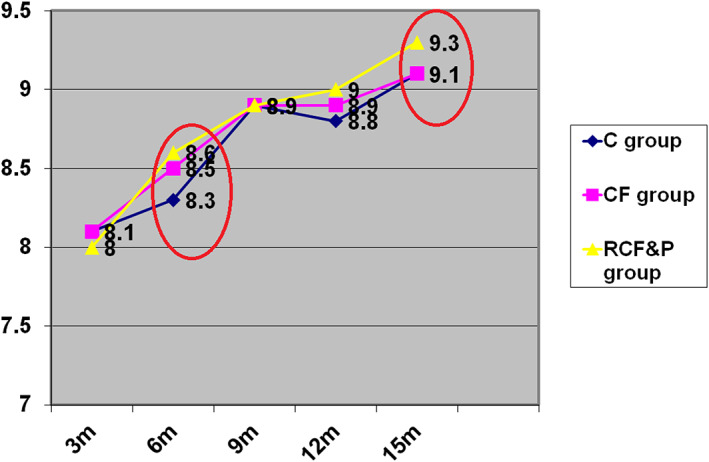
A cluster randomized trial design was used to test the efficacy of a behaviour change communication intervention on the quality of the home environment and infant development at 15 months of age. Children (n = 600) in rural South India were followed from 3 through 15 months of age. The control group (C group) received the standard of care, the complementary feeding group (CF group) received recommendations on complementary foods and the responsive complementary feeding and play group (RCF&P group) received recommendations on complementary foods plus skills on responsive feeding and play. The intervention was delivered in biweekly home visits to caregivers using flip charts. At postintervention, infants (n = 521) were assessed for development (Bayley-II scales) and their home environment was assessed (Home Observation for Measurement of the Environment [HOME] scale). Cluster adjusted analysis of variance showed no significant differences at baseline. The HOME score at 15 months differed by group, F(2, 38) = 6.41, P = 0.004; the CF and RCF&P groups had higher scores than the C group. Scores on subscales 'Opportunities for Variety in Daily Stimulation' and 'Caregiver Promotion of Child Development' (CPCD) were higher for the RCF&P group than for the C and CF groups. Mental development index (MDI) scores differed by group, F(2, 37) = 3.31, P = 0.04, with the RCF&P group showing higher scores than the C group (P < 0.04); no differences were noted in psychomotor development index (PDI) scores (P = 0.48). The subscales of HOME associated with MDI at 15 months were 'CPCD' and 'Cleanliness of Child' (R = 0.076). 'CPCD' was also associated with PDI (R = 0.039). A responsive complementary feeding and play intervention delivered through home visits benefitted children's mental development and caregiving environment at 15 months.
采用整群随机试验设计,测试行为改变交流干预对家庭环境质量和 15 月龄婴儿发育的效果。在印度南部农村,从 3 月龄至 15 月龄期间对 600 名儿童进行随访。对照组(C 组)接受标准护理,补充喂养组(CF 组)接受补充食品建议,反应性补充喂养和游戏组(RCF&P 组)接受补充食品建议加反应性喂养和游戏技能。通过使用翻页图在两周一次的家访中向照顾者提供干预。干预结束后,对婴儿(n = 521)进行发育评估(贝利婴幼儿发育量表),并评估其家庭环境(家庭观察评估环境量表)。集群调整方差分析显示基线时无显著差异。15 月龄时的 HOME 评分因组而异,F(2, 38)=6.41,P=0.004;CF 组和 RCF&P 组的评分高于 C 组。RCF&P 组在“每日刺激多样化机会”和“促进儿童发展的照顾者”(CPCD)子量表上的得分高于 C 组和 CF 组。心理发育指数(MDI)评分因组而异,F(2, 37)=3.31,P=0.04,RCF&P 组的 MDI 评分高于 C 组(P<0.04);精神运动发育指数(PDI)评分无差异(P=0.48)。与 15 月龄时 MDI 相关的 HOME 子量表为“CPCD”和“儿童清洁度”(R=0.076)。“CPCD”也与 PDI 相关(R=0.039)。通过家访提供的反应性补充喂养和游戏干预对 15 月龄儿童的精神发育和养育环境有益。