McGill Group for Suicide Studies, Douglas Mental Health University Institute & Department of Psychiatry, McGill University, Montreal, Canada.
Bordeaux Population Health Research Centre, INSERM U1219 and University of Bordeaux, Bordeaux, France.
PLoS One. 2019 Jul 3;14(7):e0219133. doi: 10.1371/journal.pone.0219133. eCollection 2019.
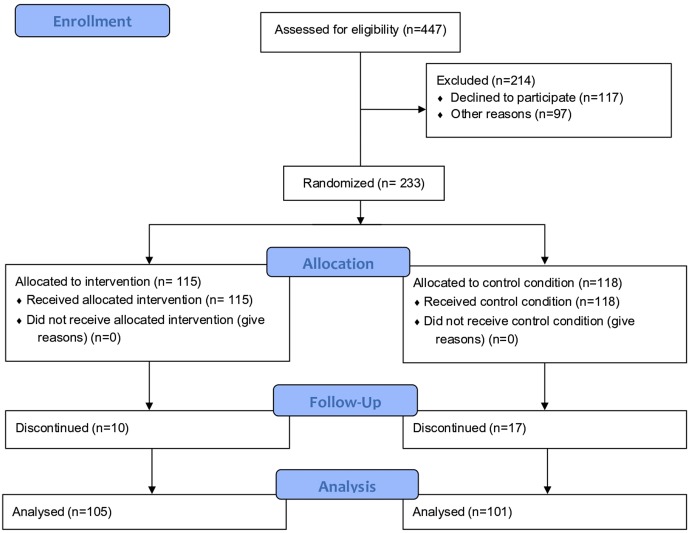
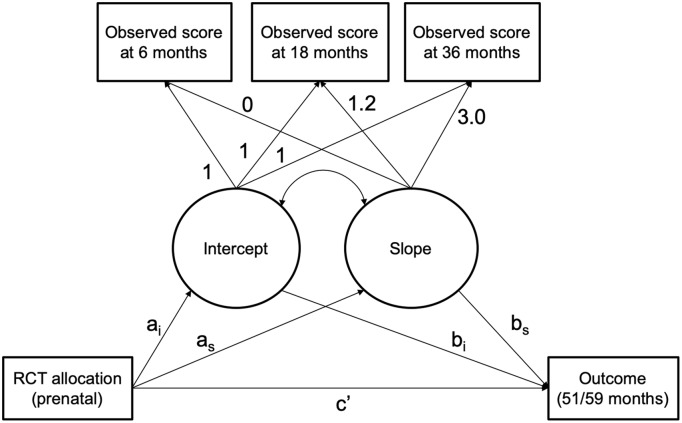
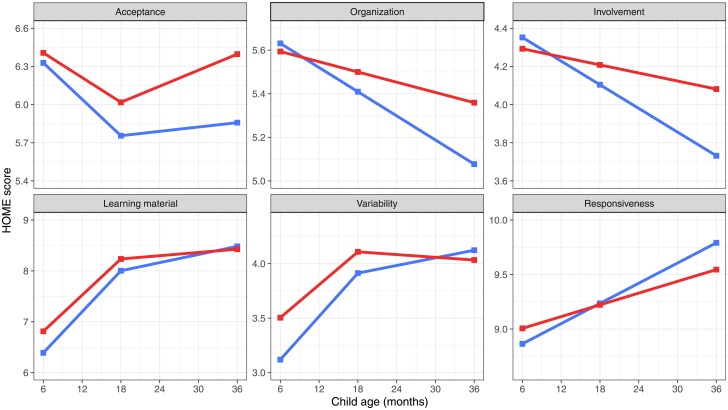
The objective of this study was to use secondary data from the Preparing for Life (PFL) trial to test (1) the impact of a prenatal-to-age-five intervention targeting women from a disadvantaged Irish community on the quality of the home environment; (2) whether any identified changes in the home environment explain the positive effects of the PFL program on children's cognitive and emotional development at school entry which have been identified in previous reports of the PFL trial (ES = .72 and .50, respectively). Pregnant women were randomized into a treatment (home visits, baby massage, and parenting program, n = 115) or control (n = 118) group (trial registration: ISRCTN04631728). The home environment was assessed at 6 months, 1½, and 3 years using the Home Observation for Measurement of the Environment (responsiveness, acceptance, organization, learning material, involvement, variety). Cognitive skills were assessed at 5 years using the British Ability Scales. Emotional problems were teacher-reported at 5 years using the Short Early Development Inventory. Latent growth modeling was used to model changes in the home environment, and mediation analyses to test whether those changes explained children outcomes. Compared to controls, treatment children were exposed to more stimulating environments in terms of learning material (B = -1.62, p = 0.036) and environmental variety (B = -1.58, p = 0.009) at 6 months, but these differences faded at 3 years. Treatment families were also more likely to accept suboptimal child behaviors without using punishment (acceptance score, B = 1.49, p = 0.048) and were more organized at 3 years (B = 1.08, p = 0.033). None of the changes mediated children's outcomes. In conclusion, we found that the program positively impacted different home environment dimensions, but these changes did not account for improvements in children's outcomes. Exploratory analyses suggest that the impact of improvements in the home environment on child outcomes may be limited to specific groups of children. Limitations of the study include the potential lack of generalizability to other populations, the inability to assess the individual treatment components, and sample size restrictions which precluded a moderated mediation analysis.
这项研究的目的是利用 Preparing for Life(PFL)试验的二次数据,检验(1)针对来自爱尔兰弱势社区的女性的产前至五岁干预措施对家庭环境质量的影响;(2)以前报告的 PFL 试验中已经确定的 PFL 计划对儿童入学时认知和情绪发展的积极影响(ES =.72 和.50)是否可以解释家庭环境的任何变化。孕妇被随机分配到治疗组(家访、婴儿按摩和育儿计划,n = 115)或对照组(n = 118)(试验注册:ISRCTN04631728)。家庭环境使用家庭观察测量环境(响应性、接受性、组织性、学习材料、参与度、多样性)在 6 个月、1 岁半和 3 岁时进行评估。认知技能在 5 岁时使用英国能力量表进行评估。情绪问题由教师在 5 岁时使用早期发展简短量表报告。潜在增长模型用于模拟家庭环境的变化,并进行中介分析以检验这些变化是否解释了儿童的结果。与对照组相比,治疗组的儿童在 6 个月时接触到了更具激励性的学习材料(B = -1.62,p = 0.036)和环境多样性(B = -1.58,p = 0.009)方面的环境,但是这些差异在 3 岁时就消失了。治疗家庭也更有可能在不使用惩罚的情况下接受孩子的不良行为(接受度评分,B = 1.49,p = 0.048),并且在 3 岁时组织性更强(B = 1.08,p = 0.033)。这些变化都没有影响孩子的结果。总之,我们发现该计划对家庭环境的不同维度产生了积极影响,但这些变化并不能解释儿童结果的改善。探索性分析表明,家庭环境改善对儿童结果的影响可能仅限于特定的儿童群体。研究的局限性包括缺乏对其他人群的普遍适用性、无法评估个别治疗成分以及样本量限制,这使得调节中介分析无法进行。