
通过低密度脂蛋白受体相关蛋白-1 靶向策略在小鼠模型中成像致痫灶。
Imaging epileptic foci in mouse models via a low-density lipoprotein receptor-related protein-1 targeting strategy.
机构信息
Key Laboratory of Smart Drug Delivery, Ministry of Education, School of Pharmacy, Fudan University, Shanghai, China; National Pharmaceutical Engineering Research Center, China State Institute of Pharmaceutical Industry, Shanghai, China.
Institute of Modern Physics, Fudan University, Shanghai, China; Shanghai Engineering Research Center for Molecular Imaging Probes, Shanghai, China; Department of Nuclear Medicine, Shanghai Cancer Center, Fudan University, Shanghai, China; Key Laboratory of Medical Molecular Virology (MOE/NHC/CAMS), School of Basic Medical Sciences, Fudan University, Shanghai, China.
出版信息
EBioMedicine. 2021 Jan;63:103156. doi: 10.1016/j.ebiom.2020.103156. Epub 2020 Dec 18.
BACKGROUND
In the setting of drug-resistant epilepsy (DRE), the success of surgery depends on the ability to accurately locate the epileptic foci to be resected or disconnected. However, the epileptic foci in a considerable percentage of the DRE patients cannot be adequately localised. This warrants the need for a reliable imaging strategy to identify the "concealed" epileptic regions.
METHODS
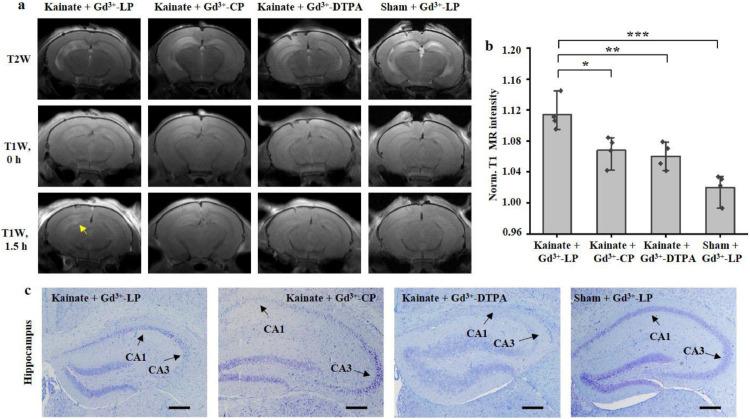
Brain specimens from DRE patients and kainate-induced epileptic mouse models were immuno-stained to evaluate the integrity of the blood-brain barrier (BBB). The expression of low-density lipoprotein receptor-related protein-1 (LRP1) in the epileptic region of DRE patients and kainate models was studied by immunofluorescence. A micellar-based LRP1-targeted paramagnetic probe (Gd-LP) was developed and its ability to define the epileptic foci was investigated by magnetic resonance imaging (MRI).
FINDINGS
The integrity of the BBB in the epileptic region of DRE patients and kainate mouse models were demonstrated. LRP1 expression levels in the epileptic foci of DRE patients and kainate models were 1.70-2.38 and 2.32-3.97 folds higher than in the control brain tissues, respectively. In vivo MRI demonstrated that Gd-LP offered 1.68 times higher (P < 0.05) T1-weighted intensity enhancement in the ipsilateral hippocampus of chronic kainite models than the control probe without LRP1 specificity.
INTERPRETATION
The expression of LRP1 is up-regulated in vascular endothelium, activated glia in both DRE patients and kainate models. LRP1-targeted imaging strategy may provide an alternative strategy to define the "concealed" epileptic foci by overcoming the intact BBB.
FUNDING
This work was supported by the National Natural Science Foundation, Shanghai Science and Technology Committee, Shanghai Municipal Science and Technology, Shanghai Municipal Health and Family Planning Commission and the National Postdoctoral Program for Innovative Talents.
背景
在耐药性癫痫(DRE)的情况下,手术的成功取决于能否准确定位要切除或断开的癫痫灶。然而,相当一部分 DRE 患者的癫痫灶无法充分定位。这就需要一种可靠的成像策略来识别“隐匿”的癫痫区域。
方法
对 DRE 患者和海人酸诱导的癫痫小鼠模型的脑标本进行免疫染色,以评估血脑屏障(BBB)的完整性。通过免疫荧光研究 DRE 患者和海人酸模型癫痫区域中低密度脂蛋白受体相关蛋白 1(LRP1)的表达。开发了一种基于胶束的 LRP1 靶向顺磁探针(Gd-LP),并通过磁共振成像(MRI)研究其定义癫痫灶的能力。
发现
DRE 患者和海人酸小鼠模型癫痫区域的 BBB 完整性得到了证明。DRE 患者和海人酸模型癫痫灶中 LRP1 的表达水平分别比对照脑组织高 1.70-2.38 和 2.32-3.97 倍。体内 MRI 表明,Gd-LP 在慢性海人酸模型的对侧海马中提供了 1.68 倍(P<0.05)的 T1 加权强度增强,而没有 LRP1 特异性的对照探针则没有。
解释
LRP1 在血管内皮细胞和 DRE 患者和海人酸模型中的活化胶质中表达上调。LRP1 靶向成像策略可能通过克服完整的 BBB 提供一种替代方法来定义“隐匿”的癫痫灶。
资金
这项工作得到了国家自然科学基金、上海市科学技术委员会、上海市科学技术、上海市卫生和计划生育委员会以及国家博士后创新人才支持计划的支持。


 Zotero 插件