From the Departments of Medical Physics (R.O.) and Radiology (R.O., H.H.), Memorial Sloan-Kettering Cancer Center, 1275 York Ave, New York, NY 10065; The D-Lab, Department of Precision Medicine, Department of Radiology & Nuclear Medicine, GROW-School for Oncology, Maastricht University Medical Centre, Maastricht, the Netherlands (P.L.); Department of Radiation Oncology, Dalhousie University, Halifax, Canada (J.P.P.); Divisions of Medical Physics in Radiology (M.E.L.), Radiology (H.P.S.), and Radiation Oncology/Radiobiology (M.B.), German Cancer Research Center (DKFZ), Heidelberg, Germany; Faculty of Physics and Astronomy (M.E.L.) and Faculty of Medicine (M.E.L., M.B.), Heidelberg University, Heidelberg, Germany; and OncoRay-National Center for Radiation Research in Oncology, Faculty of Medicine and University Hospital Carl Gustav Carus, Technische Universität Dresden, Helmholtz-Zentrum Dresden-Rossendorf, Dresden, Germany (M.B.).
Radiology. 2021 Feb;298(2):248-260. doi: 10.1148/radiol.2020202747. Epub 2020 Dec 22.
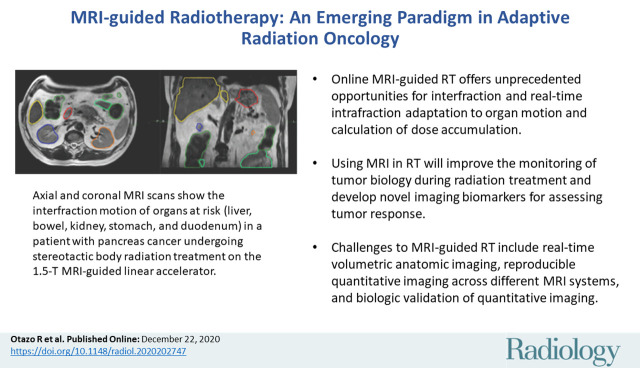
Radiation therapy (RT) continues to be one of the mainstays of cancer treatment. Considerable efforts have been recently devoted to integrating MRI into clinical RT planning and monitoring. This integration, known as MRI-guided RT, has been motivated by the superior soft-tissue contrast, organ motion visualization, and ability to monitor tumor and tissue physiologic changes provided by MRI compared with CT. Offline MRI is already used for treatment planning at many institutions. Furthermore, MRI-guided linear accelerator systems, allowing use of MRI during treatment, enable improved adaptation to anatomic changes between RT fractions compared with CT guidance. Efforts are underway to develop real-time MRI-guided intrafraction adaptive RT of tumors affected by motion and MRI-derived biomarkers to monitor treatment response and potentially adapt treatment to physiologic changes. These developments in MRI guidance provide the basis for a paradigm change in treatment planning, monitoring, and adaptation. Key challenges to advancing MRI-guided RT include real-time volumetric anatomic imaging, addressing image distortion because of magnetic field inhomogeneities, reproducible quantitative imaging across different MRI systems, and biologic validation of quantitative imaging. This review describes emerging innovations in offline and online MRI-guided RT, exciting opportunities they offer for advancing research and clinical care, hurdles to be overcome, and the need for multidisciplinary collaboration.
放射治疗(RT)仍然是癌症治疗的主要方法之一。最近,人们投入了大量精力将 MRI 整合到临床 RT 计划和监测中。这种集成被称为 MRI 引导的 RT,其动机是与 CT 相比,MRI 提供了优越的软组织对比度、器官运动可视化以及监测肿瘤和组织生理变化的能力。许多机构已经在离线使用 MRI 进行治疗计划。此外,允许在治疗过程中使用 MRI 的 MRI 引导线性加速器系统,可以与 CT 引导相比,更好地适应 RT 分次之间的解剖变化。目前正在努力开发受运动和 MRI 衍生生物标志物影响的肿瘤的实时 MRI 引导的分次内自适应 RT,以监测治疗反应并可能根据生理变化调整治疗。这些 MRI 引导方面的发展为治疗计划、监测和适应提供了范式转变的基础。推进 MRI 引导 RT 的关键挑战包括实时容积解剖成像、解决由于磁场不均匀性引起的图像失真、在不同 MRI 系统之间实现可重复的定量成像,以及定量成像的生物学验证。这篇综述描述了离线和在线 MRI 引导 RT 的新兴创新,它们为推进研究和临床护理提供了令人兴奋的机会、需要克服的障碍以及多学科合作的必要性。