Department of General Biochemistry, Faculty of Biology and Environmental Protection, University of Lodz, Lodz, Poland.
Department of Pathology, Microbiology and Immunology, Vanderbilt University Medical Center, Nashville, TN.
Blood Adv. 2020 Dec 22;4(24):6135-6147. doi: 10.1182/bloodadvances.2020002456.
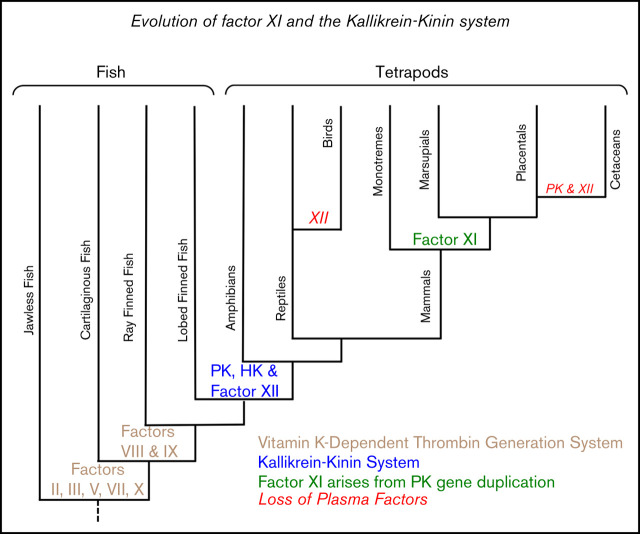
Factor XI (FXI) is the zymogen of a plasma protease (FXIa) that contributes to hemostasis by activating factor IX (FIX). In the original cascade model of coagulation, FXI is converted to FXIa by factor XIIa (FXIIa), a component, along with prekallikrein and high-molecular-weight kininogen (HK), of the plasma kallikrein-kinin system (KKS). More recent coagulation models emphasize thrombin as a FXI activator, bypassing the need for FXIIa and the KKS. We took an evolutionary approach to better understand the relationship of FXI to the KKS and thrombin generation. BLAST searches were conducted for FXI, FXII, prekallikrein, and HK using genomes for multiple vertebrate species. The analysis shows the KKS appeared in lobe-finned fish, the ancestors of all land vertebrates. FXI arose later from a duplication of the prekallikrein gene early in mammalian evolution. Features of FXI that facilitate efficient FIX activation are present in all living mammals, including primitive egg-laying monotremes, and may represent enhancement of FIX-activating activity inherent in prekallikrein. FXI activation by thrombin is a more recent acquisition, appearing in placental mammals. These findings suggest FXI activation by FXIIa may be more important to hemostasis in primitive mammals than in placental mammals. FXI activation by thrombin places FXI partially under control of the vitamin K-dependent coagulation mechanism, reducing the importance of the KKS in blood coagulation. This would explain why humans with FXI deficiency have a bleeding abnormality, whereas those lacking components of the KKS do not.
凝血因子 XI(FXI)是血浆蛋白酶原(FXIa),通过激活凝血因子 IX(FIX)参与止血。在最初的凝血级联模型中,FXI 被凝血因子 XIIa(FXIIa)转化为 FXIa,FXIIa 与前激肽释放酶和高分子量激肽原(HK)一起,是血浆激肽释放酶-激肽系统(KKS)的组成部分。最近的凝血模型强调凝血酶是 FXI 的激活物,绕过了 FXIIa 和 KKS 的需要。我们采用进化方法来更好地理解 FXI 与 KKS 和凝血酶生成的关系。使用多个脊椎动物物种的基因组对 FXI、FXII、前激肽释放酶和 HK 进行了 BLAST 搜索。分析表明,KKS 出现在有颌鱼中,即所有陆地脊椎动物的祖先。FXI 是在哺乳动物进化早期从前激肽释放酶基因的重复中产生的。促进 FIX 有效激活的 FXI 特征存在于所有现存的哺乳动物中,包括原始的产卵单孔目动物,并且可能代表了前激肽释放酶固有 FIX 激活活性的增强。凝血酶激活 FXI 是一个较新的获得物,出现在胎盘哺乳动物中。这些发现表明,FXI 由 FXIIa 激活可能对原始哺乳动物的止血比胎盘哺乳动物更重要。凝血酶对 FXI 的激活使 FXI 部分受到维生素 K 依赖性凝血机制的控制,从而降低了 KKS 在血液凝固中的重要性。这可以解释为什么 FXI 缺乏症患者会出现出血异常,而缺乏 KKS 成分的患者则不会。