Klein Nicola P, Zerbo Ousseny, Goddard Kristin, Wang Weiqi, Fohner Alison E, Wiesner Amy, Shokoohi Vida, Coller John, Bok Karin, Gans Hayley A
Kaiser Permanente Vaccine Study Center, Oakland, CA, USA.
Department of Epidemiology & Institute of Public Health Genetics, University of Washington, Seattle, WA, USA.
Hum Vaccin Immunother. 2021 Jun 3;17(6):1763-1769. doi: 10.1080/21645515.2020.1849520. Epub 2020 Dec 22.
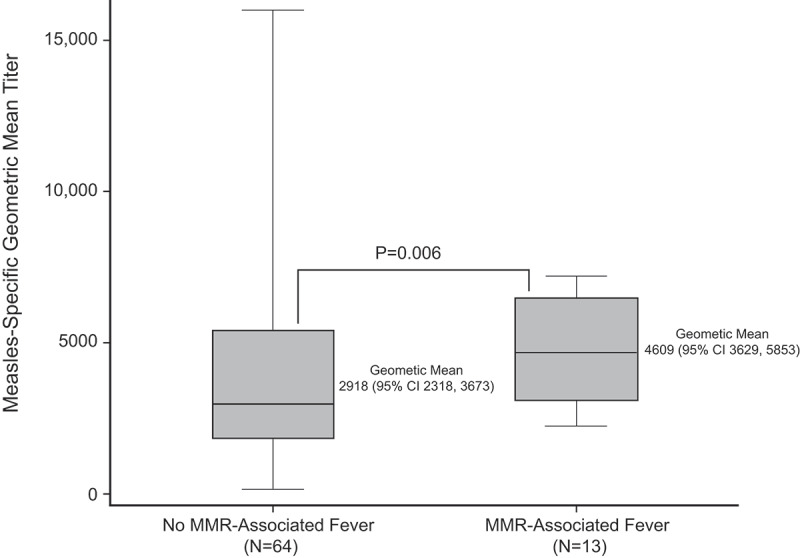
Children have elevated fever risk 1 to 2 weeks after the first dose of a measles-containing vaccine (MCV), which is likely affected by genetic, immunologic, and clinical factors. Fever after MCV is associated with febrile seizures, though may also be associated with higher measles antibody titers. This exploratory study investigated genetic and immunologic associations with a fever after MCV. Concurrent with a randomized Phase 3 clinical trial of 12-15-month-olds who received their first measles-mumps-rubella (MMR) vaccine in which parents recorded post-vaccination temperatures daily, we consented a subset to collect additional blood and performed human leukocyte antigens (HLA) typing. Association between fever 5-12 days after MMR ("MMR-associated") and HLA type was assessed using logistic regression. We compared 42-day post-vaccination geometric mean titers (GMT) to measles between children who did and did not have fever using a t-test. We enrolled 86 children and performed HLA typing on 82; 13 (15.1%) had MMR-associated fever. Logistic regressions identified associations between MMR-associated fever and HLA Class I loci A-29:02 ( = .036), B-57:01 ( = .018), C-06:02 ( = .006), C-14:02 ( = .022), and Class II loci DRB1-15 ( = .045). However, Bonferroni's adjustment for multiple comparisons suggests that these associations could have been due to chance. Ninety-eight percent of children had protective antibody titers to measles; however, GMT was higher among those with fever compared with children without fever ( = .006). Fever after the measles vaccine correlated with genetic factors and higher immune response. This study suggests a possible genetic susceptibility to MMR-associated fever.
在接种第一剂含麻疹疫苗(MCV)后的1至2周内,儿童出现发热的风险升高,这可能受到遗传、免疫和临床因素的影响。MCV接种后的发热与热性惊厥有关,不过也可能与更高的麻疹抗体滴度有关。这项探索性研究调查了与MCV接种后发热相关的遗传和免疫关联。在一项针对12至15个月大儿童接种第一剂麻疹-腮腺炎-风疹(MMR)疫苗的随机3期临床试验中,父母每天记录接种疫苗后的体温,与此同时,我们同意对一部分儿童采集额外的血液并进行人类白细胞抗原(HLA)分型。使用逻辑回归评估MMR接种后5至12天发热(“MMR相关发热”)与HLA类型之间的关联。我们使用t检验比较了有发热和无发热儿童接种疫苗后42天的麻疹几何平均滴度(GMT)。我们招募了86名儿童,对其中82名进行了HLA分型;13名(15.1%)出现了MMR相关发热。逻辑回归确定了MMR相关发热与HLA I类基因座A-29:02(P = 0.036)、B-57:01(P = 0.018)、C-06:02(P = 0.006)、C-14:02(P = 0.022)以及II类基因座DRB1-15(P = 0.045)之间的关联。然而,经Bonferroni多重比较校正后表明,这些关联可能是偶然的。98%的儿童对麻疹具有保护性抗体滴度;然而,发热儿童的GMT高于无发热儿童(P = 0.006)。麻疹疫苗接种后的发热与遗传因素和更高的免疫反应相关。这项研究表明可能存在对MMR相关发热的遗传易感性。