Institute for Medical Virology, University Hospital Frankfurt, Goethe University Frankfurt am Main, Germany.
Institute for Medical Virology, University Hospital Frankfurt, Goethe University Frankfurt am Main, Germany.
J Clin Virol. 2021 Feb;135:104713. doi: 10.1016/j.jcv.2020.104713. Epub 2020 Dec 5.
Severe acute respiratory syndrome coronavirus 2 (SARS-CoV-2) can spread from symptomatic patients with COVID-19, but also from asymptomatic individuals. Therefore, robust surveillance and timely interventions are essential for the control of virus spread within the community. In this regard the frequency of testing and speed of reporting, but not the test sensitivity alone, play a crucial role.
In order to reduce the costs and meet the expanding demands in real-time RT-PCR (rRT-PCR) testing for SARS-CoV-2, complementary assays, such as rapid antigen tests, have been developed. Rigorous analysis under varying conditions is required to assess the clinical performance of these tests and to ensure reproducible results.
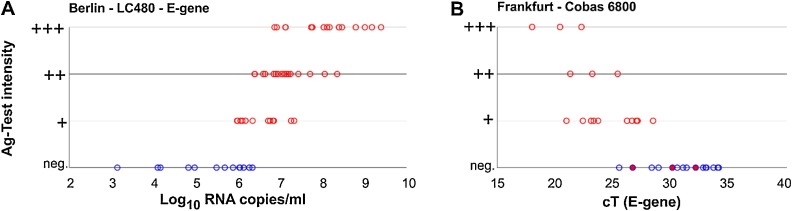
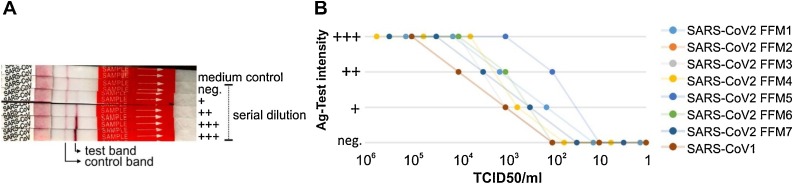
We evaluated the sensitivity and specificity of a recently licensed rapid antigen test using 137 clinical samples in two institutions. Test sensitivity was between 88.2-89.6 % when applied to samples with viral loads typically seen in infectious patients. Of 32 rRT-PCR positive samples, 19 demonstrated infectivity in cell culture, and 84 % of these samples were reactive with the antigen test. Seven full-genome sequenced SARS-CoV-2 isolates and SARS-CoV-1 were detected with this antigen test, with no cross-reactivity against other common respiratory viruses.
Numerous antigen tests are available for SARS-CoV-2 testing and their performance to detect infectious individuals may vary. Head-to-head comparison along with cell culture testing for infectivity may prove useful to identify better performing antigen tests. The antigen test analyzed in this study is easy-to-use, inexpensive, and scalable. It can be helpful in monitoring infection trends and thus has potential to reduce transmission.
严重急性呼吸综合征冠状病毒 2(SARS-CoV-2)可由 COVID-19 有症状患者传播,但也可由无症状个体传播。因此,强大的监测和及时的干预对于控制社区内病毒传播至关重要。在这方面,检测的频率和报告的速度,而不仅仅是测试的敏感性,起着至关重要的作用。
为了降低成本并满足实时 RT-PCR(rRT-PCR)检测 SARS-CoV-2 的需求不断扩大,已经开发了补充检测方法,例如快速抗原检测。需要进行严格的分析,以评估这些测试的临床性能并确保可重复的结果。
我们使用两个机构的 137 个临床样本评估了最近获得许可的快速抗原检测的敏感性和特异性。当应用于具有传染性患者中通常看到的病毒载量的样本时,测试的敏感性在 88.2-89.6%之间。在 32 个 rRT-PCR 阳性样本中,有 19 个在细胞培养中显示出感染性,其中 84%的样本对抗原检测呈反应。该抗原检测可检测到七种全基因组测序的 SARS-CoV-2 分离株和 SARS-CoV-1,与其他常见呼吸道病毒无交叉反应。
有许多抗原检测可用于 SARS-CoV-2 检测,其检测传染性个体的性能可能会有所不同。对头对头比较以及感染性细胞培养测试可能有助于识别性能更好的抗原检测。在这项研究中分析的抗原检测易于使用、价格低廉且可扩展。它有助于监测感染趋势,从而具有降低传播的潜力。