Department of Epidemiology, University Medical Center Groningen, University of Groningen, P.O. Box 30.001, 9700 RB Groningen, The Netherlands.
Center for Human Movement Sciences, Section F, University Medical Center Groningen, University of Groningen, P.O. Box 196, 9700 AD Groningen, The Netherlands.
Int J Environ Res Public Health. 2020 Dec 19;17(24):9526. doi: 10.3390/ijerph17249526.
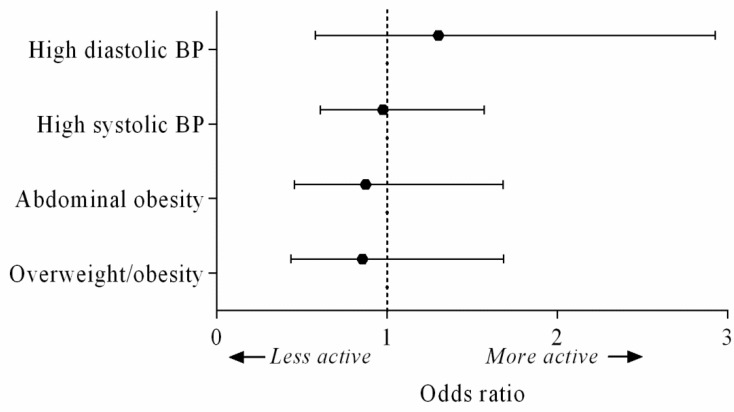
Whereas in adults, physical inactivity is strongly related to obesity and hypertension, in young children the evidence is inconsistent and scarce. We examined the association between physical activity (PA) behaviours at 5-6 years of age and adiposity and blood pressure (BP) at 10-11 years in 947 children (51% boys) from the Groningen Expert Center for Kids with Obesity (GECKO) Drenthe cohort. Sedentary time (ST) and light, moderate, and vigorous PA were assessed using accelerometry (ActiGraph GT3X, wear time > 600 min/day, ≥3 days). Body mass index (BMI), waist circumference (WC), and systolic and diastolic BP were measured at 5-6 and 10-11 years of age and standardized as age- and sex-adjusted (and height-adjusted, for BP) -scores. Adjusted linear and logistic regression models showed that most PA behaviours were not related to standardized BMI or WC, overweightness/obesity, abdominal overweightness/obesity, standardized systolic or diastolic BP, pulse pressure, or prehypertension at 10-11 years of age. Only if children spent more time in vigorous PA was WC slightly lower ( (95% CI) = -0.08 (-0.16, -0.01) SD, stdβ = -0.068) and the increase in WC over the years was less ( (95% CI) = -0.10 (-0.18, -0.01) SD; stdβ = -0.083). To conclude, at this very young age, PA behaviours are not a strong predictor for overweightness/obesity or hypertension later in childhood.
与成年人不同,身体活动与肥胖和高血压密切相关,但在幼儿中,相关证据并不一致且缺乏。我们研究了 947 名儿童(51%为男孩)在 5-6 岁时的身体活动(PA)行为与 10-11 岁时肥胖和血压(BP)之间的关系,这些儿童来自格罗宁根儿童肥胖专家中心(GECKO)德伦特队列。使用加速度计(ActiGraph GT3X,佩戴时间>600 分钟/天,>3 天)评估久坐时间(ST)和轻、中、高强度 PA。在 5-6 岁和 10-11 岁时测量体重指数(BMI)、腰围(WC)、收缩压和舒张压,并标准化为年龄和性别调整(BP 为身高调整)-分数。调整后的线性和逻辑回归模型表明,大多数 PA 行为与标准化 BMI 或 WC、超重/肥胖、腹部超重/肥胖、标准化收缩压或舒张压、脉压或 10-11 岁时的高血压前期无关。只有当儿童进行更多的剧烈 PA 时,WC 才会略有降低((95%置信区间)=-0.08(-0.16,-0.01)SD,标准β=-0.068),且 WC 随时间的增长幅度较小((95%置信区间)=-0.10(-0.18,-0.01)SD;标准β=-0.083)。总之,在这个非常年幼的年龄,PA 行为并不是预测儿童后期超重/肥胖或高血压的有力指标。