Guth Amanda, Monk Emily, Agarwal Rajesh, Bergman Bryan C, Zemski-Berry Karin A, Minic Angela, Jordan Kimberly, Schlaepfer Isabel R
Department of Clinical Sciences, Flint Animal Cancer Center, Colorado State University, Fort Collins, CO 80523, USA.
Division of Medical Oncology, University of Colorado Anschutz Medical Campus, Aurora, CO 80045, USA.
Int J Mol Sci. 2020 Dec 18;21(24):9660. doi: 10.3390/ijms21249660.
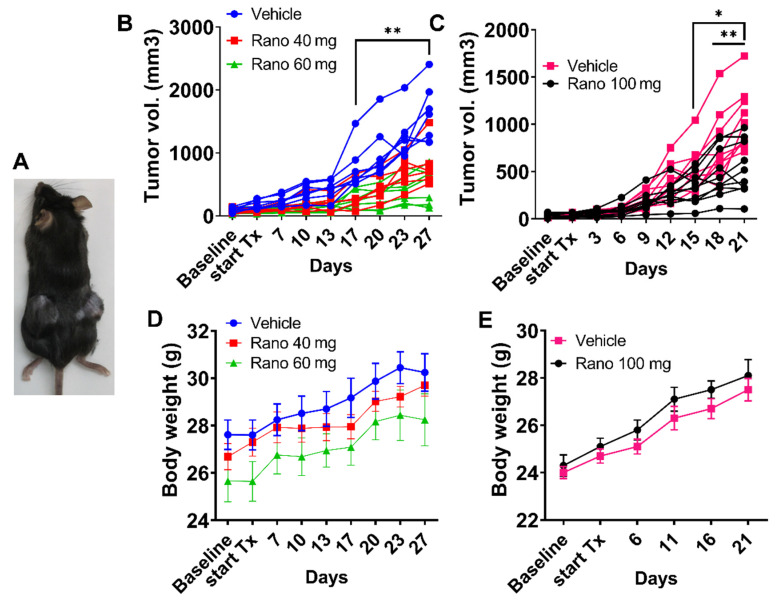
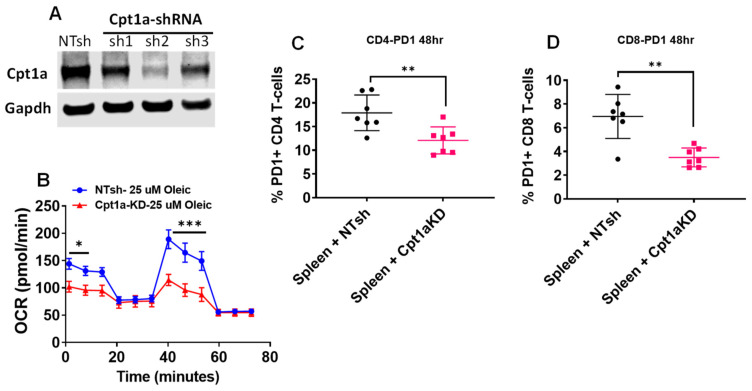
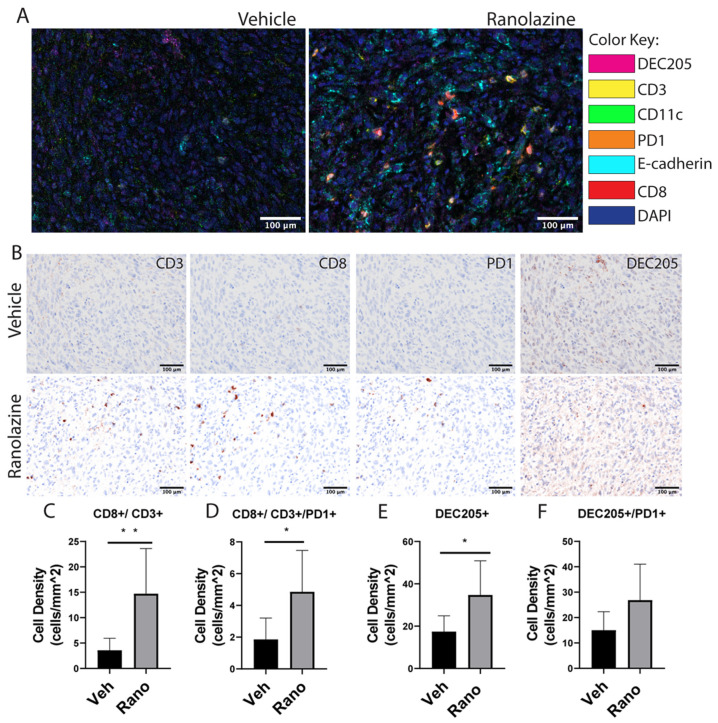
Lipid catabolism represents an Achilles heel in prostate cancer (PCa) that can be exploited for therapy. CPT1A regulates the entry of fatty acids into the mitochondria for beta-oxidation and its inhibition has been shown to decrease PCa growth. In this study, we examined the pharmacological blockade of lipid oxidation with ranolazine in TRAMPC1 PCa models. Oral administration of ranolazine (100 mg/Kg for 21 days) resulted in decreased tumor CD8 T-cells Tim3 content, increased macrophages, and decreased blood myeloid immunosuppressive monocytes. Using multispectral staining, drug treatments increased infiltration of CD8 T-cells and dendritic cells compared to vehicle. Functional studies with spleen cells of drug-treated tumors co-cultured with TRAMPC1 cells showed increased ex vivo T-cell cytotoxic activity, suggesting an anti-tumoral response. Lastly, a decrease in CD4 and CD8 T-cells expressing PD1 was observed when exhausted spleen cells were incubated with TRAMPC1 Cpt1a-KD compared to the control cells. These data indicated that genetically blocking the ability of the tumor cells to oxidize lipid can change the activation status of the neighboring T-cells. This study provides new knowledge of the role of lipid catabolism in the intercommunication of tumor and immune cells, which can be extrapolated to other cancers with high CPT1A expression.
脂质分解代谢是前列腺癌(PCa)的一个致命弱点,可被用于治疗。CPT1A调节脂肪酸进入线粒体进行β-氧化,其抑制作用已被证明可降低PCa的生长。在本研究中,我们在TRAMPC1 PCa模型中研究了雷诺嗪对脂质氧化的药理学阻断作用。口服雷诺嗪(100 mg/Kg,持续21天)导致肿瘤CD8 T细胞Tim3含量降低、巨噬细胞增加以及血液中髓样免疫抑制单核细胞减少。与载体相比,使用多光谱染色法发现药物治疗可增加CD8 T细胞和树突状细胞的浸润。对用药物处理过的肿瘤的脾细胞与TRAMPC1细胞共培养进行功能研究,结果显示体外T细胞细胞毒性活性增加,表明存在抗肿瘤反应。最后,与对照细胞相比,当耗尽的脾细胞与TRAMPC1 Cpt1a-KD共同孵育时,观察到表达PD1的CD4和CD8 T细胞减少。这些数据表明,从基因上阻断肿瘤细胞氧化脂质的能力可以改变邻近T细胞的激活状态。本研究提供了关于脂质分解代谢在肿瘤细胞与免疫细胞相互交流中作用的新知识,这可以推广到CPT1A高表达的其他癌症。