Department of Urology, Research Institute Hospital 12 de Octubre (Imas12), Madrid 29041, Spain.
Department of Urology, University Hospital HM Montepríncipe, Madrid 28668, Spain.
Asian J Androl. 2021 May-Jun;23(3):325-329. doi: 10.4103/aja.aja_74_20.
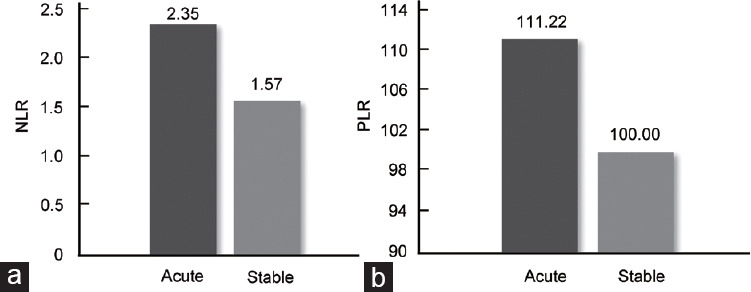
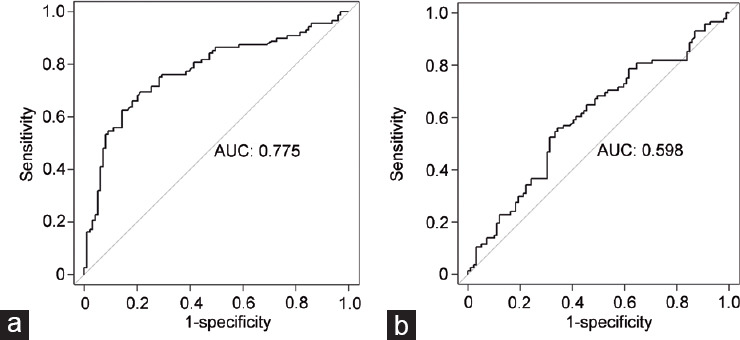
Neutrophil-to-lymphocyte ratio (NLR) and platelet-to-lymphocyte ratio (PLR) have been associated with multiple entities and several types of cancers. They can be assumed as markers of inflammatory imbalance. The objective of this study is to evaluate the NLR and PLR in Peyronie's disease (PD) and to establish a comparison of its values in the acute and chronic stages. We recruited patients with PD from March 2018 to March 2019. The patients enrolled underwent medical and sexual history as well as a physical examination. The values of blood count of each patient were collected both in the acute and chronic stages. Wilcoxon test was used to compare the acute and chronic stage ratios. Kruskal-Wallis test was carried out to evaluate the impact of treatments on the ratios. To identify cutoff values, we used sensibility and specificity tables and receiver operating characteristic (ROC) curves. A total of 120 patients were enrolled. Their mean age was 55.85 (range: 18-77) years and the mean penile curvature was 48.43° (range: 10°-100°). In the acute stage, the mean NLR was 2.35 and the mean PLR was 111.22. These ratios, in the chronic stage, were 1.57 and 100.00, respectively. Statistically significant differences between acute and stable stages for both indices were found (NLR: P< 0.0001; PLR: P= 0.0202). The optimal cutoff for classification in acute or stable stage was 2 for NLR and 102 for PLR. According to our results, with an ordinary blood count, we could have important indications regarding the disease stage of the patient, and consequently on the most appropriate type of therapy to choose.
中性粒细胞与淋巴细胞比值(NLR)和血小板与淋巴细胞比值(PLR)与多种实体瘤和多种类型的癌症有关。它们可以被认为是炎症失衡的标志物。本研究的目的是评估 Peyronie 病(PD)中的 NLR 和 PLR,并建立其在急性和慢性阶段的比较。我们招募了 2018 年 3 月至 2019 年 3 月期间患有 PD 的患者。入组患者接受了病史和体格检查。收集每位患者的血常规值,包括在急性和慢性阶段。Wilcoxon 检验用于比较急性和慢性阶段的比值。Kruskal-Wallis 检验用于评估治疗对比值的影响。为了确定截断值,我们使用了敏感性和特异性表和接收器操作特征(ROC)曲线。共纳入 120 例患者,平均年龄 55.85 岁(范围:18-77 岁),平均阴茎弯曲度为 48.43°(范围:10°-100°)。在急性阶段,NLR 平均为 2.35,PLR 平均为 111.22。在慢性阶段,这两个比值分别为 1.57 和 100.00。两个指标的急性和稳定阶段之间均存在统计学差异(NLR:P<0.0001;PLR:P=0.0202)。用于分类急性或稳定阶段的最佳截断值为 NLR 的 2 和 PLR 的 102。根据我们的结果,通过普通血常规,我们可以获得有关患者疾病阶段的重要指示,进而可以选择最合适的治疗类型。