Harvey Raymond A, Rassen Jeremy A, Kabelac Carly A, Turenne Wendy, Leonard Sandy, Klesh Reyna, Meyer William A, Kaufman Harvey W, Anderson Steve, Cohen Oren, Petkov Valentina I, Cronin Kathy A, Van Dyke Alison L, Lowy Douglas R, Sharpless Norman E, Penberthy Lynne T
Aetion, Inc., New York, NY.
HealthVerity, Philadelphia, PA.
medRxiv. 2020 Dec 20:2020.12.18.20248336. doi: 10.1101/2020.12.18.20248336.
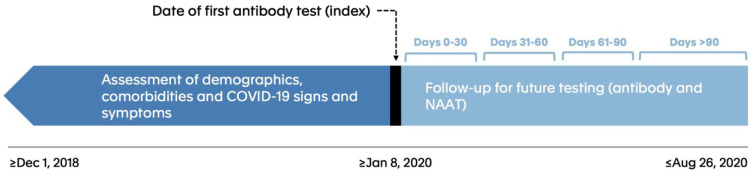
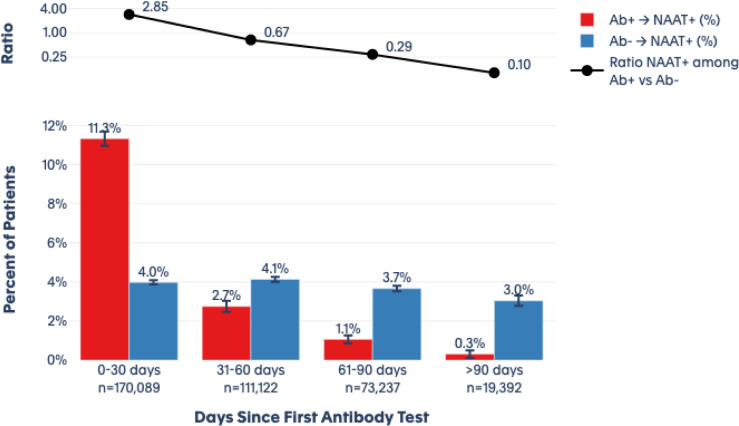
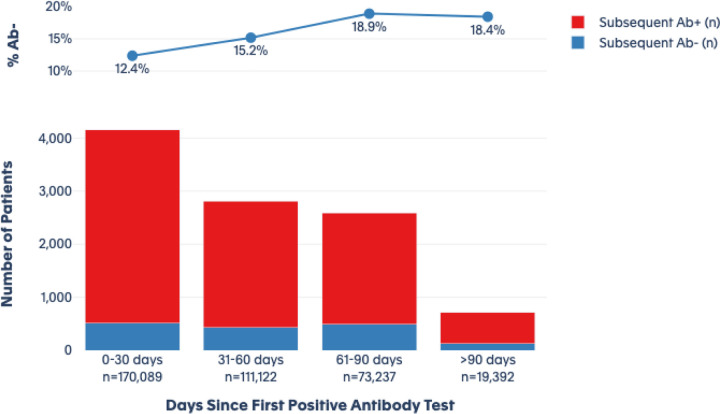
Importance There is limited evidence regarding whether the presence of serum antibodies to SARS-CoV-2 is associated with a decreased risk of future infection. Understanding susceptibility to infection and the role of immune memory is important for identifying at-risk populations and could have implications for vaccine deployment. Objective The purpose of this study was to evaluate subsequent evidence of SARS-CoV-2 infection based on diagnostic nucleic acid amplification test (NAAT) among individuals who are antibody-positive compared with those who are antibody-negative, using real-world data. Design This was an observational descriptive cohort study. Participants The study utilized a national sample to create cohorts from a de-identified dataset composed of commercial laboratory test results, open and closed medical and pharmacy claims, electronic health records, hospital billing (chargemaster) data, and payer enrollment files from the United States. Patients were indexed as antibody-positive or antibody-negative according to their first SARS-CoV-2 antibody test recorded in the database. Patients with more than 1 antibody test on the index date where results were discordant were excluded. Main Outcomes/Measures Primary endpoints were index antibody test results and post-index diagnostic NAAT results, with infection defined as a positive diagnostic test post-index, as measured in 30-day intervals (0-30, 31-60, 61-90, >90 days). Additional measures included demographic, geographic, and clinical characteristics at the time of the index antibody test, such as recorded signs and symptoms or prior evidence of COVID-19 (diagnoses or NAAT+) and recorded comorbidities. Results We included 3,257,478 unique patients with an index antibody test. Of these, 2,876,773 (88.3%) had a negative index antibody result, 378,606 (11.6%) had a positive index antibody result, and 2,099 (0.1%) had an inconclusive index antibody result. Patients with a negative antibody test were somewhat older at index than those with a positive result (mean of 48 versus 44 years). A fraction (18.4%) of individuals who were initially seropositive converted to seronegative over the follow up period. During the follow-up periods, the ratio (CI) of positive NAAT results among individuals who had a positive antibody test at index versus those with a negative antibody test at index was 2.85 (2.73 - 2.97) at 0-30 days, 0.67 (0.6 - 0.74) at 31-60 days, 0.29 (0.24 - 0.35) at 61-90 days), and 0.10 (0.05 - 0.19) at >90 days. Conclusions Patients who display positive antibody tests are initially more likely to have a positive NAAT, consistent with prolonged RNA shedding, but over time become markedly less likely to have a positive NAAT. This result suggests seropositivity using commercially available assays is associated with protection from infection. The duration of protection is unknown and may wane over time; this parameter will need to be addressed in a study with extended duration of follow up.
重要性 关于严重急性呼吸综合征冠状病毒2(SARS-CoV-2)血清抗体的存在是否与未来感染风险降低相关的证据有限。了解感染易感性和免疫记忆的作用对于识别高危人群很重要,并且可能对疫苗部署产生影响。目的 本研究的目的是利用真实世界数据,评估与抗体阴性个体相比,抗体阳性个体中基于诊断性核酸扩增试验(NAAT)的SARS-CoV-2感染的后续证据。设计 这是一项观察性描述性队列研究。参与者 该研究利用全国样本,从一个去识别化的数据集中创建队列,该数据集由商业实验室检测结果、开放和封闭的医疗及药房理赔、电子健康记录、医院计费(收费主档)数据以及来自美国的付款人登记文件组成。根据数据库中记录的首次SARS-CoV-2抗体检测结果,将患者分类为抗体阳性或抗体阴性。在索引日期有多次抗体检测且结果不一致的患者被排除。主要结局/指标 主要终点是索引抗体检测结果和索引后诊断性NAAT结果,感染定义为索引后诊断检测呈阳性,以30天为间隔(0 - 30天、31 - 60天、61 - 90天、>90天)进行测量。其他指标包括索引抗体检测时的人口统计学、地理和临床特征,如记录的体征和症状或既往2019冠状病毒病(COVID-19)证据(诊断或NAAT阳性)以及记录的合并症。结果 我们纳入了3257478名进行索引抗体检测的独特患者。其中,2876773名(88.3%)索引抗体结果为阴性,378606名(11.6%)索引抗体结果为阳性,2099名(0.1%)索引抗体结果不确定。抗体检测阴性的患者在索引时比阳性患者年龄稍大(平均年龄分别为48岁和44岁)。在随访期间,一部分(18.4%)最初血清学阳性的个体转为血清学阴性。在随访期间,索引时抗体检测呈阳性的个体与索引时抗体检测呈阴性的个体相比,NAAT阳性结果的比例(置信区间)在0 - 30天为2.85(2.73 - 2.97),在31 - 60天为0.67(0.6 - 0.74),在61 - 90天为0.29(0.24 - 0.35),在>90天为0.10(0.05 - 0.19)。结论 抗体检测呈阳性的患者最初更有可能NAAT呈阳性,这与RNA长时间脱落一致,但随着时间推移,NAAT呈阳性的可能性显著降低。这一结果表明,使用商业可用检测方法检测出的血清学阳性与预防感染相关。保护持续时间未知,可能会随时间减弱;这一参数需要在一项随访时间更长的研究中加以解决。