Nevada Institute of Personalized Medicine, University of Nevada, Las Vegas, NV, USA; University of Nevada, Reno Center for Bioinformatics, Reno, NV, USA.
Theiagen Consulting LLC, Highlands Ranch, CO, USA.
Lancet Infect Dis. 2021 Jan;21(1):52-58. doi: 10.1016/S1473-3099(20)30764-7. Epub 2020 Oct 12.
The degree of protective immunity conferred by infection with severe acute respiratory syndrome coronavirus 2 (SARS-CoV-2) is currently unknown. As such, the possibility of reinfection with SARS-CoV-2 is not well understood. We describe an investigation of two instances of SARS-CoV-2 infection in the same individual.
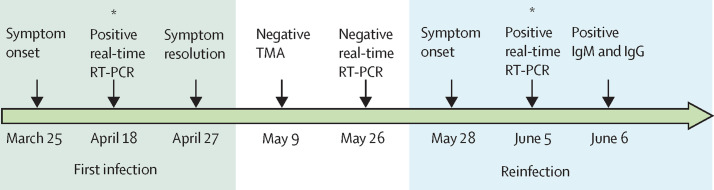
A 25-year-old man who was a resident of Washoe County in the US state of Nevada presented to health authorities on two occasions with symptoms of viral infection, once at a community testing event in April, 2020, and a second time to primary care then hospital at the end of May and beginning of June, 2020. Nasopharyngeal swabs were obtained from the patient at each presentation and twice during follow-up. Nucleic acid amplification testing was done to confirm SARS-CoV-2 infection. We did next-generation sequencing of SARS-CoV-2 extracted from nasopharyngeal swabs. Sequence data were assessed by two different bioinformatic methodologies. A short tandem repeat marker was used for fragment analysis to confirm that samples from both infections came from the same individual.
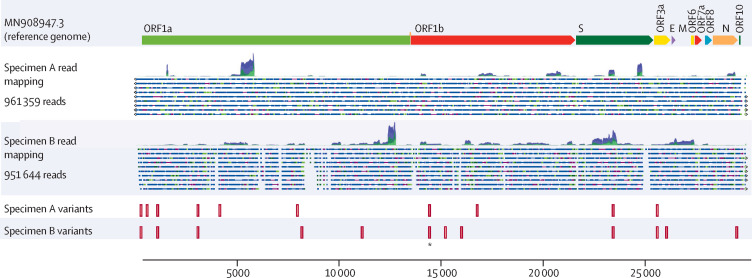
The patient had two positive tests for SARS-CoV-2, the first on April 18, 2020, and the second on June 5, 2020, separated by two negative tests done during follow-up in May, 2020. Genomic analysis of SARS-CoV-2 showed genetically significant differences between each variant associated with each instance of infection. The second infection was symptomatically more severe than the first.
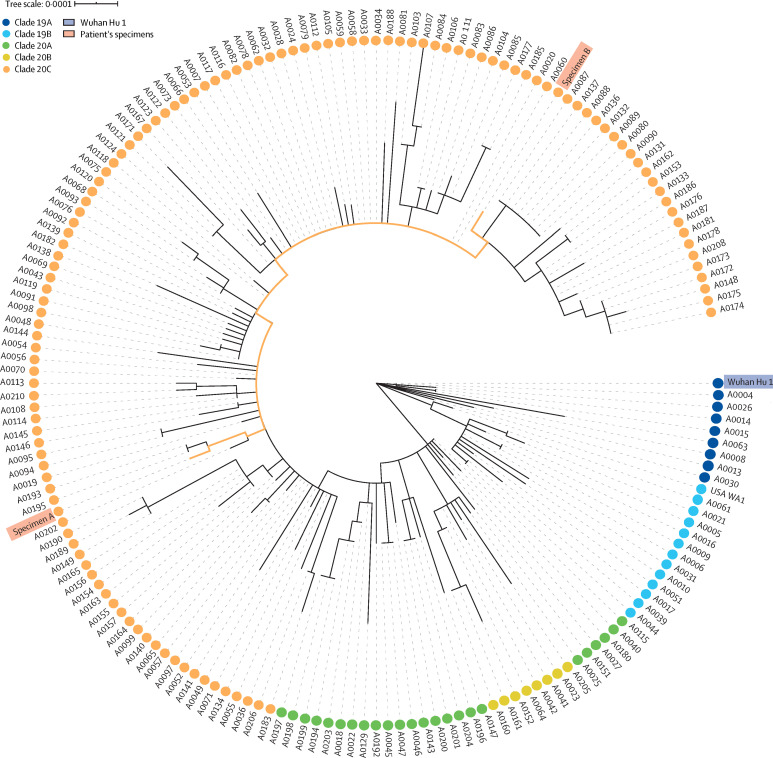
Genetic discordance of the two SARS-CoV-2 specimens was greater than could be accounted for by short-term in vivo evolution. These findings suggest that the patient was infected by SARS-CoV-2 on two separate occasions by a genetically distinct virus. Thus, previous exposure to SARS-CoV-2 might not guarantee total immunity in all cases. All individuals, whether previously diagnosed with COVID-19 or not, should take identical precautions to avoid infection with SARS-CoV-2. The implications of reinfections could be relevant for vaccine development and application.
Nevada IDEA Network of Biomedical Research, and the National Institute of General Medical Sciences (National Institutes of Health).
目前尚不清楚感染严重急性呼吸综合征冠状病毒 2(SARS-CoV-2)所产生的保护免疫程度。因此,人们对 SARS-CoV-2 再次感染的可能性了解甚少。我们描述了一例个体中发生的 2 次 SARS-CoV-2 感染。
一位 25 岁的男性,居住在美国内华达州瓦肖县,于 2020 年 4 月在社区检测活动中首次出现病毒感染症状,并于 2020 年 5 月底和 6 月初再次出现症状至初级保健和住院治疗。每次就诊时均从患者鼻拭子中提取样本,在随访期间提取了两次。进行核酸扩增检测以确认 SARS-CoV-2 感染。我们对从鼻拭子中提取的 SARS-CoV-2 进行了下一代测序。通过两种不同的生物信息学方法评估序列数据。使用短串联重复标记进行片段分析,以确认两次感染的样本均来自同一患者。
该患者有两次 SARS-CoV-2 阳性检测结果,第一次是在 2020 年 4 月 18 日,第二次是在 2020 年 6 月 5 日,两次检测之间在 2020 年 5 月进行了两次阴性随访。SARS-CoV-2 的基因组分析显示,每次感染的变异株之间存在遗传上显著差异。第二次感染的症状比第一次更为严重。
两次 SARS-CoV-2 标本的遗传差异大于体内短期进化所能解释的范围。这些发现表明,该患者两次分别感染了遗传上不同的 SARS-CoV-2 病毒。因此,以前感染过 SARS-CoV-2 并不能保证在所有情况下都能获得完全免疫力。所有个体,无论以前是否诊断为 COVID-19,都应采取相同的预防措施来避免 SARS-CoV-2 感染。再次感染的意义可能与疫苗的开发和应用有关。
内华达州 IDEA 网络生物医学研究和美国国立卫生研究院国家普通医学科学研究所(美国国立卫生研究院)。