Health Sciences, University of York, York, UK.
Health Sciences, University of York, York, UK
Arch Dis Child. 2021 Jul 19;106(8):780-785. doi: 10.1136/archdischild-2020-319700.
To assess trends in place of death for children with a life-limiting condition and the factors associated with death at home or hospice rather than hospital.
Observational cohort study using linked routinely collected data.
England.
Children aged 0-25 years who died between 2003 and 2017.
Place of death: hospital, hospice, home. Multivariable multinomial logistic regression models.
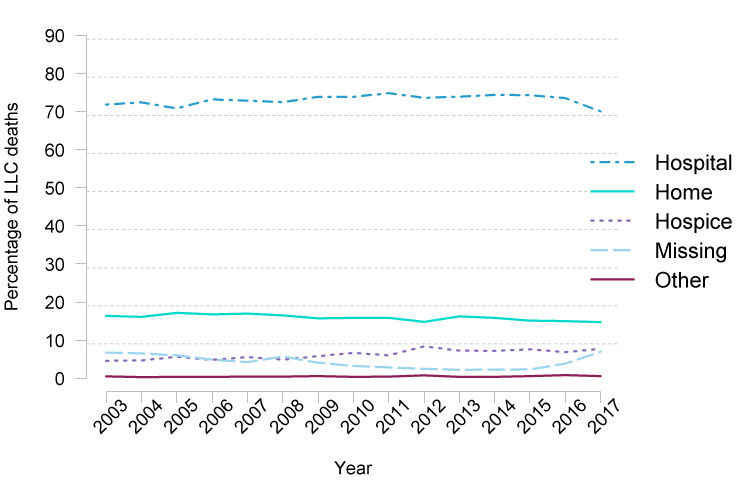
39 349 children died: 73% occurred in hospital, 6% in hospice and 16% at home. In the multivariable models compared with dying in a hospital: neonates were less likely, and those aged 1-10 years more likely, than those aged 28 days to <1 year to die in hospice. Children from all ethnic minority groups were significantly less likely to die in hospice, as were those in the most deprived group (RR 0.8, 95% CI 0.7 to 0.9). Those who died from 2008 were more likely than those who died earlier to die in a hospice.Children with cancer (RR 4.4, 95% CI 3.8 to 5.1), neurological (RR 2.0, 95% CI 1.7 to 2.3) or metabolic (RR 3.7, 95% CI 3.0 to 4.6) diagnoses were more likely than those with a congenital diagnosis to die in a hospice.Similar patterns were seen for clinical/demographic factors associated with home versus hospital deaths.
Most children with a life-limiting condition continue to die in the hospital setting. Further research on preferences for place of death is needed especially in children with conditions other than cancer. Paediatric palliative care services should be funded adequately to enable equal access across all settings, diagnostic groups and geographical regions.
评估患有生命末期疾病的儿童的死亡地点的趋势,以及与在家或临终关怀而非医院死亡相关的因素。
使用链接的常规收集数据进行观察性队列研究。
英格兰。
2003 年至 2017 年间死亡的 0-25 岁儿童。
死亡地点:医院、临终关怀、家中。多变量多项逻辑回归模型。
39349 名儿童死亡:73%发生在医院,6%发生在临终关怀,16%在家中。在多变量模型中,与在医院死亡相比:新生儿死亡的可能性较小,年龄为 1-10 岁的儿童死亡的可能性较大,而年龄为 28 天至<1 岁的儿童死亡的可能性较大在临终关怀中。所有少数族裔群体的儿童在临终关怀中死亡的可能性明显较小,而最贫困群体的儿童(RR0.8,95%CI0.7-0.9)也是如此。2008 年死亡的儿童比早期死亡的儿童更有可能在临终关怀中死亡。患有癌症(RR4.4,95%CI3.8-5.1)、神经(RR2.0,95%CI1.7-2.3)或代谢(RR3.7,95%CI3.0-4.6)诊断的儿童比患有先天性疾病的儿童更有可能在临终关怀中死亡。在家中与医院死亡相关的临床/人口统计学因素也存在类似的模式。
大多数患有生命末期疾病的儿童仍在医院环境中死亡。需要进一步研究死亡地点的偏好,特别是在患有癌症以外疾病的儿童中。应充分为儿科姑息治疗服务提供资金,以便在所有环境、诊断组和地理区域实现平等获得服务。