
自噬有助于叶片线粒体的质量控制。
Autophagy Contributes to the Quality Control of Leaf Mitochondria.
机构信息
Center for Sustainable Resource Science (CSRS), RIKEN, Wako, 351-0198 Japan.
Exploratory Research Center on Life and Living Systems (ExCELLs), National Institute of Natural Sciences, Okazaki, 444-8787 Japan.
出版信息
Plant Cell Physiol. 2021 May 11;62(2):229-247. doi: 10.1093/pcp/pcaa162.
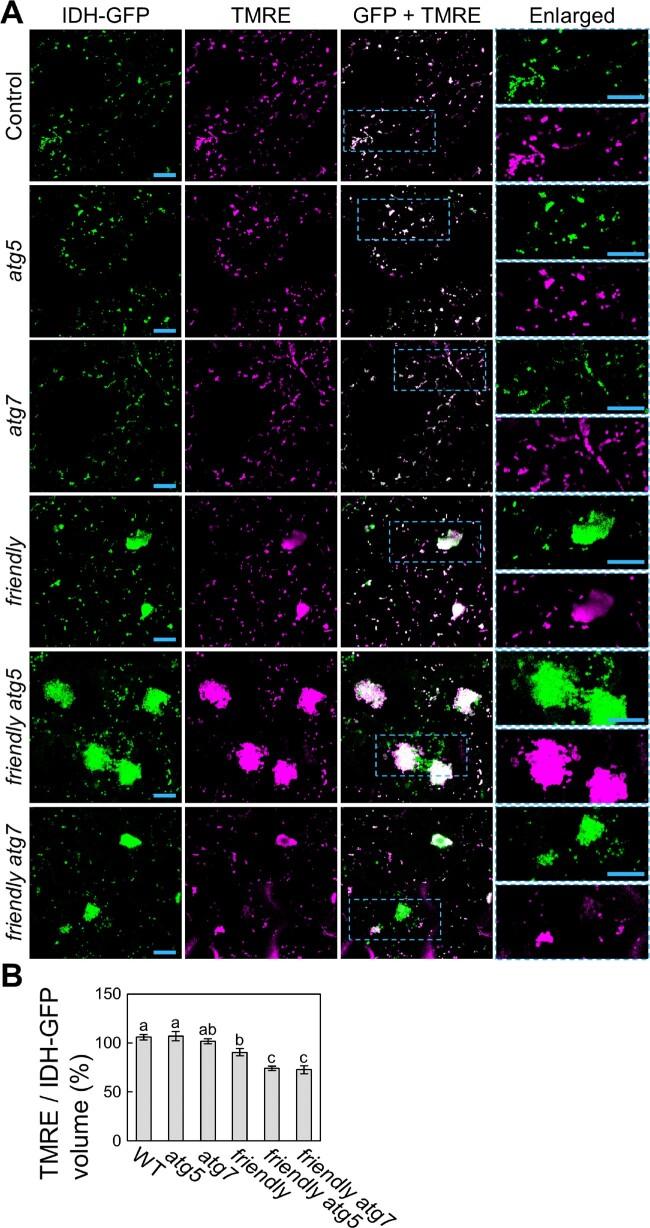
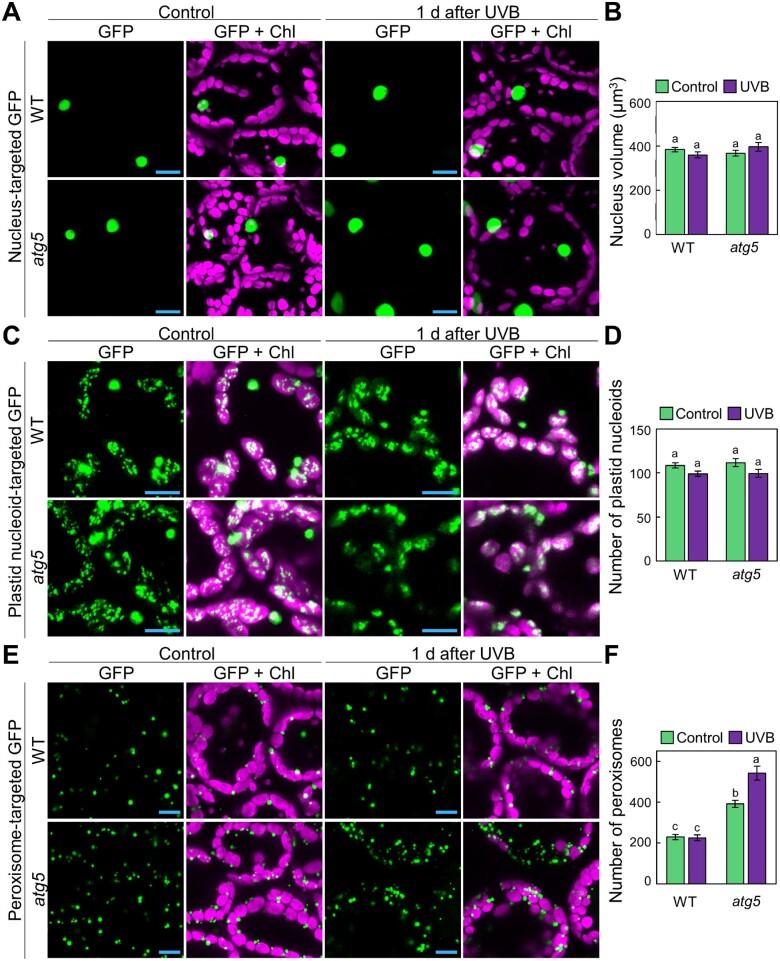
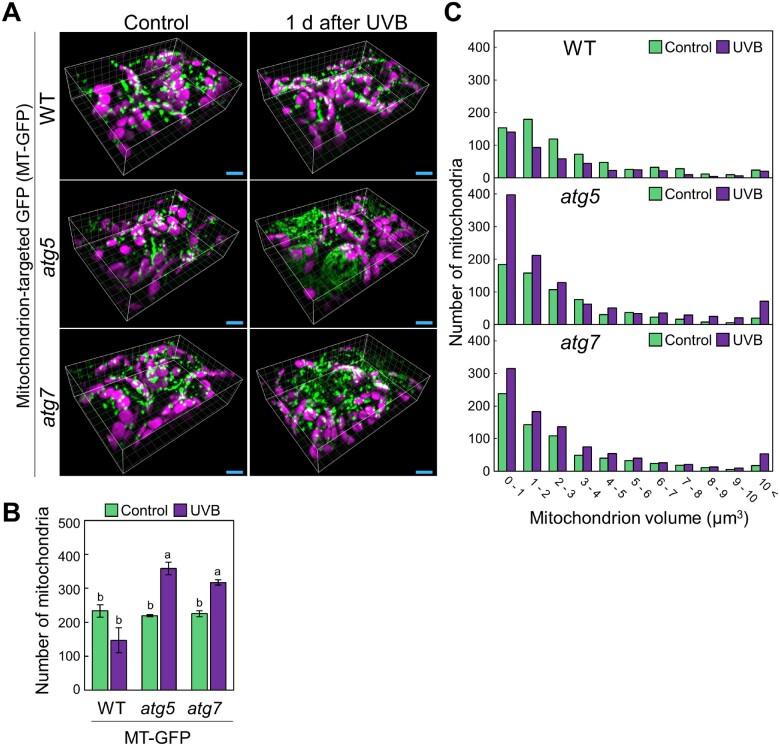
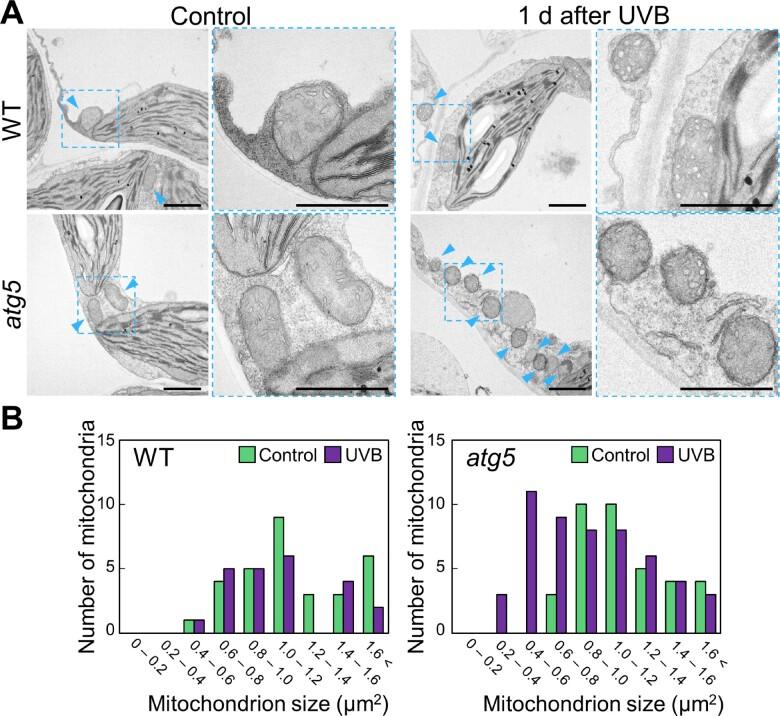
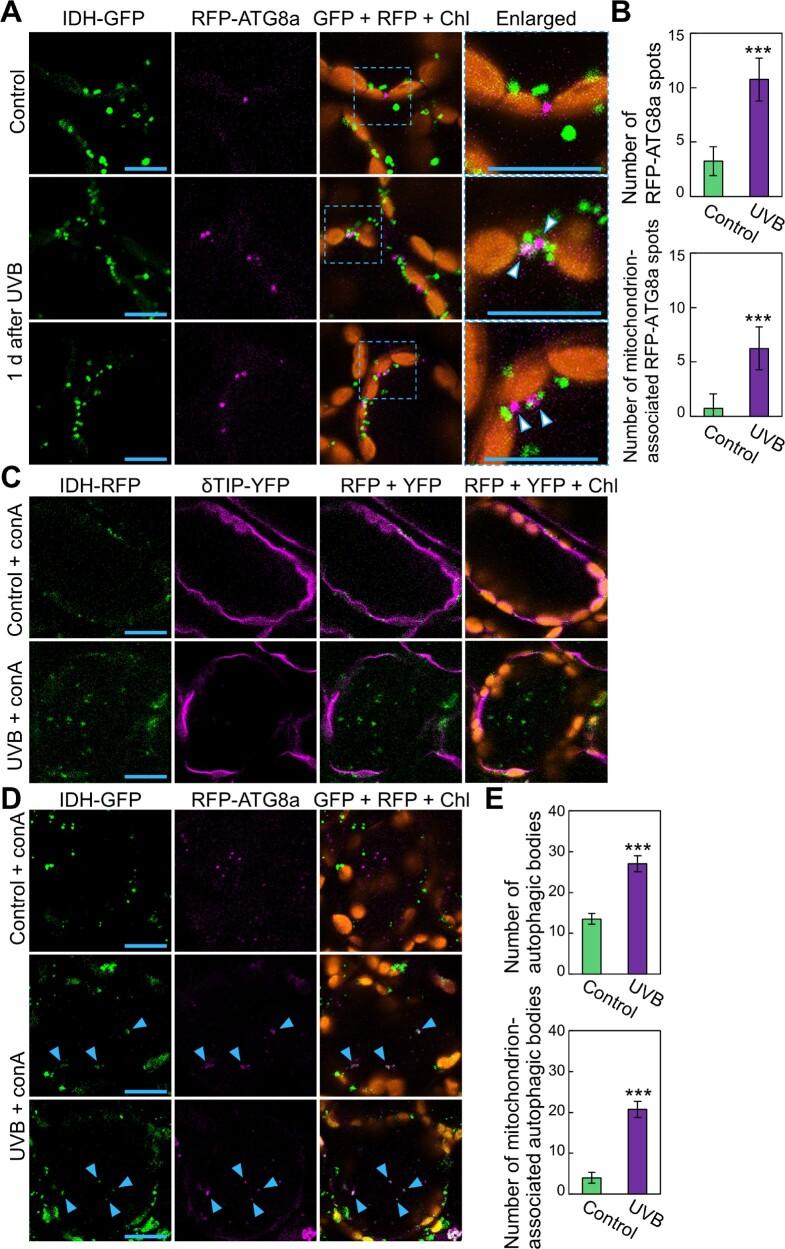
In autophagy, cytoplasmic components of eukaryotic cells are transported to lysosomes or the vacuole for degradation. Autophagy is involved in plant tolerance to the photooxidative stress caused by ultraviolet B (UVB) radiation, but its roles in plant adaptation to UVB damage have not been fully elucidated. Here, we characterized organellar behavior in UVB-damaged Arabidopsis (Arabidopsis thaliana) leaves and observed the occurrence of autophagic elimination of dysfunctional mitochondria, a process termed mitophagy. Notably, Arabidopsis plants blocked in autophagy displayed increased leaf chlorosis after a 1-h UVB exposure compared to wild-type plants. We visualized autophagosomes by labeling with a fluorescent protein-tagged autophagosome marker, AUTOPHAGY8 (ATG8), and found that a 1-h UVB treatment led to increased formation of autophagosomes and the active transport of mitochondria into the central vacuole. In atg mutant plants, the mitochondrial population increased in UVB-damaged leaves due to the cytoplasmic accumulation of fragmented, depolarized mitochondria. Furthermore, we observed that autophagy was involved in the removal of depolarized mitochondria when mitochondrial function was disrupted by mutation of the FRIENDLY gene, which is required for proper mitochondrial distribution. Therefore, autophagy of mitochondria functions in response to mitochondrion-specific dysfunction as well as UVB damage. Together, these results indicate that autophagy is centrally involved in mitochondrial quality control in Arabidopsis leaves.
在自噬中,真核细胞的细胞质成分被运输到溶酶体或液泡中进行降解。自噬参与植物对紫外 B (UVB) 辐射引起的光氧化应激的耐受,但它在植物适应 UVB 损伤中的作用尚未完全阐明。在这里,我们对 UVB 损伤的拟南芥(Arabidopsis thaliana)叶片中的细胞器行为进行了表征,并观察到功能失调的线粒体通过自噬消除的发生,这一过程称为线粒体自噬。值得注意的是,与野生型植物相比,自噬被阻断的拟南芥植物在 1 小时的 UVB 暴露后叶片失绿增加。我们通过用荧光蛋白标记的自噬体标记物 AUTOPHAGY8(ATG8)标记来可视化自噬体,并发现 1 小时的 UVB 处理导致自噬体的形成增加和线粒体向中央液泡的主动运输。在 atg 突变体植物中,由于细胞质中碎片化、去极化的线粒体积累,线粒体群体在 UVB 损伤的叶片中增加。此外,我们观察到,当需要适当的线粒体分布的 FRiENDLY 基因发生突变导致线粒体功能障碍时,自噬参与了去极化线粒体的清除。因此,线粒体的自噬功能响应于线粒体特异性功能障碍以及 UVB 损伤。总之,这些结果表明自噬在拟南芥叶片中线粒体质量控制中起着核心作用。




 Zotero 插件