Department of Endocrinology, First Affiliated Hospital of Harbin Medical University, Harbin, Heilongjiang 150001, P.R. China.
Mol Med Rep. 2021 Feb;23(2). doi: 10.3892/mmr.2020.11786. Epub 2020 Dec 23.
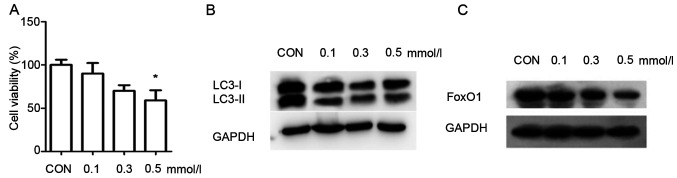
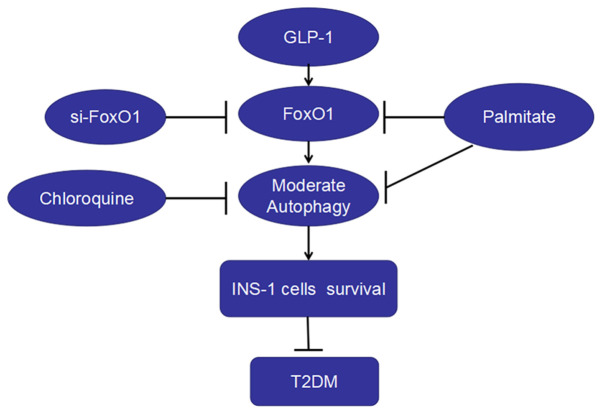
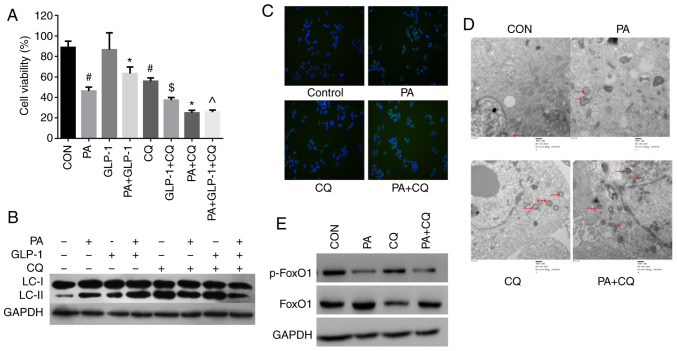
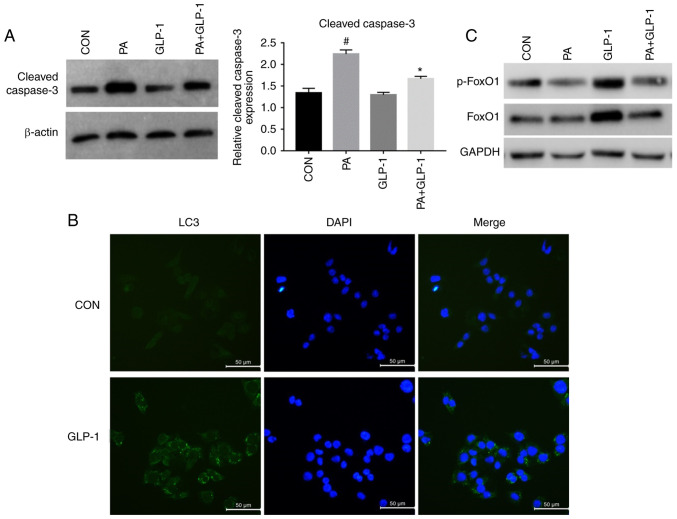
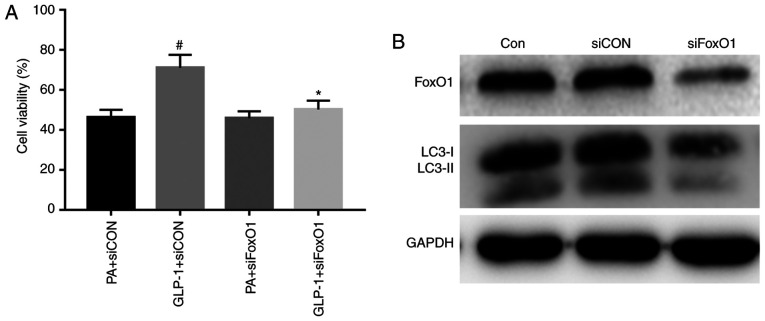
Type 2 diabetes mellitus (T2DM) is characterized by insulin resistance and a progressive loss in mass and function of pancreatic β-cells. In T2DM, lipotoxicity leads to β-cells dysfunction and decreases its number. Autophagy serves a crucial role in maintaining the normal islet architecture and the function of β-cells. Moreover, glucagon-like peptide-1 (GLP-1) and its analogs have beneficial roles in pancreatic β-cells. However, the protective effects of GLP-1 agents on palmitate (PA)-induced pancreatic β-cells and their underlying mechanisms are not fully elucidated. Forkhead box O1 (FoxO1) can prevent pancreatic β-cells from apoptosis. Whether GLP-1 protects against PA-induced β-cells injury via FoxO1 remains unknown. The present study exposed INS-1 cells to PA to establish a T2DM injury model. Cell viability was evaluated using a Cell Counting Kit-8 assay, and apoptosis was determined via western blotting. Furthermore, autophagy was examined using western blotting, immunofluorescence and transmission electron microscopy. Silencing FoxO1 was used to inhibit the activities of FoxO1. The results suggested that the GLP-1 analog liraglutide enhanced the cell viability, inhibited the protein expression of cleaved caspase-3 and increased the expression levels of microtubule-associated protein 1 light chain3 (LC3) II/I, and FoxO1 in INS-1 cells. The autophagy inhibitor chloroquine inhibited the protective effects of liraglutide on INS-1 cells. Silencing of FoxO1 decreased the expression levels of LC3-II and attenuated the protection of liraglutide on the viability of INS-1 cells. In conclusion, the results indicated that liraglutide ameliorated the PA-induced islet β-cells injury via the upregulation of autophagy-mediated by FoxO1.
2 型糖尿病(T2DM)的特征是胰岛素抵抗以及胰腺β细胞质量和功能的进行性丧失。在 T2DM 中,脂毒性导致β细胞功能障碍并减少其数量。自噬在维持胰岛正常结构和β细胞功能方面起着至关重要的作用。此外,胰高血糖素样肽-1(GLP-1)及其类似物对β细胞具有有益作用。然而,GLP-1 对棕榈酸(PA)诱导的胰岛β细胞的保护作用及其潜在机制尚未完全阐明。叉头框蛋白 O1(FoxO1)可以防止胰岛β细胞凋亡。GLP-1 是否通过 FoxO1 来保护β细胞免受 PA 诱导的损伤尚不清楚。本研究将 INS-1 细胞暴露于 PA 中以建立 T2DM 损伤模型。使用细胞计数试剂盒-8 测定法评估细胞活力,通过 Western blot 测定细胞凋亡。此外,通过 Western blot、免疫荧光和透射电子显微镜检查自噬。沉默 FoxO1 用于抑制 FoxO1 的活性。结果表明,GLP-1 类似物利拉鲁肽增强了 INS-1 细胞的活力,抑制了裂解半胱氨酸天冬氨酸蛋白酶-3 的蛋白表达,并增加了微管相关蛋白 1 轻链 3(LC3)II/I 和 FoxO1 的表达水平。自噬抑制剂氯喹抑制了利拉鲁肽对 INS-1 细胞的保护作用。FoxO1 的沉默降低了 LC3-II 的表达水平,并减弱了利拉鲁肽对 INS-1 细胞活力的保护作用。综上所述,结果表明,利拉鲁肽通过 FoxO1 上调自噬来改善 PA 诱导的胰岛β细胞损伤。