Department of Clinical and Developmental Neuropsychology, Faculty of Behavioral and Social Sciences, University of Groningen, Grote Kruisstraat 2/1, 9712 TS, Groningen, The Netherlands.
Department of Psychiatry and Psychotherapy, Faculty of Medicine, LVR Hospital Essen, University of Duisburg-Essen, Essen, Germany.
J Neural Transm (Vienna). 2021 Jul;128(7):877-891. doi: 10.1007/s00702-020-02281-0. Epub 2020 Dec 23.
Numerous studies showed that adults with attention deficit hyperactivity disorder (ADHD) suffer from impairments in a range of cognitive functions when compared to healthy controls. However, only little is known about the neuropsychological functions when compared to various clinical control groups and whether a distinct neuropsychological profile can be identified for adult ADHD.
This retrospective study examined data of 199 outpatients referred for clinical evaluation of adult ADHD, allocated either to an ADHD group (n = 78) or to one of two clinical comparison groups, depending on whether they show indications (n = 71) or no indications (n = 50) for the presence of psychiatric disorders other than ADHD. All individuals performed a comprehensive neuropsychological test battery.
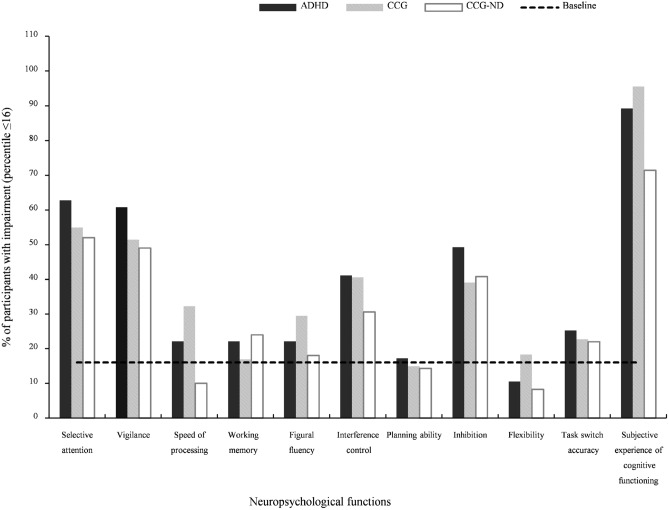
Data analysis revealed impairments in a range of cognitive functions in a substantial number of patients of all three groups. However, profiles of neuropsychological impairments were similar between groups. Furthermore, significant small- to medium-sized correlations between basic and higher-order cognitive functions were revealed in the ADHD group and the clinical comparison group with indications for psychiatric disorders other than ADHD.
Neuropsychological impairments are prominent in psychiatric outpatients seeking a clinical evaluation of adult ADHD but are not specific for ADHD. It is concluded that neuropsychological test performance may have limited incremental value to support the psychiatric differential diagnosis. Furthermore, a clinical trajectory may need to take into account that deficits in a range of higher-order cognitive functions can be substantially explained by deficits in basic cognitive functions.
大量研究表明,与健康对照组相比,患有注意缺陷多动障碍(ADHD)的成年人在一系列认知功能上存在损伤。然而,与各种临床对照组相比,关于神经心理学功能的了解甚少,也不知道是否可以为成年 ADHD 确定独特的神经心理学特征。
这项回顾性研究检查了 199 名因成年 ADHD 的临床评估而转介的门诊患者的数据,根据他们是否存在 ADHD 以外的精神障碍的迹象(n=71)或没有迹象(n=50),将他们分配到 ADHD 组(n=78)或两个临床对照组之一。所有个体都进行了全面的神经心理学测试组合。
数据分析显示,所有三组患者中都有相当数量的患者存在一系列认知功能损伤。然而,各组之间的神经心理学损伤模式相似。此外,在 ADHD 组和有 ADHD 以外的精神障碍迹象的临床对照组中,基本和高阶认知功能之间存在显著的小到中等大小的相关性。
在寻求成年 ADHD 临床评估的精神科门诊患者中,神经心理学损伤很突出,但并不特定于 ADHD。因此,可以得出结论,神经心理学测试表现对支持精神科鉴别诊断的增量价值有限。此外,临床轨迹可能需要考虑到,高阶认知功能的缺陷可以在很大程度上由基本认知功能的缺陷来解释。