Eye Center, Medical Center, University of Freiburg, Killianstr. 5, 79106, Freiburg, Germany.
Faculty of Medicine, University of Freiburg, Freiburg, Germany.
Doc Ophthalmol. 2021 Jun;142(3):389-393. doi: 10.1007/s10633-020-09813-9. Epub 2020 Dec 23.
It is well known that repetitive flash stimulation may trigger seizures in susceptible individuals. Nevertheless, reports of such incidents occurring during recording of a flash electroretinogram (ERG) are extremely rare. Here, we describe the case of a photic-induced seizure triggered during an ERG recording in the absence of a history of epilepsy or other paroxysmal events.
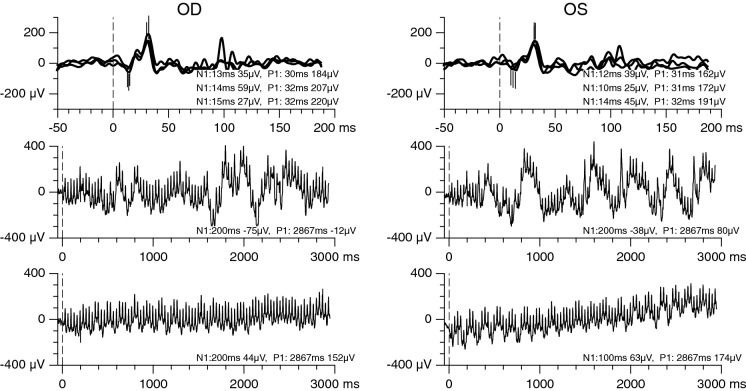
A 14-year-old male patient presented with reduced visual acuity and impaired mesopic vision. Ophthalmological exams confirmed the patient's complaints but were inconclusive as to the underlying pathophysiology. An ERG recording was performed, during which the 30-Hz flicker stimulus triggered a seizure.
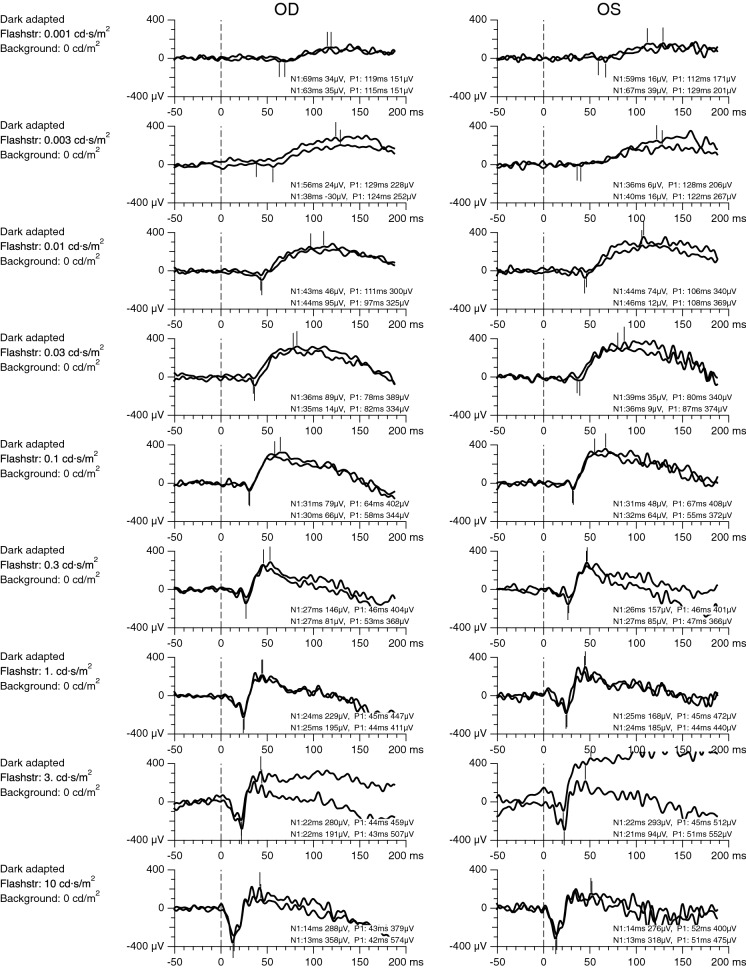
The ERG was essentially normal, with the exception of a 7-Hz rhythm superimposed onto the flicker ERG response that was recorded when the seizure developed.
The present case highlights the possibility that the 30-Hz ERG flash stimulus triggers a seizure in patients with no previous paroxysmal events. Literature evidence suggests that the likelihood of such an incident could be reduced by stimulating monocularly.
众所周知,重复闪光刺激可能会引发易感个体的癫痫发作。然而,在闪光视网膜电图(ERG)记录期间发生此类事件的报告极为罕见。在这里,我们描述了在没有癫痫或其他阵发性事件病史的情况下,在 ERG 记录期间由光诱发的癫痫发作的病例。
一名 14 岁男性患者出现视力下降和中间视觉受损。眼科检查证实了患者的主诉,但无法确定潜在的病理生理学。进行了 ERG 记录,在此期间,30-Hz 闪烁刺激引发了癫痫发作。
除了在癫痫发作时记录到的闪烁 ERG 反应上叠加的 7-Hz 节律外,ERG 基本正常。
本病例强调了在没有先前阵发性事件的情况下,30-Hz ERG 闪光刺激可能引发癫痫发作的可能性。文献证据表明,通过单眼刺激可以降低这种事件发生的可能性。