Ceccato F, Voltan G, Sabbadin C, Camozzi V, Merante Boschin I, Mian C, Zanotto V, Donato D, Bordignon G, Capizzi A, Carretta G, Scaroni C
Endocrinology Unit, Department of Medicine DIMED, University-Hospital of Padova, European Reference Network On Rare Endocrine Conditions (endoERN) Center of Padova, Via Ospedale Civile, 105, 35128, Padova, Italy.
Department of Neuroscience DNS, University of Padova, Padova, Italy.
J Endocrinol Invest. 2021 Aug;44(8):1689-1698. doi: 10.1007/s40618-020-01476-2. Epub 2020 Dec 23.
The COVID-19 outbreak in Italy is the major concern of Public Health in 2020: measures of containment were progressively expanded, limiting Outpatients' visit.
We have developed and applied an emergency plan, tailored for Outpatients with endocrine diseases.
Cross-sectional study from March to May 2020.
Referral University-Hospital center.
1262 patients in 8 weeks.
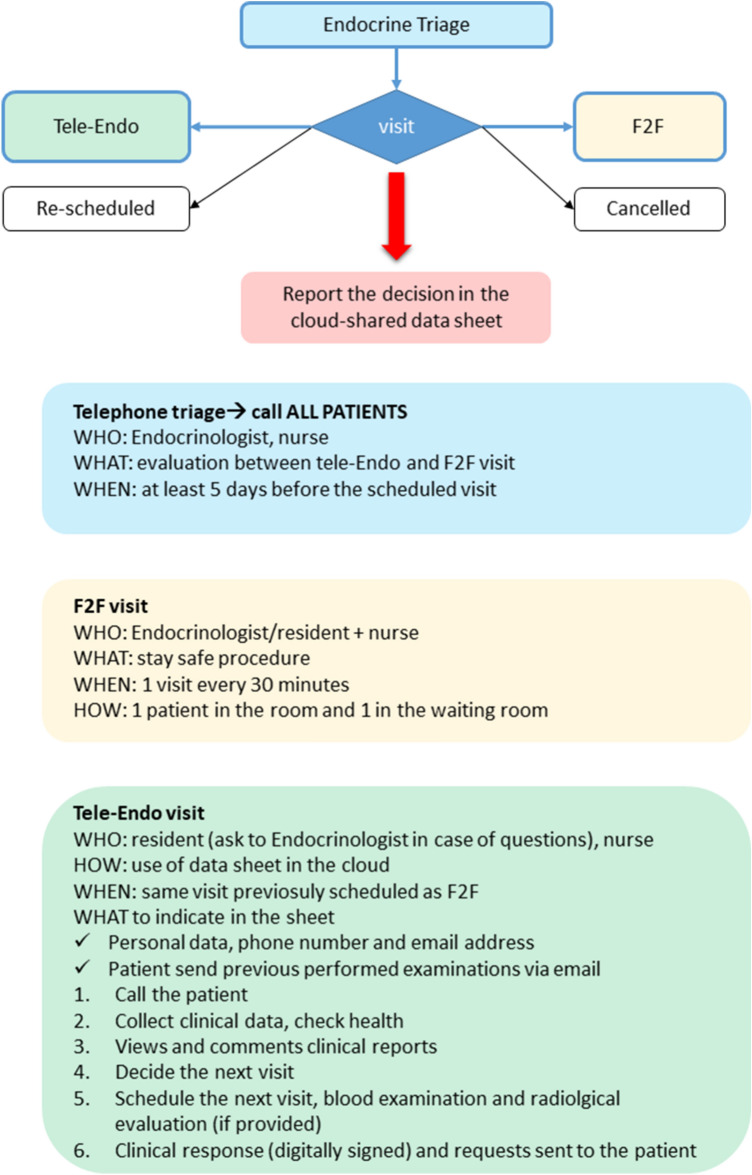
The emergency plan is based upon the endocrine triage, the stay-safe procedures and the tele-Endo. During endocrine triage every patient was contacted by phone to assess health status and define if the visit will be performed face-to-face (F2F) or by tele-Medicine (tele-Endo). In case of F2F, targeted stay-safe procedures have been adopted. Tele-Endo, performed by phone and email, is dedicated to COVID-19-infected patients, to elderly or frail people, or to those with a stable disease.
To assess efficacy of the emergency plan to continue the follow-up of Outpatients.
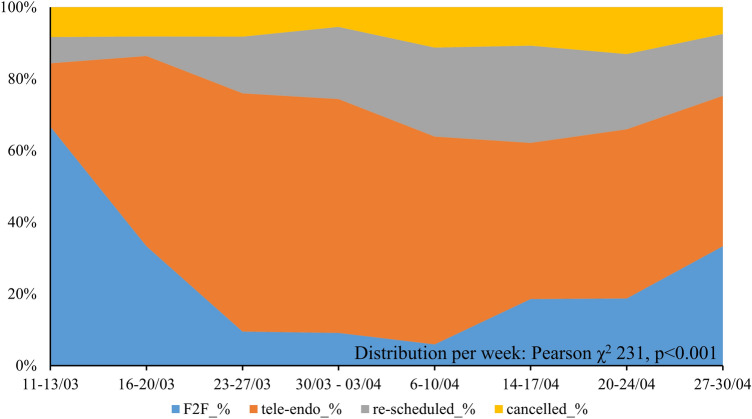
The number of visits cancelled after endocrine triage (9%) is lower than that cancelled independently by the patients (37%, p < 0.001); the latter reduced from 47 to 19% during the weeks of lockdown (p = 0.032). 86% of patients contacted by endocrine-triage received a clinical response (F2F and tele-Endo visits). F2F visit was offered especially to young patients; tele-Endo was applied to 63% of geriatric patients (p < 0.001), visits' outcome was similar between young and aged patients.
The emergency plan respects the WHO recommendations to limit viral spread and is useful to continue follow-up for outpatients with endocrine diseases.
2020年意大利的新型冠状病毒肺炎疫情是公共卫生领域的主要关注点:防控措施逐步扩大,限制了门诊就诊。
我们制定并应用了一项针对内分泌疾病门诊患者的应急预案。
2020年3月至5月的横断面研究。
转诊大学医院中心。
8周内共1262例患者。
应急预案基于内分泌分诊、安全保障程序和远程内分泌诊疗。在内分泌分诊过程中,通过电话联系每位患者,评估其健康状况,并确定就诊方式为面对面(F2F)还是通过远程医疗(远程内分泌诊疗)。对于面对面就诊的情况,采取了针对性的安全保障程序。通过电话和电子邮件进行的远程内分泌诊疗适用于新型冠状病毒肺炎感染患者、老年人或体弱患者,或病情稳定的患者。
评估应急预案对继续门诊患者随访的有效性。
内分泌分诊后取消的就诊次数(9%)低于患者自行取消的次数(37%,p<0.001);在封锁期间,后者从47%降至19%(p=0.032)。内分泌分诊联系的患者中有86%得到了临床回复(面对面和远程内分泌诊疗就诊)。面对面就诊主要提供给年轻患者;63%的老年患者接受了远程内分泌诊疗(p<0.001),年轻患者和老年患者的就诊结果相似。
该应急预案符合世界卫生组织关于限制病毒传播的建议,有助于继续对内分泌疾病门诊患者进行随访。