Essentia Institute of Rural Health, Duluth, Minnesota, USA.
Feinberg School of Medicine, Northwestern University, Chicago, Illinois, USA.
Clin Cardiol. 2021 Feb;44(2):186-192. doi: 10.1002/clc.23521. Epub 2020 Dec 23.
Patients with phenotypic severe hypercholesterolemia (SH), low-density lipoprotein-cholesterol (LDL-c) ≥ 190 mg/dl, atherosclerotic cardiovascular disease (ASCVD) or adults 40-75 years with diabetes with risk factors or 10-year ASCVD risk ≥20% benefit from maximally tolerated statin therapy. Rural patients have decreased access to specialty care, potentially limiting appropriate treatment.
Prior visit with cardiology will improve treatment of severe hypercholesterolemia.
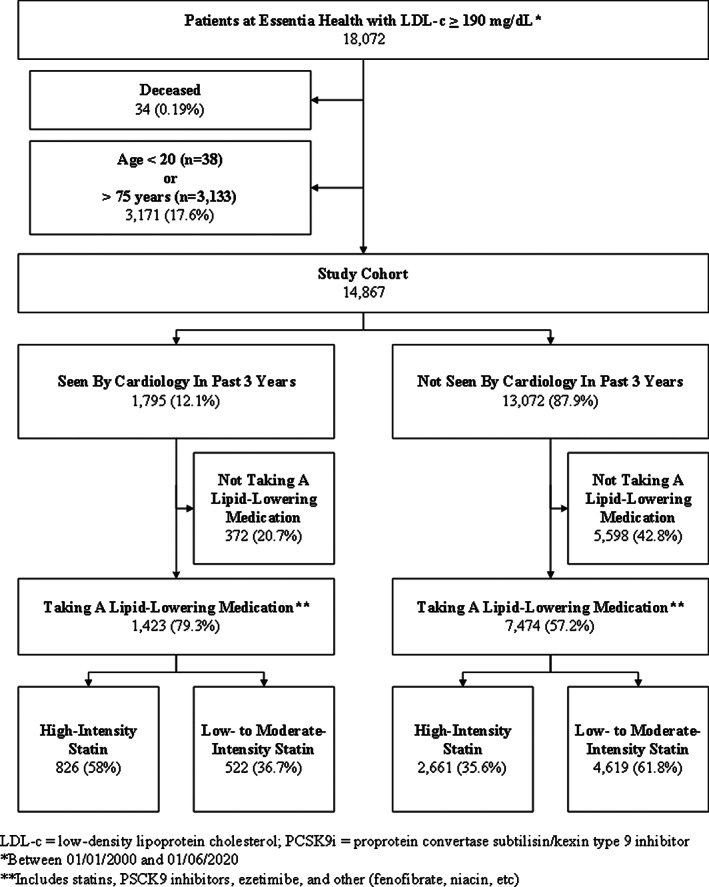
We used an electronic medical record-based SH registry defined as ever having an LDL-c ≥ 190 mg/dl since January 1, 2000 (n = 18 072). We excluded 3205 (17.7%) patients not alive or age 20-75 years. Patients defined as not seen by cardiology if they had no visit within the past 3 years (2017-2019).
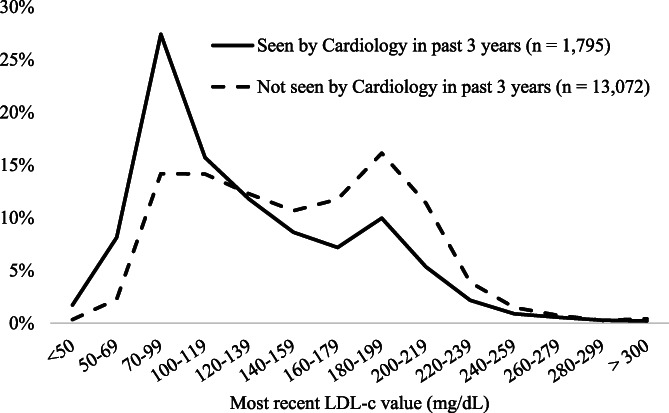
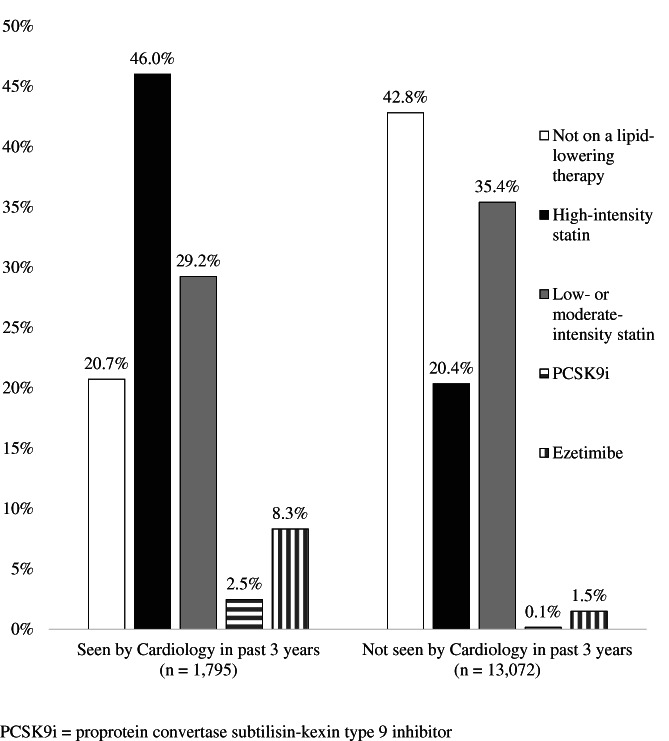
We included 14 867 patients (82.3%; mean age 59.7 ± 10.3 years; 58.7% female). Most patients were not seen by cardiology (n = 13 072; 72.3%). After adjusting for age, sex, CVD, hypertension, diabetes and obesity, patients seen by cardiology were more likely to have any lipid-lowering medication (OR = 1.46, 95% CI: 1.29-1.65), high-intensity statin (OR = 1.81, 95% CI: 1.61-2.03), or proprotein convertase subtilisin-kexin type 9 (PCSK9) inhibitor (OR = 5.96, 95% CI: 3.34-10.65) compared to those not seen by cardiology. Mean recent LDL-c was lower in patients seen by cardiology (126.8 ± 51.6 mg/dl vs. 152.4 ± 50.2 mg/dl, respectively; p < .001).
In our predominantly rural population, a visit with cardiology improved the likelihood to be prescribed any statin, a high-intensity statin, or PCSK9 inhibitor. This more appropriately addressed their high life-time risk of ASCVD. Access to specialty care could improve SH patient's outcomes.
表型严重高胆固醇血症(SH)患者,即低密度脂蛋白胆固醇(LDL-c)≥190mg/dl,动脉粥样硬化性心血管疾病(ASCVD)或 40-75 岁有糖尿病且有危险因素或 10 年 ASCVD 风险≥20%的成年人,从最大耐受他汀类药物治疗中获益。农村患者获得专科医疗的机会减少,可能限制了适当的治疗。
此前有过心脏病学就诊经历会改善严重高胆固醇血症的治疗效果。
我们使用了一个基于电子病历的 SH 登记系统,该系统将 LDL-c≥190mg/dl 的患者定义为自 2000 年 1 月 1 日以来(n=18072)曾有过此类记录。我们排除了 3205 名(17.7%)已经去世或年龄在 20-75 岁之间的患者。如果患者在过去 3 年内没有就诊记录(2017-2019 年),则将其定义为未接受过心脏病学治疗。
我们纳入了 14867 名患者(82.3%;平均年龄 59.7±10.3 岁;58.7%为女性)。大多数患者未接受过心脏病学治疗(n=13072;72.3%)。调整年龄、性别、CVD、高血压、糖尿病和肥胖因素后,接受过心脏病学治疗的患者更有可能接受任何降脂药物治疗(OR=1.46,95%CI:1.29-1.65)、高强度他汀类药物治疗(OR=1.81,95%CI:1.61-2.03)或前蛋白转化酶枯草溶菌素 9(PCSK9)抑制剂治疗(OR=5.96,95%CI:3.34-10.65)。与未接受过心脏病学治疗的患者相比,接受过心脏病学治疗的患者的近期 LDL-c 平均值更低(分别为 126.8±51.6mg/dl 和 152.4±50.2mg/dl;p<.001)。
在我们以农村为主的人群中,心脏病学就诊增加了接受任何他汀类药物、高强度他汀类药物或 PCSK9 抑制剂治疗的可能性。这更恰当地解决了他们一生中 ASCVD 风险较高的问题。获得专科医疗服务的机会可以改善 SH 患者的预后。