Department of Medicine, Division of Endocrinology, Diabetes, and Metabolism, Beth Israel Deaconess Medical Center, Harvard Medical School, Boston, Massachusetts.
Research Group of Food Processing, Korea Food Research Institute, Jeollabuk-do, South Korea.
Am J Physiol Endocrinol Metab. 2021 Feb 1;320(2):E379-E389. doi: 10.1152/ajpendo.00399.2020. Epub 2020 Dec 28.
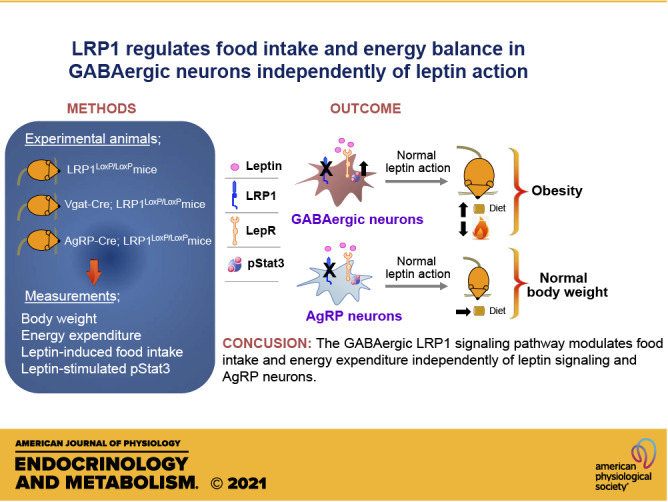
Low-density lipoprotein receptor-related protein 1 (LRP1) is a member of LDL receptor family that plays a key role in systemic glucose and lipid homeostasis. LRP1 also regulates energy balance in the hypothalamus by mediating leptin's anorexigenic action, although the underlying neurocircuitry involved is still unclear. Because GABAergic neurons are a major mediator of hypothalamic leptin action, we studied the role of GABAergic LRP1 in energy balance and leptin action using mice lacking LRP1 in Vgat- or AgRP-expressing neurons (Vgat-Cre; LRP1 or AgRP-Cre; LRP1). Here, we show that LRP1 deficiency in GABAergic neurons results in severe obesity in male and female mice fed a normal-chow diet. This effect is most likely due to increased food intake and decreased energy expenditure and locomotor activity. Increased adiposity in GABAergic neuron-specific LRP1-deficient mice is accompanied by hyperleptinemia and hyperinsulinemia. Insulin resistance and glucose intolerance in these mice are occurred without change in body weight. Importantly, LRP1 in GABAergic neurons is not required for leptin action, as evidenced by normal leptin's anorexigenic action and leptin-induced hypothalamic Stat3 phosphorylation. In contrast, LRP1 deficiency in AgRP neurons has no effect on adiposity and caloric intake. In conclusion, our data identify GABAergic neurons as a key neurocircuitry that underpins LRP1-dependent regulation of systemic energy balance and body-weight homeostasis. We further find that the GABAergic LRP1 signaling pathway modulates food intake and energy expenditure independently of leptin signaling and AgRP neurons.
低密度脂蛋白受体相关蛋白 1(LRP1)是 LDL 受体家族的成员,在全身葡萄糖和脂质稳态中发挥关键作用。LRP1 还通过介导瘦素的厌食作用来调节下丘脑的能量平衡,尽管涉及的潜在神经回路仍不清楚。由于 GABA 能神经元是下丘脑瘦素作用的主要介导者,我们使用 Vgat 或 AgRP 表达神经元中缺乏 LRP1 的小鼠(Vgat-Cre;LRP1 或 AgRP-Cre;LRP1)研究了 GABA 能 LRP1 在能量平衡和瘦素作用中的作用。在这里,我们表明正常饮食喂养的雄性和雌性小鼠中 GABA 能神经元中的 LRP1 缺乏会导致严重肥胖。这种效应很可能是由于食物摄入量增加、能量消耗和运动活性减少所致。GABA 能神经元特异性 LRP1 缺乏小鼠的肥胖增加伴随着高瘦素血症和高胰岛素血症。这些小鼠的胰岛素抵抗和葡萄糖不耐受发生而体重没有变化。重要的是,GABA 能神经元中的 LRP1 对于瘦素作用不是必需的,正如正常的瘦素的厌食作用和瘦素诱导的下丘脑 Stat3 磷酸化所证明的那样。相比之下,AgRP 神经元中的 LRP1 缺乏对脂肪量和热量摄入没有影响。总之,我们的数据确定 GABA 能神经元是一种关键的神经回路,它支持 LRP1 依赖调节全身能量平衡和体重稳态。我们还发现,GABA 能 LRP1 信号通路独立于瘦素信号和 AgRP 神经元调节食物摄入和能量消耗。