Au Dianaly T, Strickland Dudley K, Muratoglu Selen C
Center for Vascular and Inflammatory Diseases, University of Maryland School of Medicine, Baltimore, MD, USA.
Department of Surgery, University of Maryland School of Medicine, Baltimore, MD, USA.
J Diabetes Res. 2017;2017:8356537. doi: 10.1155/2017/8356537. Epub 2017 May 11.
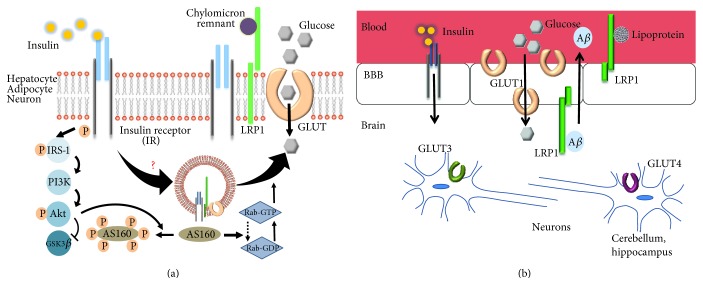
The metabolic syndrome is an escalating worldwide public health concern. Defined by a combination of physiological, metabolic, and biochemical factors, the metabolic syndrome is used as a clinical guideline to identify individuals with a higher risk for type 2 diabetes and cardiovascular disease. Although risk factors for type 2 diabetes and cardiovascular disease have been known for decades, the molecular mechanisms involved in the pathophysiology of these diseases and their interrelationship remain unclear. The LDL receptor-related protein 1 (LRP1) is a large endocytic and signaling receptor that is widely expressed in several tissues. As a member of the LDL receptor family, LRP1 is involved in the clearance of chylomicron remnants from the circulation and has been demonstrated to be atheroprotective. Recently, studies have shown that LRP1 is involved in insulin receptor trafficking and regulation and glucose metabolism. This review summarizes the role of tissue-specific LRP1 in insulin signaling and its potential role as a link between lipoprotein and glucose metabolism in diabetes.
代谢综合征是一个在全球范围内日益引起公众健康关注的问题。代谢综合征由生理、代谢和生化因素综合定义,用作识别2型糖尿病和心血管疾病高风险个体的临床指南。尽管2型糖尿病和心血管疾病的风险因素已为人所知数十年,但这些疾病病理生理学中涉及的分子机制及其相互关系仍不清楚。低密度脂蛋白受体相关蛋白1(LRP1)是一种大型内吞和信号受体,在多个组织中广泛表达。作为低密度脂蛋白受体家族的成员,LRP1参与乳糜微粒残粒从循环中的清除,并已被证明具有抗动脉粥样硬化作用。最近,研究表明LRP1参与胰岛素受体的运输和调节以及葡萄糖代谢。本综述总结了组织特异性LRP1在胰岛素信号传导中的作用及其作为糖尿病中脂蛋白和葡萄糖代谢之间联系的潜在作用。