Department of Critical Care Medicine, Wuhan Pulmonary Hospital, Wuhan, 430030, China.
Division of Cardiology, Department of Internal Medicine, Tongji Hospital, Tongji Medical College, Huazhong University of Science and Technology, Wuhan, 430030, China.
BMC Pulm Med. 2020 Dec 24;20(1):324. doi: 10.1186/s12890-020-01354-w.
It had been shown that High-flow nasal cannula (HFNC) is an effective initial support strategy for patients with acute respiratory failure. However, the efficacy of HFNC for patients with COVID-19 has not been established. This study was performed to assess the efficacy of HFNC for patients with COVID-19 and describe early predictors of HFNC treatment success in order to develop a prediction tool that accurately identifies the need for upgrade respiratory support therapy.
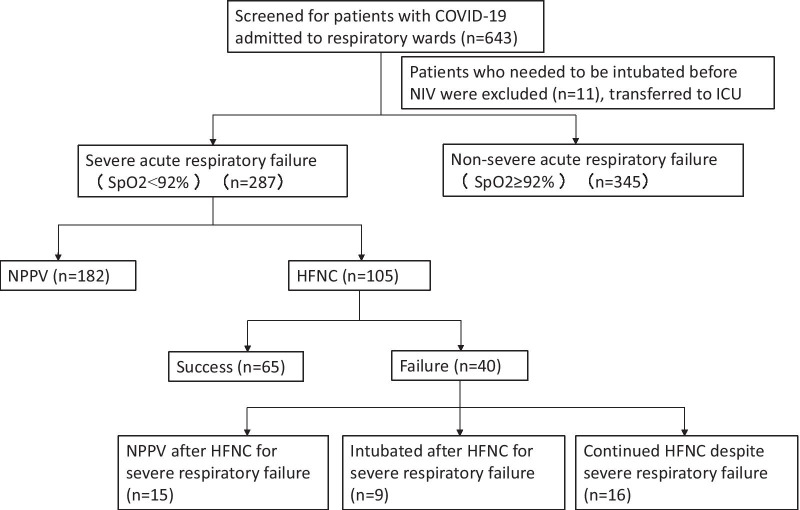
We retrospectively reviewed the medical records of patients with COVID-19 treated by HFNC in respiratory wards of 2 hospitals in Wuhan between 1 January and 1 March 2020. Overall clinical outcomes, the success rate of HFNC strategy and related respiratory variables were evaluated.
A total of 105 patients were analyzed. Of these, 65 patients (61.9%) showed improved oxygenation and were successfully withdrawn from HFNC. The PaO/FiO ratio, SpO/FiO ratio and ROX index (SpO/FiO*RR) at 6h, 12h and 24h of HFNC initiation were closely related to the prognosis. The ROX index after 6h of HFNC initiation (AUROC, 0.798) had good predictive capacity for outcomes of HFNC. In the multivariate logistic regression analysis, young age, gender of female, and lower SOFA score all have predictive value, while a ROX index greater than 5.55 at 6 h after initiation was significantly associated with HFNC success (OR, 17.821; 95% CI, 3.741-84.903 p<0.001).
Our study indicated that HFNC was an effective way of respiratory support in the treatment of COVID-19 patients. The ROX index after 6h after initiating HFNC had good predictive capacity for HFNC outcomes.
高流量鼻导管(HFNC)已被证实是急性呼吸衰竭患者的一种有效初始支持策略。然而,HFNC 治疗 COVID-19 患者的疗效尚未确定。本研究旨在评估 HFNC 治疗 COVID-19 患者的疗效,并描述 HFNC 治疗成功的早期预测因素,以便开发一种能够准确识别需要升级呼吸支持治疗的预测工具。
我们回顾性分析了 2020 年 1 月 1 日至 3 月 1 日期间,武汉两家医院呼吸病房接受 HFNC 治疗的 COVID-19 患者的病历。评估了总体临床结局、HFNC 策略的成功率以及相关呼吸变量。
共分析了 105 例患者,其中 65 例(61.9%)患者氧合改善,成功撤离 HFNC。HFNC 开始后 6h、12h 和 24h 的 PaO/FiO 比值、SpO/FiO 比值和 ROX 指数(SpO/FiO*RR)与预后密切相关。HFNC 开始后 6h 的 ROX 指数(AUROC,0.798)对 HFNC 结局具有良好的预测能力。在多变量逻辑回归分析中,年龄较小、女性性别和较低的 SOFA 评分均具有预测价值,而 HFNC 开始后 6h 的 ROX 指数大于 5.55 与 HFNC 成功显著相关(OR,17.821;95%CI,3.741-84.903;p<0.001)。
本研究表明,HFNC 是 COVID-19 患者呼吸支持的一种有效方法。HFNC 开始后 6h 的 ROX 指数对 HFNC 结局具有良好的预测能力。