Coatwala Aadila, Dhir Mayank, Sinha Sagar, Bhusare Dattatray
Department of General Surgery, K.J. Somaiya Hospital and Research Center, Mumbai, IND.
Department of Emergency Medicine, MNR Medical College and Hospital, Hyderabad, IND.
Cureus. 2024 Dec 17;16(12):e75871. doi: 10.7759/cureus.75871. eCollection 2024 Dec.
During the COVID-19 pandemic, managing respiratory failure in critically ill patients has presented significant challenges. A high-flow nasal cannula (HFNC) has been established as an effective respiratory support modality, offering heated, humidified oxygen at high flow rates. However, concerns persist regarding the potential for aerosol dispersion and the risk of viral transmission, particularly in COVID-19. This study investigates the impact of surgical mask (3-ply surgical mask) placement over HFNC on oxygenation parameters in COVID-19 patients experiencing hypoxemic respiratory failure.
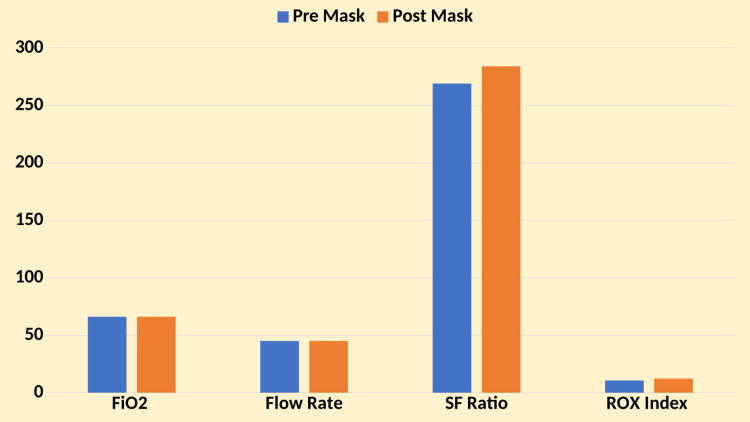
A retrospective analysis of clinical data from a tertiary medical facility was conducted. The study included 35 patients with confirmed COVID-19 and moderate to severe hypoxemia. Oxygenation indices such as the SpO/FiO (SF) ratio, flow rate, and the ratio of oxygen saturation index (ROX index) were monitored before and after the application of surgical masks over HFNC. Statistical analyses were performed to compare these parameters before and after surgical mask placement.
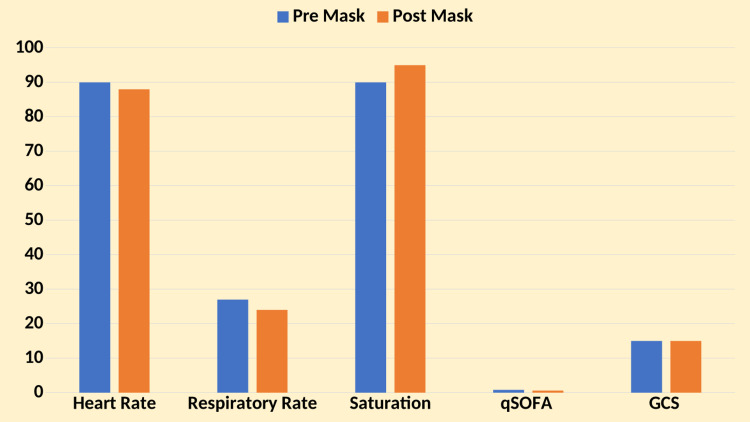
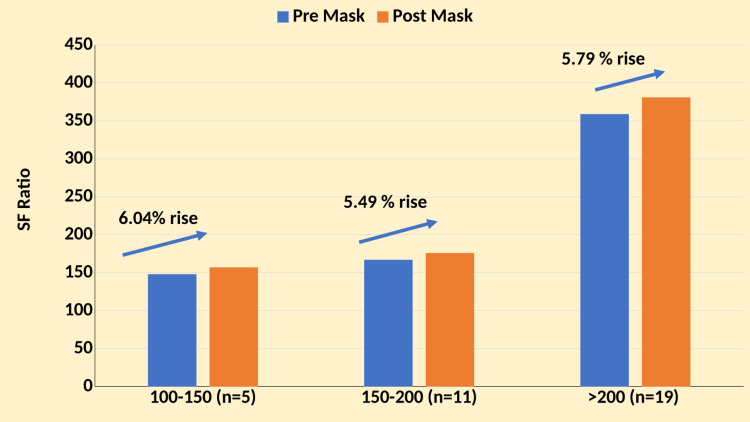
The adjunctive use of surgical masks over HFNC significantly improved oxygenation parameters compared to HFNC alone. Despite these improvements, there was no significant change in heart and respiratory rates, quick sequential organ failure assessment (qSOFA) scores, or Glasgow Coma Scale (GCS) levels. Subgroup analysis showed an increase in SF ratio ranging between 5.49% and 6.04% in patients with ROX indices, but these trends were not statistically significant.
This study provides preliminary evidence that surgical masks over HFNC may enhance oxygenation in critically ill COVID-19 patients with hypoxemic respiratory failure. These results underscore the potential importance of infection control measures in respiratory therapy during pandemics and suggest that further investigation in more extensive prospective studies is warranted.
在新型冠状病毒肺炎大流行期间,危重症患者呼吸衰竭的管理面临重大挑战。高流量鼻导管(HFNC)已被确立为一种有效的呼吸支持方式,可提供高流量的加热、湿化氧气。然而,人们对气溶胶扩散的可能性以及病毒传播风险仍存在担忧,尤其是在新型冠状病毒肺炎患者中。本研究调查了在使用HFNC的新型冠状病毒肺炎低氧性呼吸衰竭患者中,佩戴外科口罩(三层外科口罩)对氧合参数的影响。
对一家三级医疗机构的临床数据进行回顾性分析。该研究纳入了35例确诊新型冠状病毒肺炎且伴有中度至重度低氧血症的患者。在HFNC上佩戴外科口罩前后,监测氧合指数,如血氧饱和度/吸入氧分数(SF)比值、流速和氧饱和度指数比值(ROX指数)。进行统计分析以比较佩戴外科口罩前后的这些参数。
与单独使用HFNC相比,在HFNC上辅助使用外科口罩显著改善了氧合参数。尽管有这些改善,但心率、呼吸频率、快速序贯器官衰竭评估(qSOFA)评分或格拉斯哥昏迷量表(GCS)水平均无显著变化。亚组分析显示,ROX指数患者的SF比值增加了5.49%至6.04%,但这些趋势无统计学意义。
本研究提供了初步证据,表明在使用HFNC的新型冠状病毒肺炎危重症低氧性呼吸衰竭患者中,佩戴外科口罩可能会增强氧合。这些结果强调了大流行期间呼吸治疗中感染控制措施的潜在重要性,并表明有必要在更广泛的前瞻性研究中进行进一步调查。