• 文献检索
  • 文档翻译
  • 深度研究
  • 学术资讯
  • Suppr Zotero 插件Zotero 插件
  • 邀请有礼
  • 套餐&价格
  • 历史记录
应用&插件
Suppr Zotero 插件Zotero 插件浏览器插件Mac 客户端Windows 客户端微信小程序
定价
高级版会员购买积分包购买API积分包
服务
文献检索文档翻译深度研究API 文档MCP 服务
关于我们
关于 Suppr公司介绍联系我们用户协议隐私条款
关注我们

Suppr 超能文献

核心技术专利:CN118964589B侵权必究
粤ICP备2023148730 号-1Suppr @ 2026

文献检索

告别复杂PubMed语法,用中文像聊天一样搜索,搜遍4000万医学文献。AI智能推荐,让科研检索更轻松。

立即免费搜索

文件翻译

保留排版,准确专业,支持PDF/Word/PPT等文件格式,支持 12+语言互译。

免费翻译文档

深度研究

AI帮你快速写综述,25分钟生成高质量综述,智能提取关键信息,辅助科研写作。

立即免费体验

符合 24 小时身体活动准则与澳大利亚小学学龄儿童学业成绩之间的关联。

Associations between meeting 24-hour movement guidelines and academic achievement in Australian primary school-aged children.

机构信息

Alliance for Research in Exercise, Nutrition and Activity (ARENA), Allied Health and Human Performance, University of South Australia, Adelaide, SA5001, Australia.

Alliance for Research in Exercise, Nutrition and Activity (ARENA), Allied Health and Human Performance, University of South Australia, Adelaide, SA5001, Australia.

出版信息

J Sport Health Sci. 2022 Jul;11(4):521-529. doi: 10.1016/j.jshs.2020.12.004. Epub 2021 Jan 6.

DOI:10.1016/j.jshs.2020.12.004
PMID:33359235
原文链接:https://pmc.ncbi.nlm.nih.gov/articles/PMC9338336/
Abstract

BACKGROUND

Few studies have investigated associations between academic achievement and meeting recommendations from the 24-hour (24-h) movement guidelines. The specific guidelines associated with the most benefit academic achievement are unknown. Utilizing both self-report and objective movement data, this study examined associations between academic achievement and meeting individual recommendations and combinations of recommendations from the 24-h movement guidelines (sleep, physical activity, and screen time).

METHODS

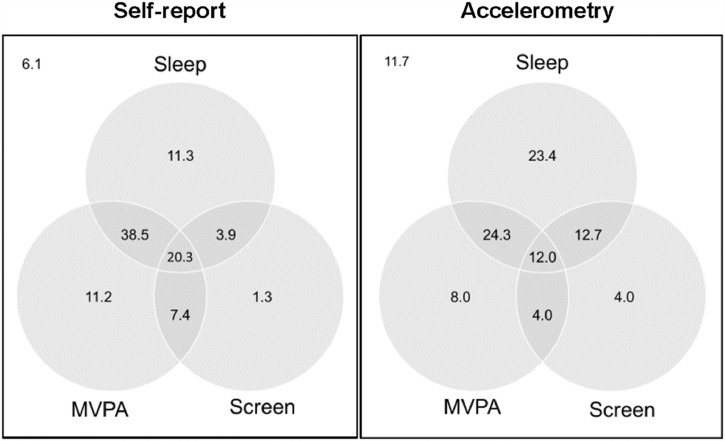
Data from CheckPoint, a cross-sectional study nested between Waves 6 and 7 of the Longitudinal Study of Australian Children, were used. Movement behaviors were measured using 24-h wrist-worn accelerometry (GENEActiv (Activinsights, Kimbolton, UK)) and were self-reported by children using the Multimedia Activity Recall for Children and Adolescents. Academic achievement was measured using a nationally administered standardized test in literacy and numeracy. Analysis of covariance, with t tests with sequential Bonferroni adjustments, was used to compare academic achievement with all possible combinations of meeting recommendations, adjusting for demographic confounders. Two models were considered: guideline compliance assessed by self-report (n = 1270, mean age = 11.99 years, 52% males) and by accelerometry (for moderate-to-vigorous intensity physical activity (MVPA) and sleep)) and self-report (screen time) in combination (n = 927, mean age = 11.97 years, 52% males).

RESULTS

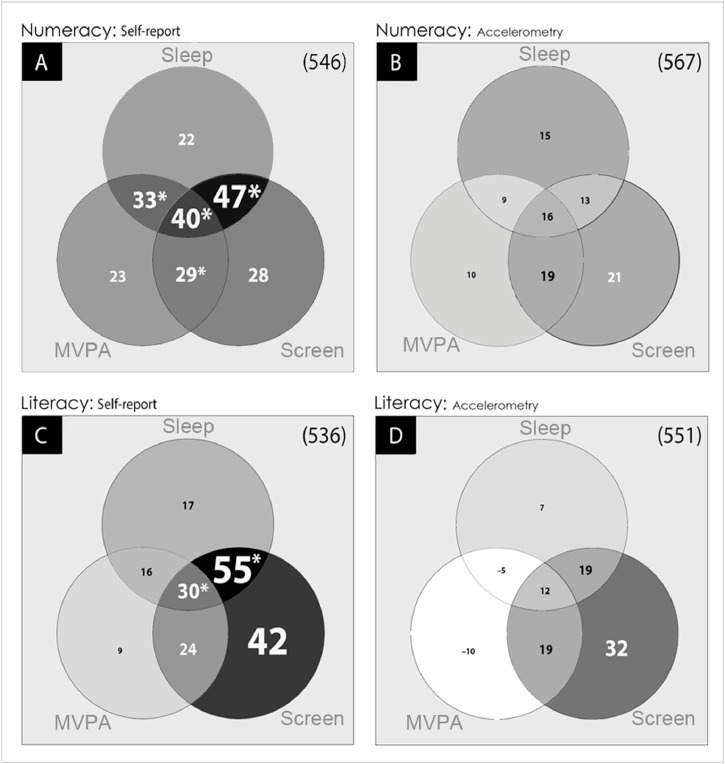
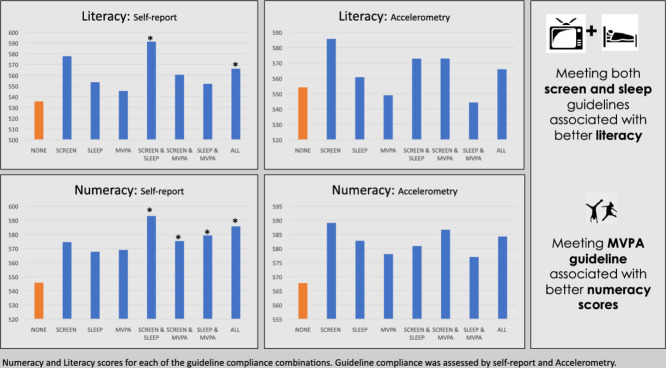
Literacy achievement significantly differed based on self-report (F = 3.08, p = 0.003) and accelerometer derived (F = 2.40, p = 0.02) guideline compliance. Numeracy achievement significantly differed based on self-report (F = 2.92, p = 0.005) but not accelerometer derived guideline compliance (F = 0.80, p = 0.58). When assessed by self-report, children who met all guidelines (t = -4.05, p = 0.0001) or met the screen time and sleep guidelines in combination (t = -5.02, p < 0.001) had superior literacy achievement. Meeting the self-report MVPA guideline in any combination was associated with higher numeracy scores (p < 0.05). Post-hoc analyses showed no differences in academic achievement for any category of accelerometer derived guideline compliance.

CONCLUSION

The findings suggest that limiting recreational screen time is important for literacy achievement and that encouraging compliance with the MVPA guideline is important for numeracy achievement.

摘要

背景

很少有研究调查学业成绩与 24 小时(24-h)运动指南建议之间的关联。与学业成绩最相关的具体指南尚不清楚。本研究利用自我报告和客观运动数据,考察了与满足 24 小时运动指南(睡眠、身体活动和屏幕时间)的个别建议和组合建议相关的学业成绩之间的关联。

方法

使用了澳大利亚儿童纵向研究第 6 波和第 7 波之间嵌套的 CheckPoint 的横断面研究数据。运动行为使用 24 小时腕戴加速度计(GENEActiv(Activinsights,金伯尔顿,英国))进行测量,并由儿童使用多媒体活动回忆进行自我报告儿童和青少年。学业成绩使用全国管理的读写和计算标准化测试进行衡量。协方差分析,使用带有连续 Bonferroni 调整的 t 检验,用于比较满足建议的所有可能组合与学业成绩的关系,调整了人口统计学混杂因素。考虑了两种模型:自我报告评估的指南遵守情况(n=1270,平均年龄=11.99 岁,52%为男性)和加速度计评估的中等到剧烈强度体力活动(MVPA)和睡眠)和自我报告(屏幕时间)的组合(n=927,平均年龄=11.97 岁,52%为男性)。

结果

读写成绩显著因自我报告(F=3.08,p=0.003)和加速度计衍生(F=2.40,p=0.02)指南遵守情况而有所不同。计算成绩显著因自我报告(F=2.92,p=0.005)而有所不同,但不因加速度计衍生的指南遵守情况(F=0.80,p=0.58)而有所不同。当通过自我报告评估时,满足所有指南的儿童(t=-4.05,p=0.0001)或满足屏幕时间和睡眠指南组合的儿童(t=-5.02,p<0.001)的读写成绩更好。以任何组合满足自我报告的 MVPA 指南与更高的计算分数相关(p<0.05)。事后分析显示,任何加速度计衍生的指南遵守情况类别对学业成绩均无差异。

结论

研究结果表明,限制娱乐性屏幕时间对读写成绩很重要,鼓励遵守 MVPA 指南对计算成绩很重要。
https://cdn.ncbi.nlm.nih.gov/pmc/blobs/6dee/9338336/45b1ef972f68/gr2.jpg
https://cdn.ncbi.nlm.nih.gov/pmc/blobs/6dee/9338336/b01983fb8f35/ga1.jpg
https://cdn.ncbi.nlm.nih.gov/pmc/blobs/6dee/9338336/0a1844fff108/gr1.jpg
https://cdn.ncbi.nlm.nih.gov/pmc/blobs/6dee/9338336/45b1ef972f68/gr2.jpg
https://cdn.ncbi.nlm.nih.gov/pmc/blobs/6dee/9338336/b01983fb8f35/ga1.jpg
https://cdn.ncbi.nlm.nih.gov/pmc/blobs/6dee/9338336/0a1844fff108/gr1.jpg
https://cdn.ncbi.nlm.nih.gov/pmc/blobs/6dee/9338336/45b1ef972f68/gr2.jpg

相似文献

1
Associations between meeting 24-hour movement guidelines and academic achievement in Australian primary school-aged children.符合 24 小时身体活动准则与澳大利亚小学学龄儿童学业成绩之间的关联。
J Sport Health Sci. 2022 Jul;11(4):521-529. doi: 10.1016/j.jshs.2020.12.004. Epub 2021 Jan 6.
2
Associations Between 24-Hour Time Use and Academic Achievement in Australian Primary School-Aged Children.澳大利亚学龄儿童24小时时间利用与学业成绩之间的关联
Health Educ Behav. 2020 Dec;47(6):905-913. doi: 10.1177/1090198120952041. Epub 2020 Aug 26.
3
The prospective associations of 24-hour movement behaviors and domain-specific activities with executive function and academic achievement among school-aged children in Singapore.新加坡学龄儿童 24 小时活动行为和特定领域活动与执行功能和学业成绩的前瞻性关联。
Front Public Health. 2024 Sep 4;12:1412634. doi: 10.3389/fpubh.2024.1412634. eCollection 2024.
4
Changes in 24-hour movement behaviours during the transition from primary to secondary school among Australian children.澳大利亚儿童从小学到中学过渡期间 24 小时活动行为的变化。
Eur J Sport Sci. 2022 Aug;22(8):1276-1286. doi: 10.1080/17461391.2021.1903562. Epub 2021 Apr 2.
5
Associations between meeting sleep, physical activity or screen time behaviour guidelines and academic performance in Australian school children.澳大利亚学龄儿童的睡眠、身体活动或屏幕时间行为准则与学业成绩之间的关系。
BMC Public Health. 2020 Apr 17;20(1):520. doi: 10.1186/s12889-020-08620-w.
6
Proportion of children meeting recommendations for 24-hour movement guidelines and associations with adiposity in a 12-country study.一项12国研究中符合24小时运动指南建议的儿童比例及其与肥胖的关联。
Int J Behav Nutr Phys Act. 2016 Nov 25;13(1):123. doi: 10.1186/s12966-016-0449-8.
7
Prospective associations with physiological, psychosocial and educational outcomes of meeting Australian 24-Hour Movement Guidelines for the Early Years.与满足澳大利亚幼儿 24 小时运动指南的生理、心理社会和教育结果的前瞻性关联。
Int J Behav Nutr Phys Act. 2020 Mar 10;17(1):36. doi: 10.1186/s12966-020-00935-6.
8
Is adherence to 24-Hour Movement Guidelines associated with a higher academic achievement among adolescent males and females?青少年男、女的 24 小时身体活动指南遵循率与学业成绩较高是否存在关联?
J Sci Med Sport. 2022 Feb;25(2):155-161. doi: 10.1016/j.jsams.2021.09.005. Epub 2021 Sep 17.
9
Recommendations on screen time, sleep and physical activity: associations with academic achievement in Swiss adolescents.屏幕时间、睡眠和体力活动建议:与瑞士青少年学业成绩的关联。
Public Health. 2021 Sep;198:211-217. doi: 10.1016/j.puhe.2021.07.027. Epub 2021 Sep 1.
10
Prevalence and trends in Australian adolescents' adherence to 24-hour movement guidelines: findings from a repeated national cross-sectional survey.澳大利亚青少年遵守 24 小时运动指南的流行率和趋势:来自一项重复全国横断面调查的结果。
BMC Public Health. 2022 Jan 15;22(1):105. doi: 10.1186/s12889-021-12387-z.

引用本文的文献

1
School-Based Homework Interventions for Improving 24-hour Movement Behaviours in Primary School Children: A Systematic Review and Meta-Analysis.基于学校的家庭作业干预对改善小学生24小时运动行为的影响:系统评价与Meta分析
Sports Med Open. 2025 Aug 9;11(1):94. doi: 10.1186/s40798-025-00898-7.
2
Global research on 24-hour movement behaviours guidelines in children and adolescents: a systematic review.全球儿童和青少年24小时运动行为指南研究:一项系统综述。
Int J Behav Nutr Phys Act. 2025 Aug 8;22(1):108. doi: 10.1186/s12966-025-01809-5.
3
Is muscle-strengthening exercise associated with better academic performance of Literacy, Mathematics and Language? Results from a cross-sectional study.

本文引用的文献

1
Adherence to 24-hour movement guidelines and academic performance in adolescents.青少年遵循 24 小时活动指南与学业表现。
Public Health. 2020 Jun;183:8-14. doi: 10.1016/j.puhe.2020.03.011. Epub 2020 May 8.
2
Physical activity and sedentary activity: population epidemiology and concordance in Australian children aged 11-12 years and their parents.体力活动与久坐行为:澳大利亚 11-12 岁儿童及其家长的人群流行病学和一致性研究。
BMJ Open. 2019 Jul 4;9(Suppl 3):136-146. doi: 10.1136/bmjopen-2018-023194.
3
Child Health CheckPoint: cohort summary and methodology of a physical health and biospecimen module for the Longitudinal Study of Australian Children.
肌肉强化运动与读写、数学和语言方面更好的学业成绩有关联吗?一项横断面研究的结果。
J Exerc Sci Fit. 2025 Oct;23(4):306-312. doi: 10.1016/j.jesf.2025.06.002. Epub 2025 Jun 12.
4
Adherence to 24-h Movement Guidelines in children: a systematic review and meta-analysis.儿童对24小时运动指南的依从性:系统评价与荟萃分析。
Eur J Pediatr. 2025 Jul 14;184(8):479. doi: 10.1007/s00431-025-06308-0.
5
Are more muscle-strengthening exercise participations associated with weight status in children and adolescents? Results from 67,281 participants.儿童和青少年中更多的肌肉强化运动参与与体重状况有关吗?来自67281名参与者的结果。
BMC Public Health. 2025 Jul 8;25(1):2408. doi: 10.1186/s12889-025-23556-9.
6
Profile of the PLAY spaces & environments for children's physical activity, sedentary behaviour and sleep (PLAYCE) cohort study, Western Australia.西澳大利亚儿童身体活动、久坐行为与睡眠的游戏空间及环境(PLAYCE)队列研究概况
J Act Sedentary Sleep Behav. 2025 Apr 14;4(1):7. doi: 10.1186/s44167-025-00078-8.
7
Longitudinal relationship between adherence to 24-h Movement Guidelines and adiposity among children.儿童对24小时运动指南的依从性与肥胖之间的纵向关系。
Eur J Pediatr. 2025 Mar 25;184(4):267. doi: 10.1007/s00431-025-06096-7.
8
Twenty Four-Hour Movement Behaviours Research Among Australian Children and Adolescents: A Scoping Review.澳大利亚儿童和青少年的24小时运动行为研究:一项范围综述
Health Promot J Austr. 2025 Apr;36(2):e70021. doi: 10.1002/hpja.70021.
9
Association between moderate-to-vigorous physical activity trajectories and academic achievement in Chinese primary school children: a 3-year longitudinal study.中国小学生中等到剧烈身体活动轨迹与学业成绩之间的关联:一项为期3年的纵向研究。
BMC Public Health. 2025 Jan 27;25(1):341. doi: 10.1186/s12889-025-21487-z.
10
Associations between meeting 24h movement behavior guidelines and cognition, gray matter volume, and academic performance in children and adolescents: a systematic review.儿童和青少年达到24小时运动行为指南与认知、灰质体积及学业成绩之间的关联:一项系统综述
Arch Public Health. 2025 Jan 10;83(1):10. doi: 10.1186/s13690-024-01493-0.
儿童健康检查点:澳大利亚儿童纵向研究的身体健康和生物样本模块的队列总结和方法学。
BMJ Open. 2019 Jul 4;9(Suppl 3):3-22. doi: 10.1136/bmjopen-2017-020261.
4
The longitudinal impact of diet, physical activity, sleep, and screen time on Canadian adolescents' academic achievement: An analysis from the COMPASS study.饮食、身体活动、睡眠和屏幕时间对加拿大青少年学业成绩的纵向影响:来自 COMPASS 研究的分析。
Prev Med. 2019 Aug;125:24-31. doi: 10.1016/j.ypmed.2019.05.007. Epub 2019 May 17.
5
A source of systematic bias in self-reported physical activity: The cutpoint bias hypothesis.自我报告体力活动中的系统偏差源:切点偏差假设。
J Sci Med Sport. 2019 Aug;22(8):924-928. doi: 10.1016/j.jsams.2019.03.006. Epub 2019 Mar 20.
6
Associations between 24 hour movement behaviours and global cognition in US children: a cross-sectional observational study.美国儿童 24 小时活动行为与整体认知能力的关系:一项横断面观察性研究。
Lancet Child Adolesc Health. 2018 Nov;2(11):783-791. doi: 10.1016/S2352-4642(18)30278-5. Epub 2018 Sep 27.
7
Effects of physical activity interventions on cognitive and academic performance in children and adolescents: a novel combination of a systematic review and recommendations from an expert panel.身体活动干预对儿童和青少年认知和学业表现的影响:系统评价和专家小组建议的新组合。
Br J Sports Med. 2019 May;53(10):640-647. doi: 10.1136/bjsports-2017-098136. Epub 2018 Jul 30.
8
Cognition and objectively measured sleep duration in children: a systematic review and meta-analysis.儿童认知与客观测量睡眠时间:系统评价与荟萃分析。
Sleep Health. 2018 Jun;4(3):292-300. doi: 10.1016/j.sleh.2018.02.004. Epub 2018 Mar 17.
9
Children's adherence to health behavior recommendations associated with reducing risk of non-communicable disease.儿童对与降低非传染性疾病风险相关的健康行为建议的依从性。
Prev Med Rep. 2017 Oct 10;8:279-285. doi: 10.1016/j.pmedr.2017.10.006. eCollection 2017 Dec.
10
Brain connectivity in children is increased by the time they spend reading books and decreased by the length of exposure to screen-based media.儿童阅读书籍的时间会增加大脑连接,而暴露于基于屏幕的媒体的时间会减少大脑连接。
Acta Paediatr. 2018 Apr;107(4):685-693. doi: 10.1111/apa.14176. Epub 2017 Dec 27.