Keenan Tiarnan D L, Chakravarthy Usha, Loewenstein Anat, Chew Emily Y, Schmidt-Erfurth Ursula
Division of Epidemiology and Clinical Applications, National Eye Institute, National Institutes of Health, Bethesda, Maryland, USA.
Centre for Experimental Medicine, Dentistry and Biomedical Sciences, Queen's University of Belfast, Belfast, United Kingdom.
Am J Ophthalmol. 2021 Apr;224:267-281. doi: 10.1016/j.ajo.2020.12.012. Epub 2021 Feb 15.
To evaluate retinal fluid volume data extracted from optical coherence tomography (OCT) scans by artificial intelligence algorithms in the treatment of neovascular age-related macular degeneration (NV-AMD).
Perspective.
A review was performed of retinal image repository datasets from diverse clinical settings.
Clinical trial (HARBOR) and trial follow-on (Age-Related Eye Disease Study 2 10-year Follow-On); real-world (Belfast and Tel-Aviv tertiary centers).
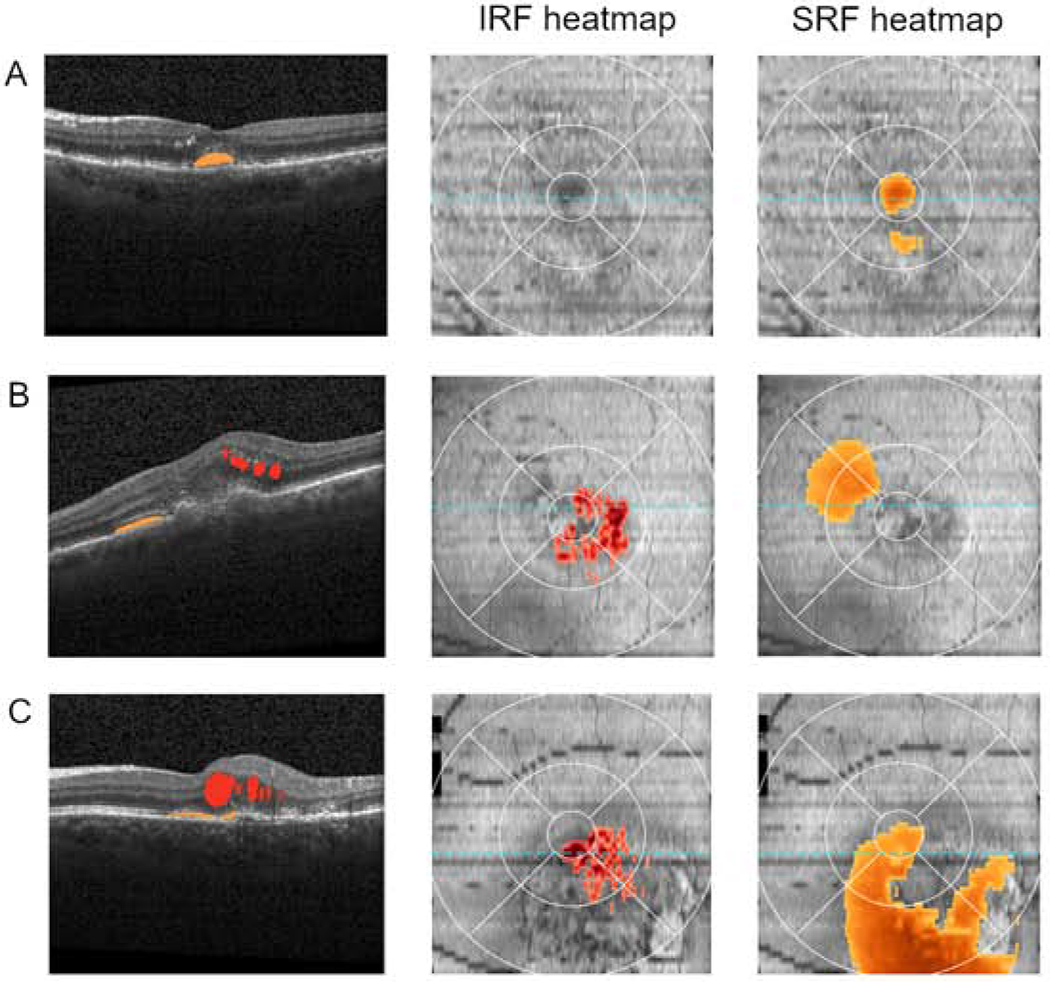
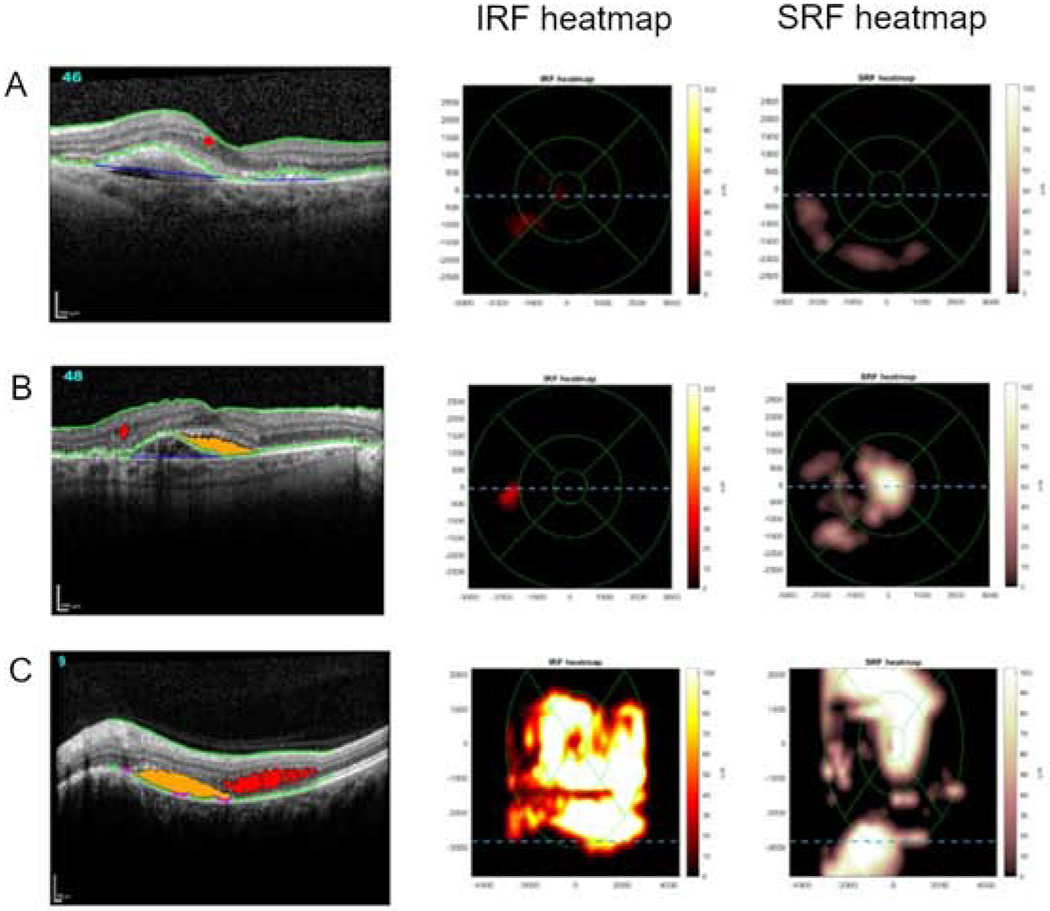
24,362 scans of 1,095 eyes (HARBOR); 4,673 of 880 (Belfast); 1,470 of 132 (Tel-Aviv); 511 of 511 (Age-Related Eye Disease Study 2 10-year Follow-On). ObservationProcedures: Vienna Fluid Monitor or Notal OCT Analyzer applied to macular cube scans. OutcomeMeasures: Intraretinal fluid (IRF), subretinal fluid (SRF), and pigment epithelial detachment (PED) volumes.
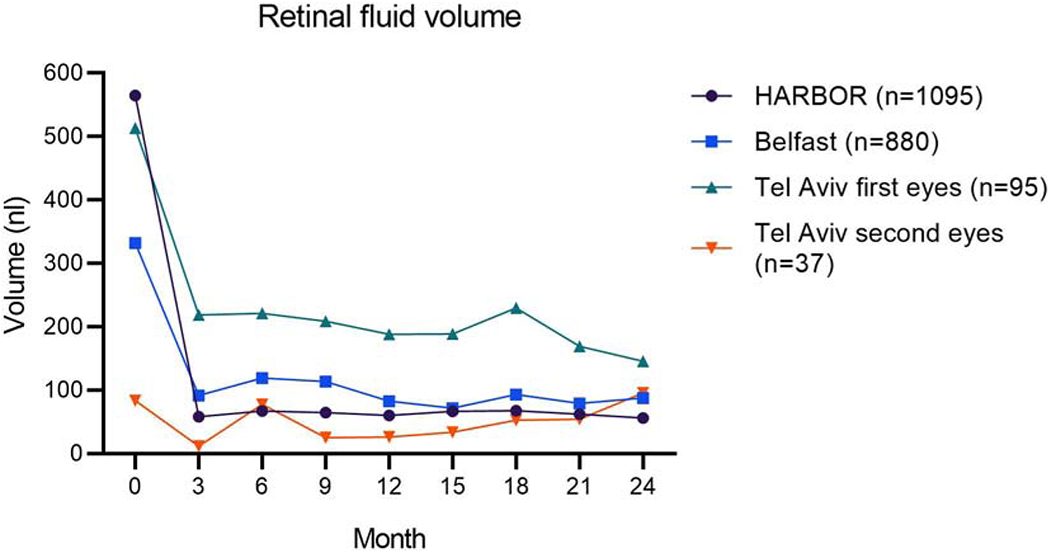
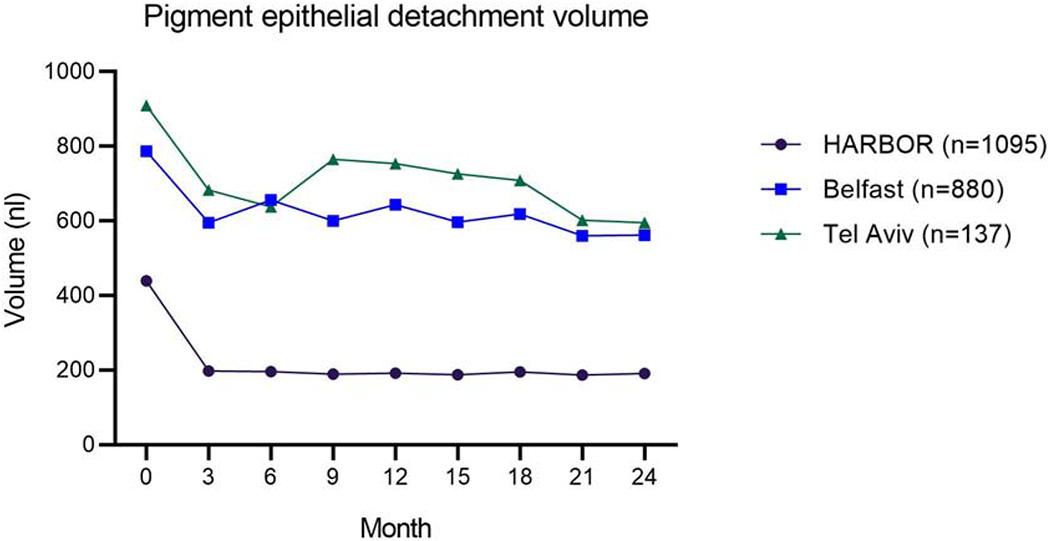
The fluid volumes measured in neovascular AMD were expressed efficiently in nanoliters. Large ranges that differed by population were observed at the treatment-naïve stage: 0-3,435 nL (IRF), 0-5,018 nL (SRF), and 0-10,022 nL (PED). Mean volumes decreased rapidly and consistently with anti-vascular endothelial growth factor therapy. During maintenance therapy, mean IRF volumes were highest in Tel-Aviv (100 nL), lower in Belfast and HARBOR-Pro Re Nata, and lowest in HARBOR-monthly (21 nL). Mean SRF volumes were low in all: 30 nL (HARBOR-monthly) and 48-49 nL (others).
Quantitative measures of IRF, SRF, and PED are important biomarkers in NV-AMD. Accurate volumes can be extracted efficiently from OCT scans by artificial intelligence algorithms to guide the treatment of exudative macular diseases. Automated fluid monitoring identifies fluid characteristics in different NV-AMD populations at baseline and during follow-up. For consistency between studies, we propose the nanoliter as a convenient unit. We explore the advantages of using these quantitative metrics in clinical practice and research.
评估通过人工智能算法从光学相干断层扫描(OCT)扫描中提取的视网膜液体积数据在治疗新生血管性年龄相关性黄斑变性(NV-AMD)中的作用。
前瞻性研究。
对来自不同临床环境的视网膜图像存储库数据集进行综述。
临床试验(HARBOR)及试验随访(年龄相关性眼病研究2 10年随访);真实世界研究(贝尔法斯特和特拉维夫三级中心)。
1095只眼的24362次扫描(HARBOR);880只眼中的4673次扫描(贝尔法斯特);132只眼中的1470次扫描(特拉维夫);511只眼中的511次扫描(年龄相关性眼病研究2 10年随访)。观察程序:将维也纳液体监测仪或诺塔尔OCT分析仪应用于黄斑区立方体扫描。观察指标:视网膜内液(IRF)、视网膜下液(SRF)和色素上皮脱离(PED)的体积。
新生血管性AMD中测量的液体积以纳升有效表示。在初治阶段观察到不同人群之间存在较大差异范围:0 - 3435纳升(IRF)、0 - 5018纳升(SRF)和0 - 10022纳升(PED)。抗血管内皮生长因子治疗后平均体积迅速且持续下降。在维持治疗期间,平均IRF体积在特拉维夫最高(100纳升),在贝尔法斯特和HARBOR - Pro Re Nata较低,在HARBOR - 每月治疗组最低(21纳升)。所有组的平均SRF体积都较低:30纳升(HARBOR - 每月治疗组)和48 - 49纳升(其他组)。
IRF、SRF和PED的定量测量是NV-AMD中的重要生物标志物。通过人工智能算法可从OCT扫描中有效提取准确的体积数据,以指导渗出性黄斑疾病的治疗。自动液体监测可识别不同NV-AMD人群在基线和随访期间的液体特征。为保证研究之间的一致性,我们建议将纳升作为一个方便的单位。我们探讨了在临床实践和研究中使用这些定量指标的优势。