Department of Environmental Health, 715 Albany Street, Boston University School of Public Health, Boston, MA, United States.
Department of Environmental Health, 715 Albany Street, Boston University School of Public Health, Boston, MA, United States.
Environ Int. 2021 Feb;147:106218. doi: 10.1016/j.envint.2020.106218. Epub 2020 Dec 21.
Numerous studies suggest that some phthalates have adverse reproductive effects. However, literature on the association between phthalates and incidence of uterine leiomyomata (UL) is limited and inconsistent, with no existing prospective studies.
We examined the association of urinary concentrations of phthalate and phthalate alternative biomarkers with UL incidence.
We conducted a case-cohort analysis within a subgroup of 754 participants in the Study of the Environment, Lifestyle, and Fibroids (SELF), a prospective cohort of premenopausal Black women aged 23-35 years who were recruited during 2010-2012. We quantified fourteen phthalates and two phthalate alternative [1,2-cyclohexane dicarboxylic acid, diisononyl ester (DINCH)] biomarkers in urine collected at baseline, 20 months, and 40 months. Transvaginal ultrasounds identified UL at baseline and every 20 months during 60 months of follow-up. We evaluated the individual biomarkers, molar sum of di(2-ethylhexyl) phthalate [ΣDEHP] and potency-weighted sum of anti-androgenic [WΣAA] biomarkers. We used Cox proportional hazards regression to estimate adjusted hazard ratios (HRs) and 95% confidence intervals (CIs) for the association between biomarkers and UL incidence. We then used quantile g-computation to examine joint associations of multiple phthalate biomarkers with UL incidence.
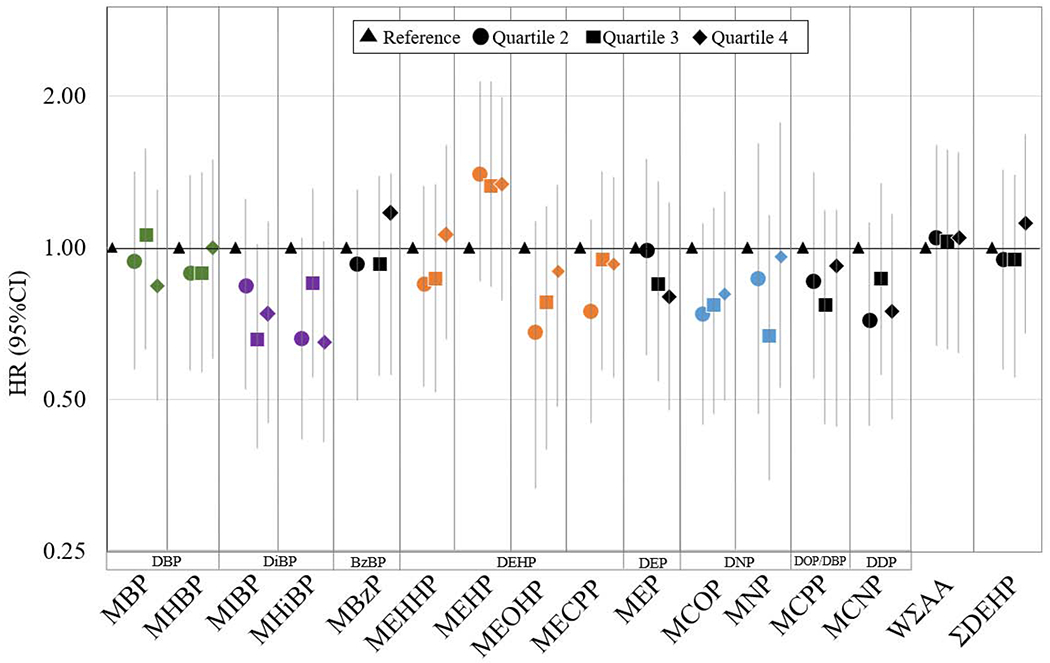
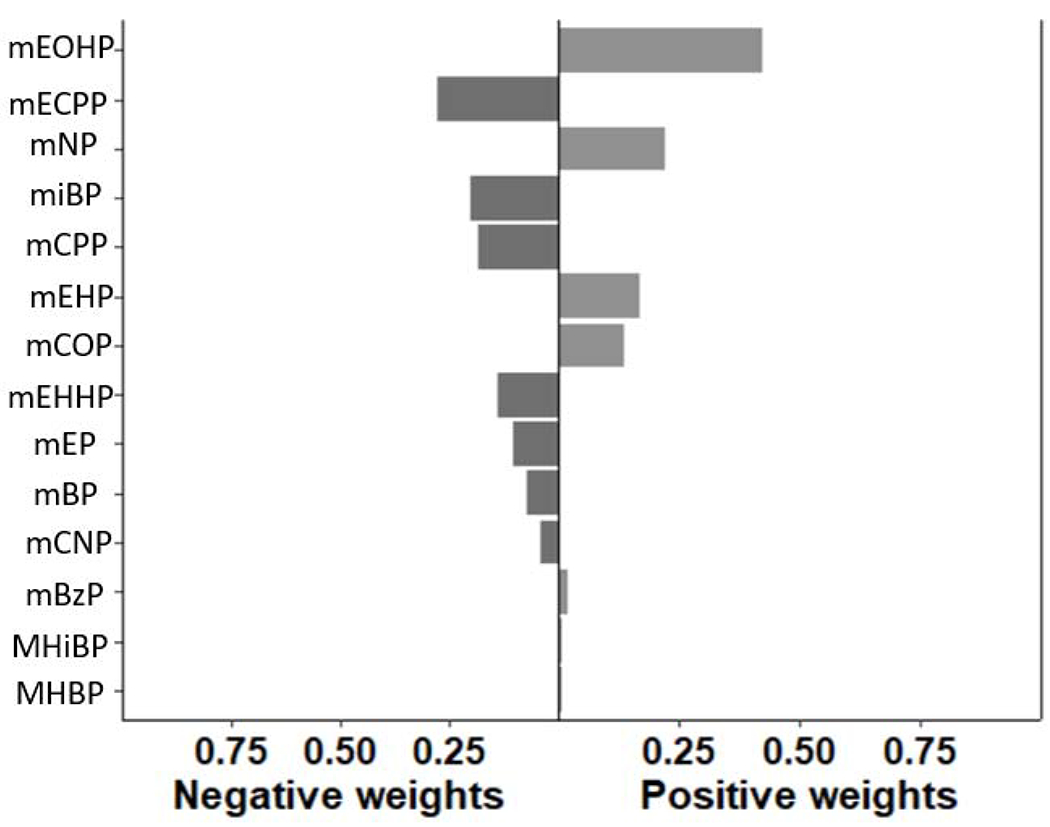
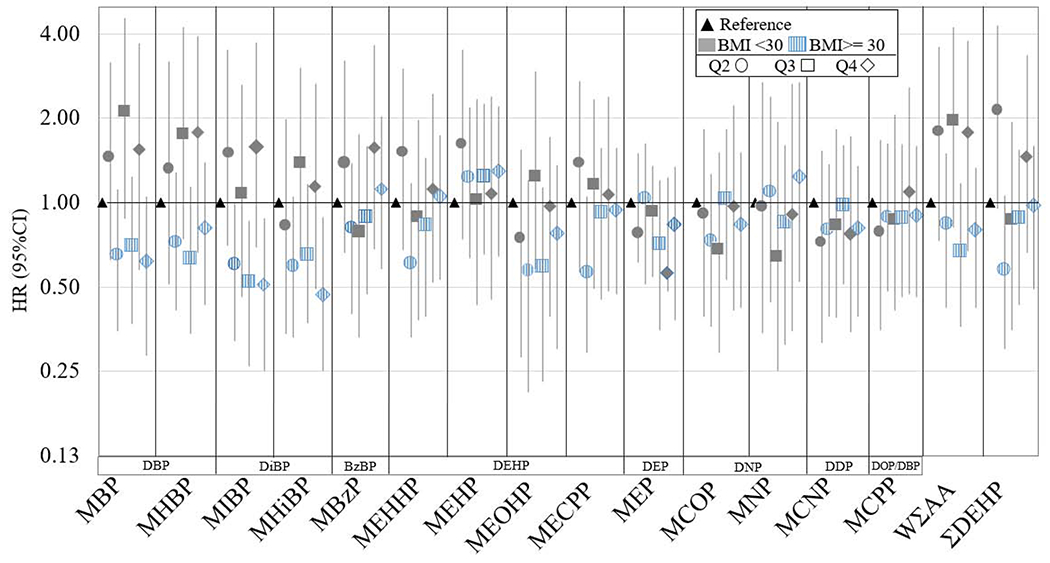
Most individual biomarkers showed weak-to-moderate inverse associations with UL incidence. HRs comparing highest vs. lowest quartiles of mono-isobutyl phthalate (MiBP) and mono-hydroxyisobutyl phthalate (MHiBP) concentrations were 0.63 (95% CI: 0.40, 1.01) and 0.61 (95% CI: 0.38, 0.96), respectively. Inverse associations for specific phthalates were stronger among women with BMI ≥ 30 kg/m. HRs comparing detectable vs. nondetectable concentrations of DINCH biomarkers were 0.92 (95% CI: 0.62, 1.35) for cyclohexane-1,2-dicarboxylic acid mono hydroxyisononyl ester (MHNCH) and 0.68 (95% CI: 0.38, 1.18) for cyclohexane-1,2-dicarboxylic acid mono carboxyisoocytl ester (MCOCH). For the DEHP metabolite of mono(2-ethylhexyl) phthalate (MEHP), we observed weak-to-moderate positive associations. HRs comparing highest vs. lowest quartiles for MEHP and ΣDEHP were 1.29 (95% CI: 0.82, 2.06) and 0.96 (95% CI: 0.61, 1.50), respectively. In the mixtures analysis, the HR for a joint quartile increase in phthalate biomarker concentrations was 0.90 (95% CI: 0.73, 1.08).
In this prospective ultrasound study of reproductive-aged Black women, urinary concentrations of phthalate and DINCH biomarkers were not appreciably associated with higher risk of UL, either individually or jointly.
许多研究表明,某些邻苯二甲酸酯类具有不良的生殖影响。然而,关于邻苯二甲酸酯类与子宫肌瘤(UL)发病率之间的关联的文献有限且不一致,没有现有的前瞻性研究。
我们研究了尿液中邻苯二甲酸酯和邻苯二甲酸酯替代生物标志物浓度与 UL 发病率之间的关联。
我们在环境、生活方式和纤维瘤研究(SELF)的一个亚组中进行了病例-队列分析,这是一个前瞻性队列,包括 23-35 岁的黑人绝经前女性,于 2010-2012 年招募。我们在基线、20 个月和 40 个月时采集尿液,以量化十四种邻苯二甲酸酯和两种邻苯二甲酸酯替代物[1,2-环己烷二羧酸,二异壬酯(DINCH)]生物标志物。阴道超声在基线和 60 个月的随访期间每 20 个月确定 UL 的发生情况。我们评估了个体生物标志物、邻苯二甲酸二(2-乙基己基)酯[ΣDEHP]摩尔总和和抗雄激素功效加权总和[WΣAA]生物标志物。我们使用 Cox 比例风险回归来估计生物标志物与 UL 发病率之间的关联的调整后危险比(HR)和 95%置信区间(CI)。然后,我们使用分位数 g 计算来检查多种邻苯二甲酸酯生物标志物与 UL 发病率的联合关联。
大多数个体生物标志物与 UL 发病率呈弱到中度的反比关系。与最高四分位数相比,单异丁基邻苯二甲酸酯(MiBP)和单羟异丁基邻苯二甲酸酯(MHiBP)浓度的 HR 分别为 0.63(95%CI:0.40,1.01)和 0.61(95%CI:0.38,0.96)。特定邻苯二甲酸酯的反比关系在 BMI≥30kg/m 的女性中更强。与可检测到的浓度相比,DINCH 生物标志物的 HR 分别为环己烷-1,2-二羧酸单羟基异壬酯(MHNCH)的 0.92(95%CI:0.62,1.35)和环己烷-1,2-二羧酸单羧基异辛酯(MCOCH)的 0.68(95%CI:0.38,1.18)。对于邻苯二甲酸二(2-乙基己基)酯的 MEHP 代谢物,我们观察到弱到中度的阳性关联。MEHP 和ΣDEHP 的最高四分位数与最低四分位数的 HR 分别为 1.29(95%CI:0.82,2.06)和 0.96(95%CI:0.61,1.50)。在混合物分析中,邻苯二甲酸酯生物标志物浓度联合四分位数增加的 HR 为 0.90(95%CI:0.73,1.08)。
在这项针对生殖年龄黑人女性的前瞻性超声研究中,尿液中邻苯二甲酸酯和 DINCH 生物标志物的浓度与 UL 风险增加没有明显关联,无论是单独还是联合。