Chang Tian-Tian, Li Zhe, Wang Xue-Qiang, Zhang Zhi-Jie
Department of Sport Rehabilitation, Shanghai University of Sport, Shanghai, China.
The First Clinical Medical School, Shaanxi University of Chinese Medicine, Xi'an, China.
Front Physiol. 2020 Dec 10;11:606706. doi: 10.3389/fphys.2020.606706. eCollection 2020.
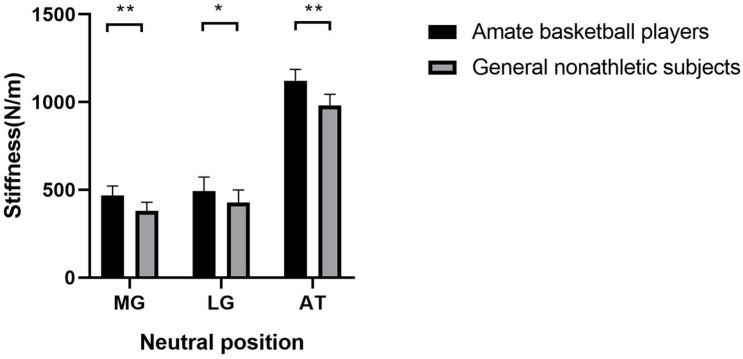
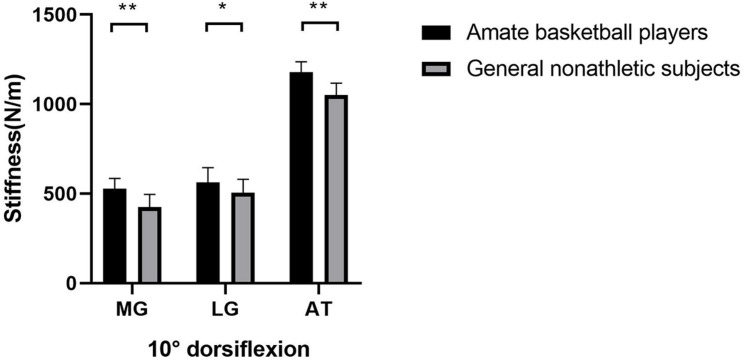
Muscle and tendon stiffness are related to sports performance, tendinopathy, and tendon degeneration. However, the effects of habitual loading on muscle and tendon mechanical properties are unclear. Using amateur basketball players as examples, we investigated the effects of mechanical loading on the stiffness of the gastrocnemius-Achilles tendon (AT) complex in non-dominant and dominant lower limbs. Then, we evaluated the correlation between gastrocnemius and AT stiffness. Forty participants (20 amateur basketball players; 20 normal non-athletic persons) were recruited for this study. Stiffness of the gastrocnemius-AT complex was assessed using MyotonPRO at neutral position and 10° dorsiflexion of the ankle joint in participants from amateur basketball players and the non-athletic general population. Our results showed a greater stiffness of the gastrocnemius-AT complex in amateur basketball players than that in healthy non-athletic subjects at neutral position and 10° dorsiflexion of the ankle joint ( < 0.05). No significant difference in stiffness was found between the non-dominant and dominant lower limbs either in amateur basketball players or in generally healthy subjects ( > 0.05). A significant positive correlation was obtained between stiffness of the AT and medial gastrocnemius (MG) in amateur basketball players (neutral position: = 0.726 and = 0.001; dorsiflexion 10°: = 0.687 and = 0.001). The amateur basketball players exhibit significantly higher stiffness value in Achilles and gastrocnemius. This is possibly caused by repeated training effects. The symmetric stiffness of the AT and gastrocnemius exists both in amateur basketball players and generally healthy subjects. A significant correlation between the AT and the MG was found in amateur basketball players.
肌肉和肌腱僵硬度与运动表现、肌腱病和肌腱退变相关。然而,习惯性负荷对肌肉和肌腱力学特性的影响尚不清楚。以业余篮球运动员为例,我们研究了机械负荷对非优势和优势下肢腓肠肌 - 跟腱(AT)复合体僵硬度的影响。然后,我们评估了腓肠肌和跟腱僵硬度之间的相关性。本研究招募了40名参与者(20名业余篮球运动员;20名正常非运动员)。使用MyotonPRO在踝关节中立位和背屈10°时评估业余篮球运动员和非运动员普通人群参与者的腓肠肌 - AT复合体僵硬度。我们的结果显示,在踝关节中立位和背屈10°时,业余篮球运动员的腓肠肌 - AT复合体僵硬度高于健康非运动员受试者(<0.05)。在业余篮球运动员或一般健康受试者中,非优势和优势下肢之间的僵硬度均未发现显著差异(>0.05)。在业余篮球运动员中,跟腱僵硬度与内侧腓肠肌(MG)僵硬度之间存在显著正相关(中立位:=0.726,=0.001;背屈10°:=0.687,=0.001)。业余篮球运动员的跟腱和腓肠肌僵硬度值显著更高。这可能是由重复训练效应引起的。业余篮球运动员和一般健康受试者的跟腱和腓肠肌僵硬度均呈对称分布。在业余篮球运动员中发现跟腱与内侧腓肠肌之间存在显著相关性。