Martí-García Celia, Fernández-Alcántara Manuel, Suárez López Patricia, Romero Ruiz Carolina, Muñoz Martín Rocío, Garcia-Caro Mᵃ Paz
Department of Nursing, University of Málaga, Málaga, Spain.
Mind, Brain and Behaviour Research Center (CIMCYC), University of Granada, Granada, Spain.
PeerJ. 2020 Dec 14;8:e10516. doi: 10.7717/peerj.10516. eCollection 2020.
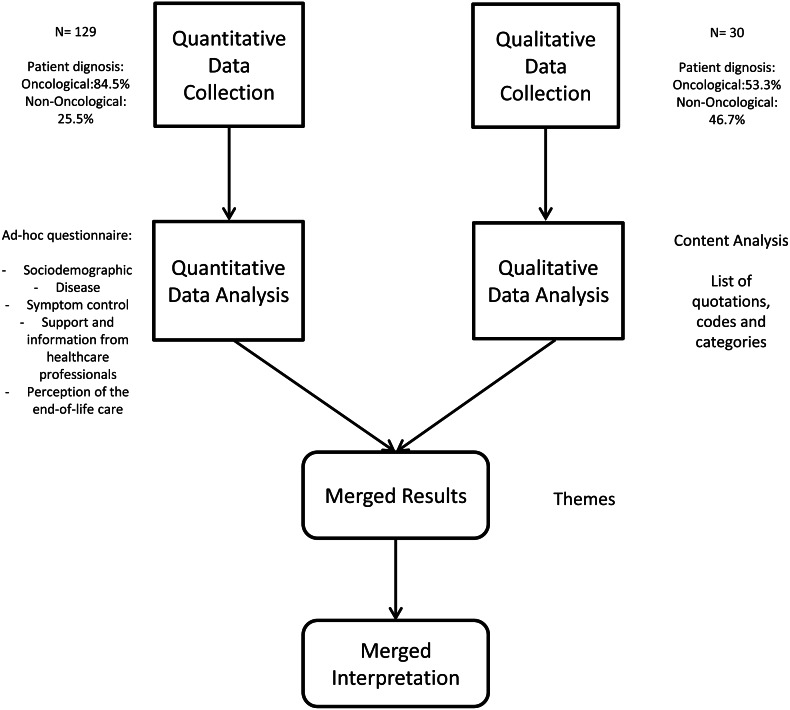
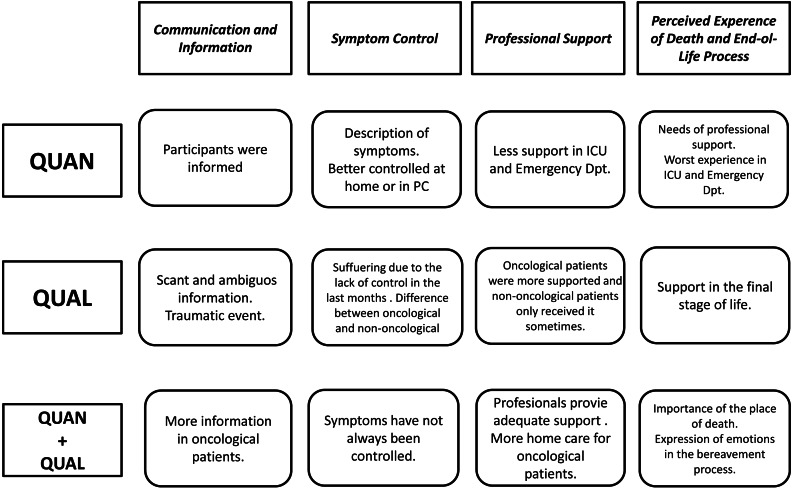
The aim of this study was to analyze the perceptions and experiences of relatives of patients dying from a terminal disease with regard to the care they received during the dying process, considering the oncological or non-oncological nature of the terminal disease, and the place where care was provided (at home, emergency department, hospital room, or palliative care unit). For this purpose, we conducted a mixed-methods observational study in which two studies were triangulated, one qualitative using semi-structured interviews ( = 30) and the other quantitative, using questionnaires ( = 129). The results showed that the perception of relatives on the quality of care was highly positive in the quantitative evaluation but more critical and negative in the qualitative interview. Experience of the support received and palliative measures was more positive for patients attended in hospital in the case of oncological patients but more positive for those attended at home in the case of non-oncological patients.
本研究的目的是分析终末期疾病患者亲属对于其在临终过程中所接受护理的看法和体验,同时考虑终末期疾病的肿瘤学或非肿瘤学性质,以及护理提供的场所(家中、急诊科、病房或姑息治疗单元)。为此,我们开展了一项混合方法的观察性研究,其中两项研究相互印证,一项定性研究采用半结构式访谈(n = 30),另一项定量研究采用问卷调查(n = 129)。结果显示,在定量评估中,亲属对护理质量的看法高度积极,但在定性访谈中则更为批判性和消极。对于肿瘤患者,在医院接受护理的患者所获得的支持和姑息治疗措施的体验更为积极;而对于非肿瘤患者,在家中接受护理的患者体验更为积极。