Tepsich Paola, Schettino Ilaria, Atzori Fabrizio, Azzolin Marta, Campana Ilaria, Carosso Lara, Cominelli Simone, Crosti Roberto, David Léa, Di-Méglio Nathalie, Frau Francesca, Gregorietti Martina, Mazzucato Veronica, Monaco Clara, Moulins Aurelie, Paraboschi Miriam, Pellegrino Giuliana, Rosso Massimiliano, Roul Marine, Saintignan Sébastien, Arcangeli Antonella
CIMA Research Foundation, Savona, Italy.
Department of Biology, University of Padua, Padova, Italy.
PeerJ. 2020 Dec 14;8:e10544. doi: 10.7717/peerj.10544. eCollection 2020.
The Mediterranean subpopulation of fin whale (Linnaeus, 1758) has recently been listed as Vulnerable by the IUCN Red List of threatened species. The species is also listed as species in need of strict protection under the Habitat Directive and is one of the indicators for the assessment of Good Environmental Status under the MSFD. Reference values on population abundance and trends are needed in order to set the threshold values and to assess the conservation status of the population.
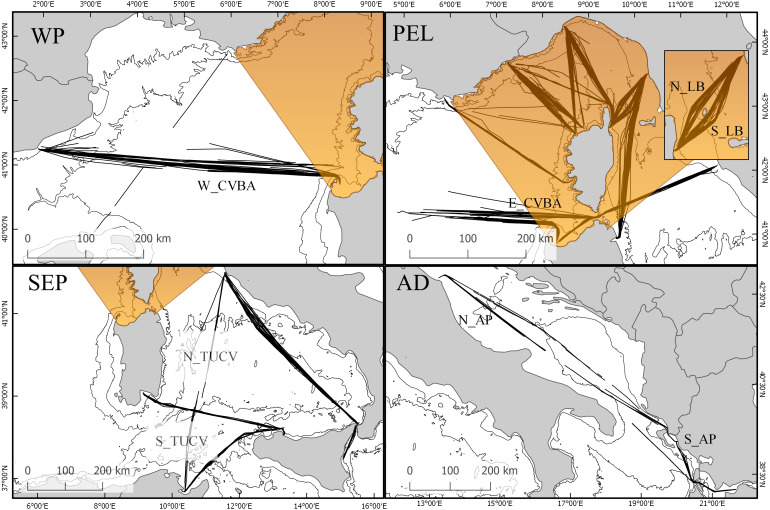
Yearly summer monitoring using ferries as platform of opportunity was performed since 2008 within the framework of the FLT Med Network. Data were collected along several fixed transects crossing the Western Mediterranean basin and the Adriatic and Ionian region. Species presence, expressed by density recorded along the sampled transects, was inspected for assessing interannual variability together with group size. Generalized Additive Models were used to describe density trends over a 11 years' period (2008-2018). A spatial multi-scale approach was used to highlight intra-basin differences in species presence and distribution during the years.
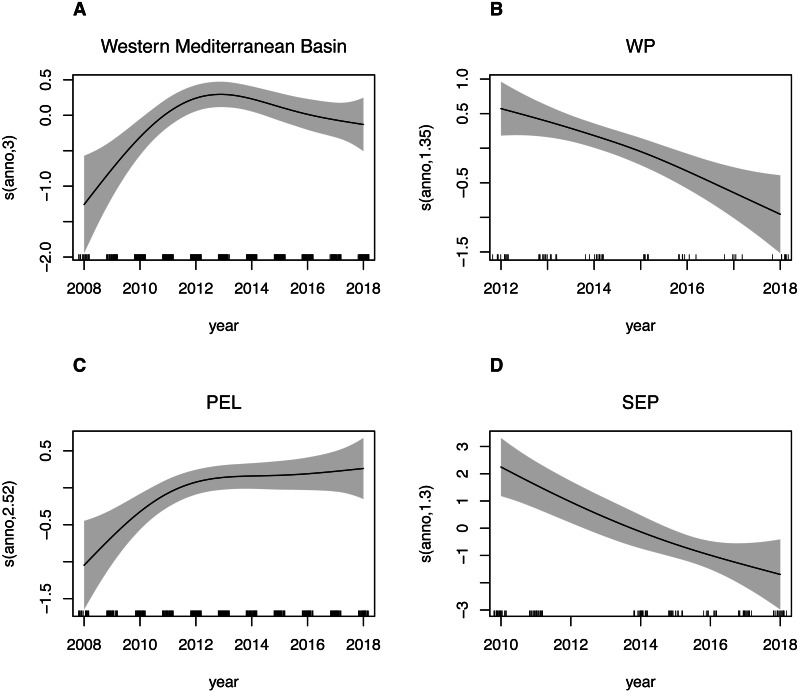
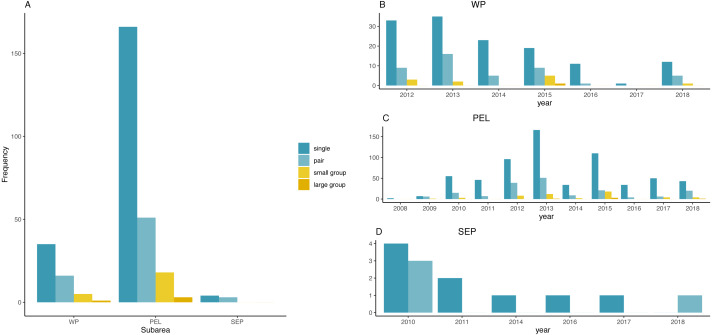
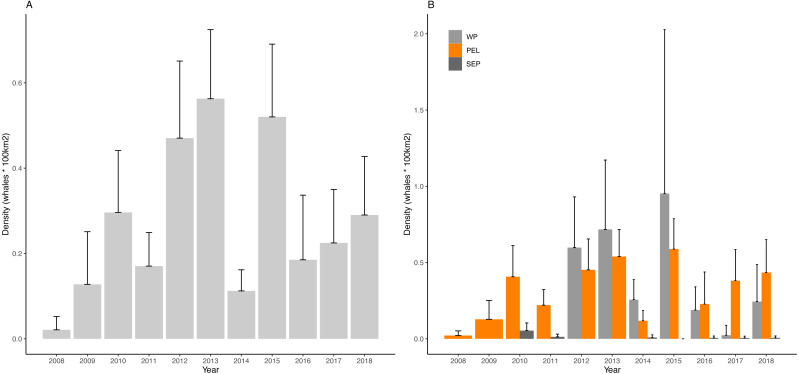
Summer presence of fin whales in the western Mediterranean area showed a strong interannual variability, characterized by the alternance of rich and poor years. Small and large groups of fin whales were sighted only during rich years, confirming the favorable feeding condition influencing species presence. Trends highlighted by the GAM can be summarized as positive from 2008 to 2013, and slightly negative from 2014 to 2018. The sub-areas analysis showed a similar pattern, but with a more stable trend during the second period in the Pelagos Sanctuary sub-area, and a negative one in the other two sub-areas. Our findings further confirm the need for an integrated approach foreseeing both, large scale surveys and yearly monitoring at different spatial scales to correct and interpret the basin wide abundance estimates, and to correlate spatial and temporal trends with the ecological and anthropogenic drivers.
长须鲸(Linnaeus,1758)的地中海亚种群最近被世界自然保护联盟濒危物种红色名录列为易危物种。该物种还被列为《栖息地指令》下需要严格保护的物种,并且是《海洋战略框架指令》下评估良好环境状况的指标之一。为了设定阈值并评估该种群的保护状况,需要种群丰度和趋势的参考值。
自2008年起,在FLT Med网络框架内,以渡轮为机会平台进行年度夏季监测。数据沿着穿过西地中海盆地以及亚得里亚海和爱奥尼亚地区的几条固定样带收集。通过沿采样样带记录的密度来表示物种的存在情况,同时检查群体大小以评估年际变化。使用广义相加模型来描述11年期间(2008 - 2018年)的密度趋势。采用空间多尺度方法来突出多年来该物种在盆地内存在和分布的差异。
西地中海地区长须鲸的夏季出现情况表现出强烈的年际变化,其特征是丰歉年份交替出现。只有在丰歉年份才会观察到小群体和大群体的长须鲸,这证实了有利的觅食条件会影响物种的出现。广义相加模型突出的趋势可概括为2008年至2013年为正,2014年至2018年略有负向。子区域分析显示了类似的模式,但在佩拉戈斯保护区子区域的第二个时期趋势更为稳定,而在其他两个子区域则为负向。我们的研究结果进一步证实了需要一种综合方法,既要进行大规模调查,又要在不同空间尺度上进行年度监测,以校正和解释整个盆地的丰度估计,并将空间和时间趋势与生态和人为驱动因素联系起来。