Abu-Farha Rana K, Alzoubi Karem H, Khabour Omar F
Department of Clinical Pharmacy and Therapeutics, Faculty of Pharmacy, Applied Science Private University, Amman, Jordan.
Department of Clinical Pharmacy, Jordan University of Science and Technology, Irbid 22110, Jordan.
Patient Prefer Adherence. 2020 Dec 14;14:2451-2458. doi: 10.2147/PPA.S284385. eCollection 2020.
The development and production of novel vaccine to prevent COVID-19 is an international imperative to human lives. For that purpose, clinical trials have to be carried out as per international ethical standards. The current study was undertaken to examine the willingness to participate in COVID-19 vaccine clinical trials and to determine factors that might affect their decision to participate.
A cross-sectional survey study was carried out among the public in Jordan. During the study period, a convenience sample of adults (aged 18 years or above) were asked to participate via an online self-administered survey that was designed to evaluate the willingness to participate in COVID-19 vaccine clinical trials and to determine factors affecting their decision to participate.
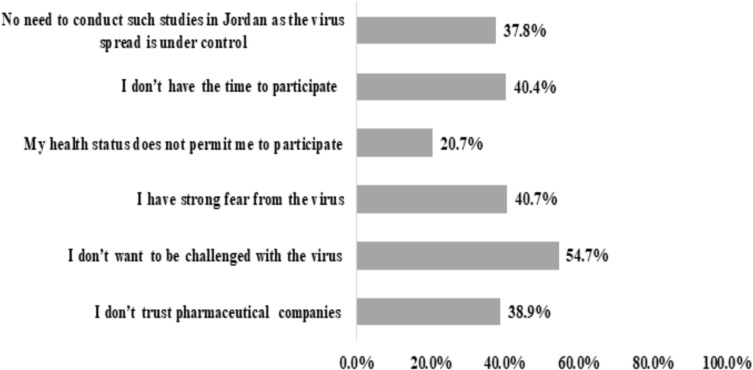
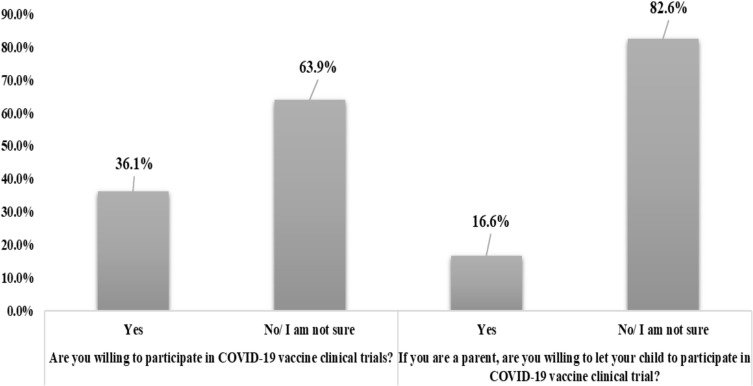
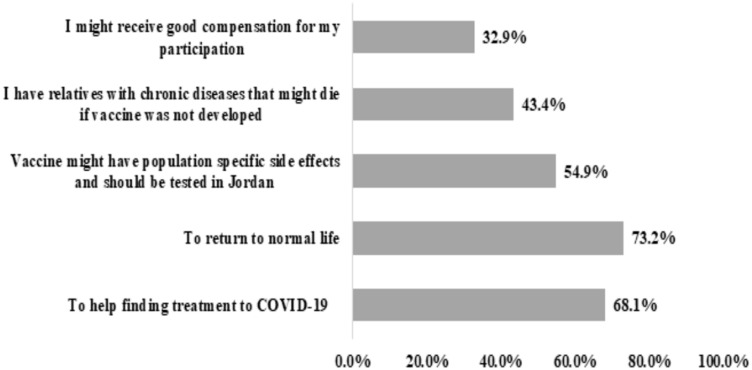
Results showed that, among participants (n=1,287), 36.1% reported to be willing to participate in clinical trials of the vaccine. Additionally, a lower percentage (18.1%) were willing to allow their children to participate. Motivators that encourage participation were the desire to return to normal life (73.2%), followed by the desire to help in finding a treatment for COVID-19 infection (68.1%). Barriers towards the participation were not wanting to be challenged by the virus (54.7%), fear (40.7%), lack of time (40.4%), and mistrust in pharmaceutical companies (38.9%). Finally, results showed that higher educational level was associated with lower willingness to participate (=0.001), whereas having a previous participation in clinical studies is associated with a significantly higher willingness to participate in COVID-19 vaccine clinical trials (<0.001).
A good portion of Jordanians are positive regarding participation in clinical studies of COVID-19 vaccine. Educational level and previous participation in clinical studies were among the determinants of such willingness. In addition, fear and lack of time were among the barriers of participation.
研发和生产新型新冠疫苗对人类生命而言是一项国际要务。为此,必须按照国际伦理标准开展临床试验。本研究旨在调查参与新冠疫苗临床试验的意愿,并确定可能影响其参与决策的因素。
在约旦公众中开展了一项横断面调查研究。在研究期间,通过一项在线自填式调查问卷邀请了一个便利样本的成年人(18岁及以上)参与,该问卷旨在评估参与新冠疫苗临床试验的意愿,并确定影响其参与决策的因素。
结果显示,在参与者(n = 1287)中,36.1%报告愿意参与该疫苗的临床试验。此外,愿意让其子女参与的比例较低(18.1%)。鼓励参与的因素是渴望恢复正常生活(73.2%),其次是渴望帮助找到新冠感染的治疗方法(68.1%)。参与的障碍包括不想受到病毒挑战(54.7%)、恐惧(40.7%)、缺乏时间(40.4%)以及对制药公司的不信任(38.9%)。最后,结果表明,受教育程度较高与参与意愿较低相关(=0.001),而此前参与过临床研究与参与新冠疫苗临床试验的意愿显著较高相关(<0.001)。
很大一部分约旦人对参与新冠疫苗临床研究持积极态度。教育程度和此前参与临床研究是这种意愿的决定因素。此外,恐惧和缺乏时间是参与的障碍。