Research and Development Solutions, Islamabad, Pakistan.
Ministry of National Health Services, Regulation and Coordination, Islamabad, Pakistan.
BMC Public Health. 2023 Jun 9;23(1):1112. doi: 10.1186/s12889-023-15905-3.
COVID-19 mass vaccination is the only hopeful savior to curb the pandemic. Vaccine distribution to achieve herd immunity is hindered by hesitance and negative attitude of the public against COVID-19 vaccination. This study aims to evaluate the vaccine hesitancy and attitudes in major cities in Pakistan as well as their determinants.
A cross-sectional telephonic survey was conducted in June 2021 in major cities of Pakistan including Karachi, Lahore, Islamabad, Peshawar, and Gilgit, from unvaccinated urban population aged 18 years or older. Random Digit Dialing through multi-stage stratified random sampling was used to ensure representation of each target city and socio-economic classes. Questionnaire collected information on socio-demographics, COVID-19-related experiences, risk perception of infection, and receptivity of COVID-19 vaccination. Multivariate logistic regression analyses were performed to identify key determinants of vaccine hesitancy and acceptance.
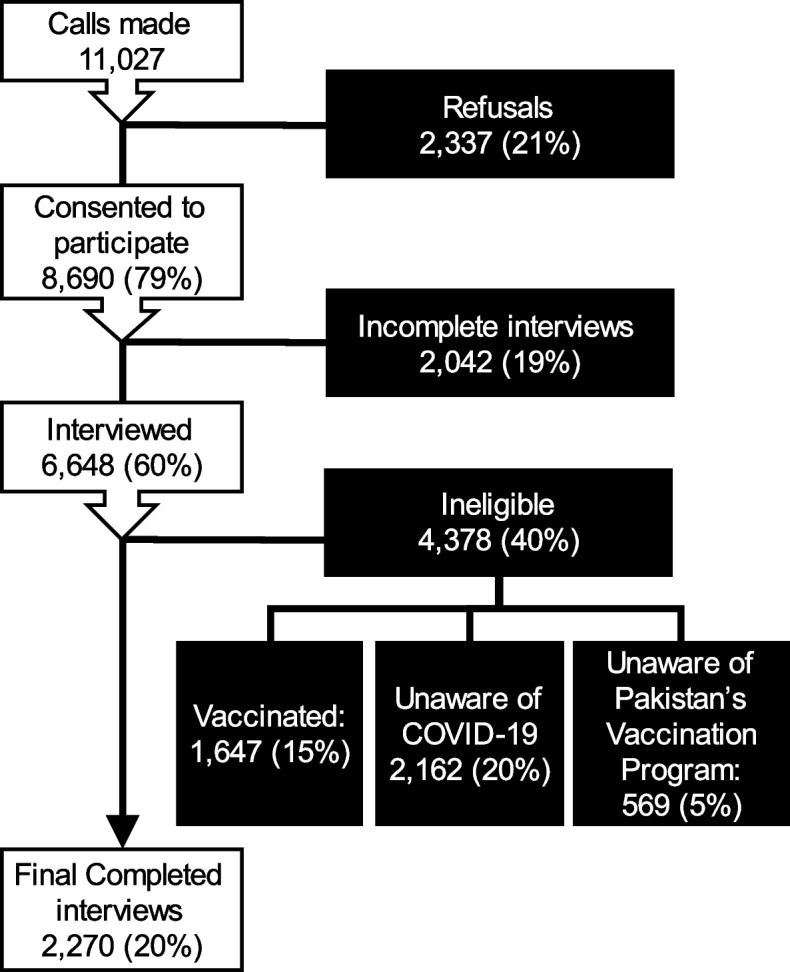
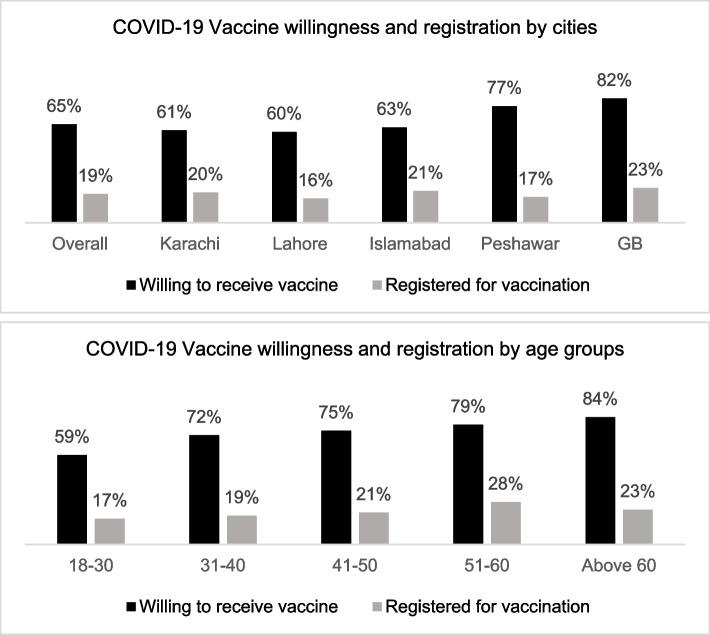
The prevalence of vaccinated population in this survey was 15%. Of the 2270 respondents, 65% respondents were willing to vaccinate, while only 19% were registered for vaccination. Factors significantly associated with vaccine willingness were older age (aOR: 6.48, 95% CI: 1.94-21.58), tertiary education (aOR: 2.02, 95% CI: 1.36, 3.01), being employed (aOR: 1.34, 95% CI: 1.01, 1.78), perceived risk of COVID-19 (aOR: 4.38, 95% CI: 2.70, 7.12), and higher compliance with standard operating procedures (aOR: 1.72, 95% CI: 1.26, 2.35). The most common vaccine hesitancy reasons were 'no need' (n = 284, 36%) and concerns with 'vaccine safety and side effects' (n = 251, 31%), while most reported vaccine motivation reasons were 'health safety' (n = 1029, 70%) and 'to end the pandemic' (n = 357, 24%).
Although our study found 35% hesitancy rate of COVID-19 vaccine, there were noticeable demographic differences that suggest tailored communication strategy to address concerns held by most hesitant subpopulation. Use of mobile vaccination facilities particularly for less mobile and disadvantaged, and implementation and evaluation of social mobilization strategy should be considered to increase overall COVID-19 vaccination acceptance and coverage.
新冠肺炎大规模疫苗接种是遏制这一大流行病的唯一希望。公众对接种新冠肺炎疫苗的犹豫和消极态度阻碍了疫苗的分发,以实现群体免疫。本研究旨在评估巴基斯坦主要城市的疫苗犹豫和态度及其决定因素。
2021 年 6 月,在巴基斯坦的主要城市(包括卡拉奇、拉合尔、伊斯兰堡、白沙瓦和吉尔吉特),采用多阶段分层随机抽样的方法,对未接种城市 18 岁及以上的人群进行了横断面电话调查。随机数字拨号法用于确保每个目标城市和社会经济阶层的代表性。调查问卷收集了与社会人口统计学、新冠肺炎相关经历、感染风险感知以及对新冠肺炎疫苗接种的接受度等信息。采用多变量逻辑回归分析确定疫苗犹豫和接受的关键决定因素。
本调查中接种疫苗人群的比例为 15%。在 2270 名受访者中,65%的受访者愿意接种疫苗,而只有 19%的人已登记接种疫苗。与接种意愿显著相关的因素是年龄较大(优势比:6.48,95%置信区间:1.94-21.58)、接受过高等教育(优势比:2.02,95%置信区间:1.36-3.01)、有工作(优势比:1.34,95%置信区间:1.01-1.78)、对新冠肺炎的感知风险(优势比:4.38,95%置信区间:2.70-7.12)和对标准操作程序的较高依从性(优势比:1.72,95%置信区间:1.26-2.35)。最常见的疫苗犹豫原因是“没必要”(n=284,36%)和“担心疫苗的安全性和副作用”(n=251,31%),而最常见的疫苗接种动机原因是“健康安全”(n=1029,70%)和“结束疫情”(n=357,24%)。
尽管我们的研究发现,新冠肺炎疫苗的犹豫率为 35%,但存在明显的人口统计学差异,这表明应制定有针对性的沟通策略,以解决大多数犹豫不决的人群所关注的问题。应考虑使用移动疫苗接种设施,特别是为行动不便和弱势群体提供服务,并实施和评估社会动员战略,以提高总体新冠肺炎疫苗接种率和覆盖率。