Lu Yang, Xie Duo, Zhang Xiaolei, Dong Sheng, Zhang Huifang, Yu Beibei, Wang Guihuai, Wang James Jin, Li Luming
Department of Neurosurgery, Beijing Tsinghua Changgung Hospital, School of Clinical Medicine, Tsinghua University, Beijing, China.
National Engineering Laboratory for Neuromodulation, School of Aerospace Engineering, Tsinghua University, Beijing, China.
Front Neurosci. 2020 Dec 8;14:594696. doi: 10.3389/fnins.2020.594696. eCollection 2020.
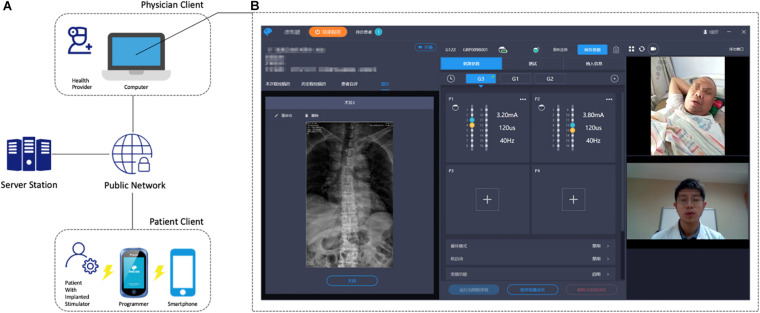
As COVID-19 rampages throughout the world and has a major impact on the healthcare system, non-emergency medical procedures have nearly come to a halt due to appropriate resource reallocation. However, pain never stops, particularly for patients with chronic intractable pain and implanted spinal cord stimulation (SCS) devices. The isolation required to fight this pandemic makes it impossible for such patients to adjust the parameters or configuration of the device on site. Although telemedicine has shown a great effect in many healthcare scenarios, there have been fewer applications of such technology focusing on the interaction with implanted devices. Here, we introduce the first remote and wireless programming system that enables healthcare providers to perform video-based real-time programming and palliative medicine for pain patients with a SCS implant. During the COVID-19 pandemic from January 23, 2020, the date of lockdown of Wuhan, to April 30, 2020, 34 sessions of remote programming were conducted with 16 patients. Thirteen of the 16 patients required programming for parameter optimization. Improvement was achieved with programming adjustment in 12 of 13 (92.3%) cases. Eleven of the 16 (68.8%) patients reported that the system was user-friendly and met their needs. Five patients complained of an unstable connection resulting from the low network speed initially, and three of these patients solved this problem. In summary, we demonstrated that a remote wireless programming system can deliver safe and effective programming operations of implantable SCS device, thereby providing palliative care of value to the most vulnerable chronic pain patients during a pandemic.
www.clinicaltrials.gov, identifier NCT03858790.
随着新冠疫情在全球肆虐并对医疗系统造成重大影响,由于进行了合理的资源重新分配,非紧急医疗程序几乎陷入停滞。然而,疼痛不会停止,尤其是对于患有慢性顽固性疼痛且植入了脊髓刺激(SCS)装置的患者。抗击疫情所需的隔离措施使这类患者无法在现场调整装置的参数或配置。尽管远程医疗在许多医疗场景中已显示出巨大效果,但专注于与植入装置交互的此类技术应用较少。在此,我们介绍首个远程无线编程系统,该系统使医疗服务提供者能够为植入SCS装置的疼痛患者进行基于视频的实时编程和姑息治疗。在2020年1月23日(武汉封城之日)至2020年4月30日的新冠疫情期间,对16例患者进行了34次远程编程。16例患者中有13例需要进行参数优化编程。在13例(92.3%)患者中,通过编程调整实现了改善。16例患者中有11例(68.8%)报告称该系统用户友好且满足他们的需求。5例患者最初抱怨因网络速度低导致连接不稳定,其中3例患者解决了这个问题。总之,我们证明了远程无线编程系统可以对可植入SCS装置进行安全有效的编程操作,从而在疫情期间为最脆弱的慢性疼痛患者提供有价值的姑息治疗。