Boldrini Tommaso, Tanzilli Annalisa, Di Cicilia Giuseppe, Gualco Ivan, Lingiardi Vittorio, Salcuni Silvia, Tata Maria Cristina, Vicari Stefano, Pontillo Maria
Department of Developmental Psychology and Socialization, University of Padua, Padua, Italy.
Department of Dynamic and Clinical Psychology, Sapienza University of Rome, Rome, Italy.
Front Psychiatry. 2020 Dec 8;11:562835. doi: 10.3389/fpsyt.2020.562835. eCollection 2020.
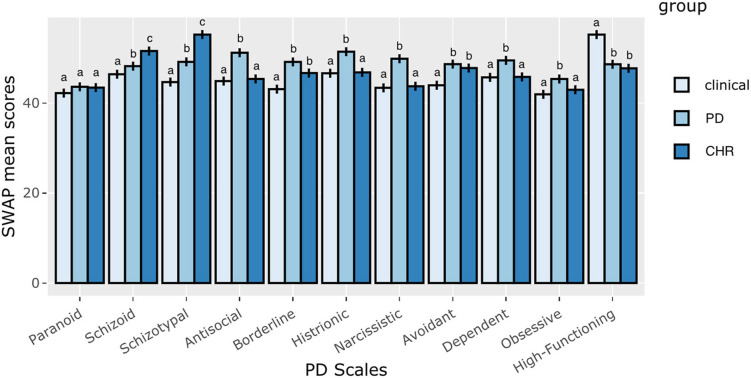
Recent meta-analytic data show that approximately 40% of individuals at clinical high risk for psychosis (CHR) receive at least one personality disorder (PD) diagnosis. Personality pathology could significantly influence CHR patients' prognosis and response to treatment. We aimed at exploring the PD traits of CHR adolescents, in order to outline a prototypic description of their most frequently observed personality characteristics. One hundred and twenty-three psychiatrists and psychologists used a Q-sort procedure [i.e., the Shedler-Westen Assessment Procedure-200 for Adolescents (SWAP-200-A)] to assess personality traits and disorders in 58 (30 male; mean age = 16 years, range = 13-19 years) CHR adolescents and two gender- and age-matched samples, respectively, with ( = 60) and without PDs ( = 59). Differences between the CHR, PD, and clinical groups showed that CHR adolescents had pervasive and more clinically relevant schizoid, schizotypal, borderline, and avoidant traits, as well as poorer adaptive functioning. Moreover, by collecting the highest mean SWAP-200-A items, we empirically outlined a prototypic description of CHR youths, comprised of avoidance of social relationships; suspiciousness; obsessional thoughts; lack of psychological insight; dysphoric and overwhelming feelings of anxiety and depression; odd and anomalous reasoning processes or perceptual experiences; symptoms of depersonalization and derealization; and negative symptoms of avolition, abulia, blunted affects, and impaired role functioning. The results suggest that avoidant interpersonal strategies, impaired mentalization, and difficulties in emotional regulation could become important targets for psychosocial interventions with CHR adolescent populations.
近期的荟萃分析数据显示,临床上有精神病高风险(CHR)的个体中,约40%至少被诊断患有一种人格障碍(PD)。人格病理学可能会显著影响CHR患者的预后及对治疗的反应。我们旨在探究CHR青少年的人格特质,以便勾勒出他们最常被观察到的人格特征的原型描述。123名精神科医生和心理学家采用Q分类程序[即青少年舍德勒-韦斯顿评估程序-200(SWAP-200-A)],分别对58名(30名男性;平均年龄 = 16岁,范围 = 13 - 19岁)CHR青少年以及两个年龄和性别匹配的样本(分别有60名患有人格障碍和59名未患人格障碍)的人格特质和障碍进行评估。CHR组、人格障碍组和临床组之间的差异表明,CHR青少年具有普遍且更具临床相关性的分裂样、分裂型、边缘型和回避型特质,以及较差的适应功能。此外,通过收集SWAP-200-A项目的最高平均得分,我们从经验上勾勒出了CHR青少年的原型描述,包括回避社交关系;多疑;强迫观念;缺乏心理洞察力;焦虑和抑郁的烦躁及压倒性情绪;奇怪和异常的推理过程或感知体验;人格解体和现实解体症状;以及意志缺乏、无动于衷、情感迟钝和角色功能受损等阴性症状。结果表明,回避性人际策略、心理化受损以及情绪调节困难可能成为针对CHR青少年群体进行心理社会干预的重要目标。