Shi Bin, Dong Xiaoheng, Ma Qingqing, Sun Suhong, Ma Long, Yu Jiang, Wang Xiaomei, Pan Juan, He Xiaoyan, Su Danhua, Yao Xinsheng
Department of Laboratory Medicine, Affiliated Hospital of Zunyi Medical University, Zunyi, China.
School of Laboratory Medicine, Zunyi Medical University, Zunyi, China.
Front Genet. 2020 Dec 8;11:524413. doi: 10.3389/fgene.2020.524413. eCollection 2020.
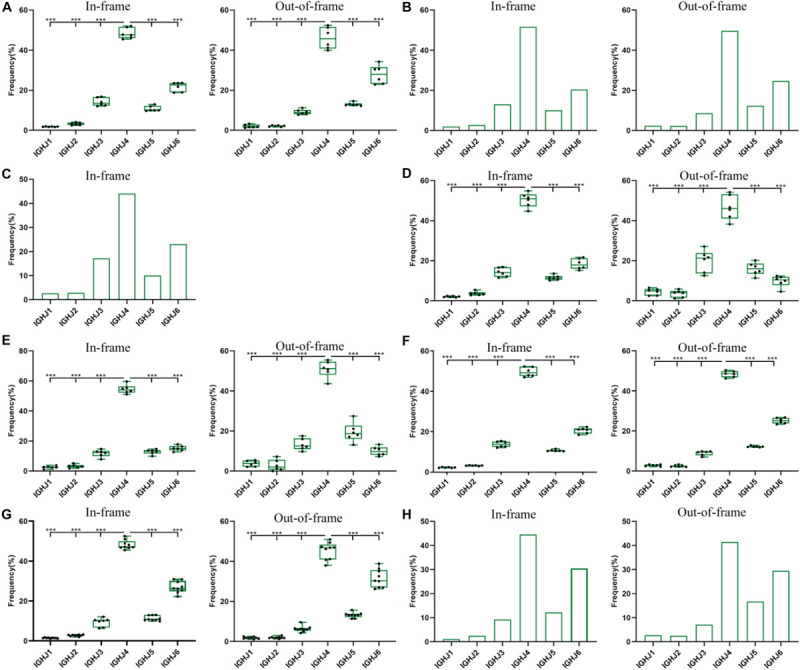
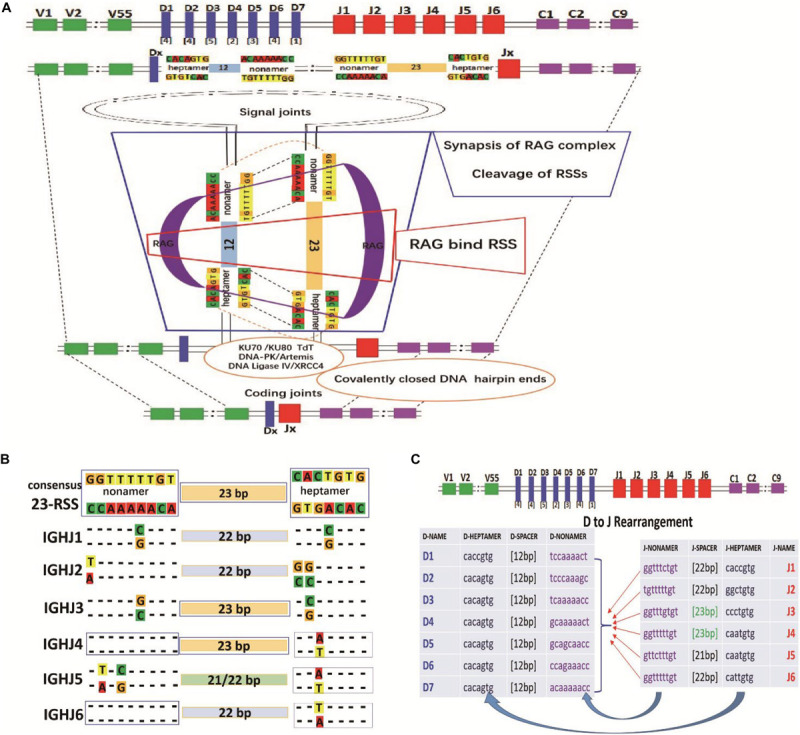
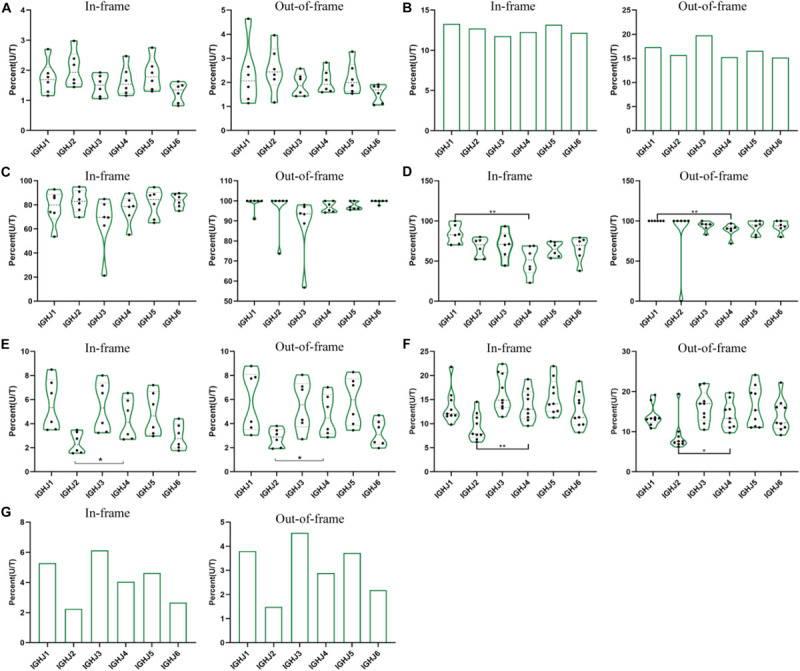
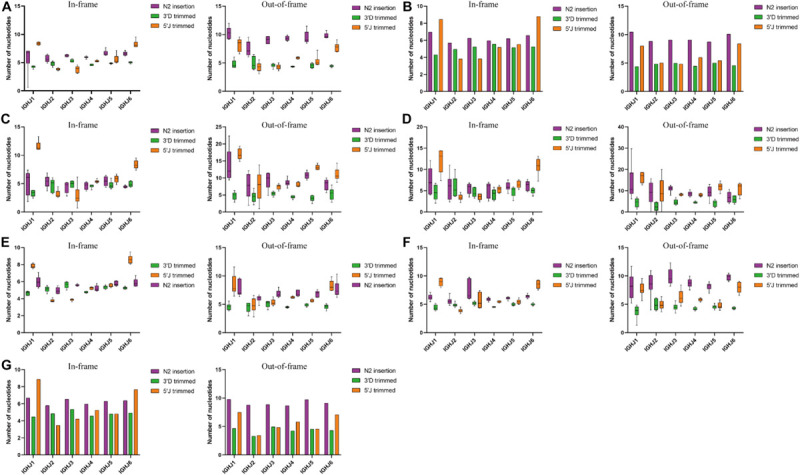
The formation of the B cell receptor (BCR) heavy chain variable region is derived from the germline V(D)J gene rearrangement according to the "12/23" rule and the "beyond 12/23" rule. The usage frequency of each V(D)J gene in the peripheral BCR repertoires is related to the initial recombination, self-tolerance selection, and the clonal proliferative response. However, their specific differences and possible mechanisms are still unknown. We analyzed in-frame and out-of-frame BCR-H repertoires from human samples with normal physiological and various pathological conditions by high-throughput sequencing. Our results showed that IGHJ gene frequency follows a similar pattern which is previously known, where IGHJ4 is used at high frequency (>40%), IGHJ6/IGHJ3/IGHJ5 is used at medium frequencies (10∼20%), and IGH2/IGHJ1 is used at low frequency (<4%) under whether normal physiological or various pathological conditions. However, our analysis of the recombination signal sequences suggested that the conserved non-amer and heptamer and certain 23 bp spacer length may affect the initial IGHD-IGHJ recombination, which results in different frequencies of IGHJ genes among the initial BCR-H repertoire. Based on this "initial repertoire," we recommend that re-evaluation and further investigation are needed when analyzing the significance and mechanism of IGHJ gene frequency in self-tolerance selection and the clonal proliferative response.
B细胞受体(BCR)重链可变区的形成源于种系V(D)J基因重排,遵循“12/23”规则和“超越12/23”规则。外周BCR库中每个V(D)J基因的使用频率与初始重组、自身耐受选择和克隆增殖反应有关。然而,它们的具体差异和可能机制仍不清楚。我们通过高通量测序分析了来自具有正常生理和各种病理状况的人类样本的框内和框外BCR-H库。我们的结果表明,IGHJ基因频率遵循一种先前已知的相似模式,即在正常生理或各种病理状况下,IGHJ4的使用频率较高(>40%),IGHJ6/IGHJ3/IGHJ5的使用频率中等(10%∼20%),IGH2/IGHJ1的使用频率较低(<4%)。然而,我们对重组信号序列的分析表明,保守的非amer和七聚体以及特定的23 bp间隔长度可能影响初始IGHD-IGHJ重组,这导致初始BCR-H库中IGHJ基因的频率不同。基于这种“初始库”,我们建议在分析IGHJ基因频率在自身耐受选择和克隆增殖反应中的意义和机制时,需要重新评估和进一步研究。