Aijaz Mir, Almanjahie Ibrahim M, Dar Javid Gani
Department of Mathematics, Govt. Degree College Kilam, Higher Education, J & K, India.
Department of Mathematics, College of Science, King Khalid University, Abha 62529, Saudi Arabia.
J Adv Res. 2020 May 25;28:1-6. doi: 10.1016/j.jare.2020.05.004. eCollection 2021 Feb.
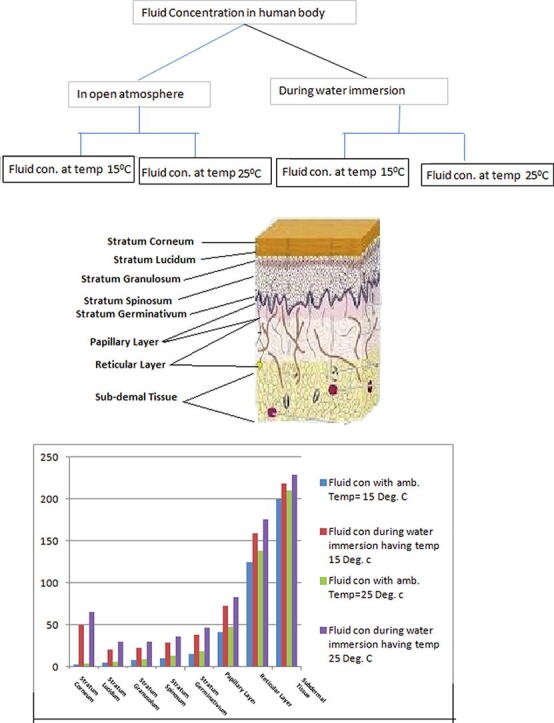
The concentration of fluid and its analysis in human skin is innately a challenge due to its continuous movement and involvement in maximum life processes. The concentration of the fluid gets affected by the diffusion of fluids through the skin, which acts as the main barrier between the human body and the external environment. Therefore, it becomes imperative to study the process and impact of the diffusion of fluids through the skin. The problem becomes more interesting when the human body is immersed in water.
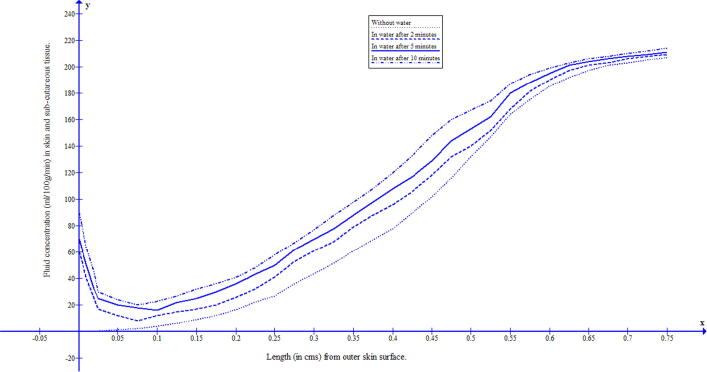
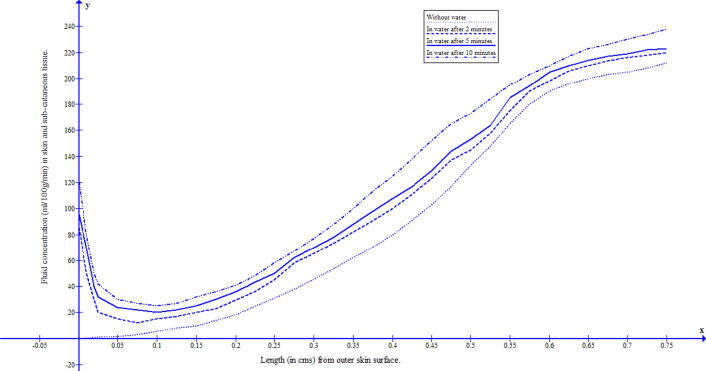
The present paper studies the change in the fluid distribution of human skin during its immersion in water of different temperatures. The application part of the paper visualizes various impaired vascular function and muscle soreness by water immersion during the physiotherapy treatment.
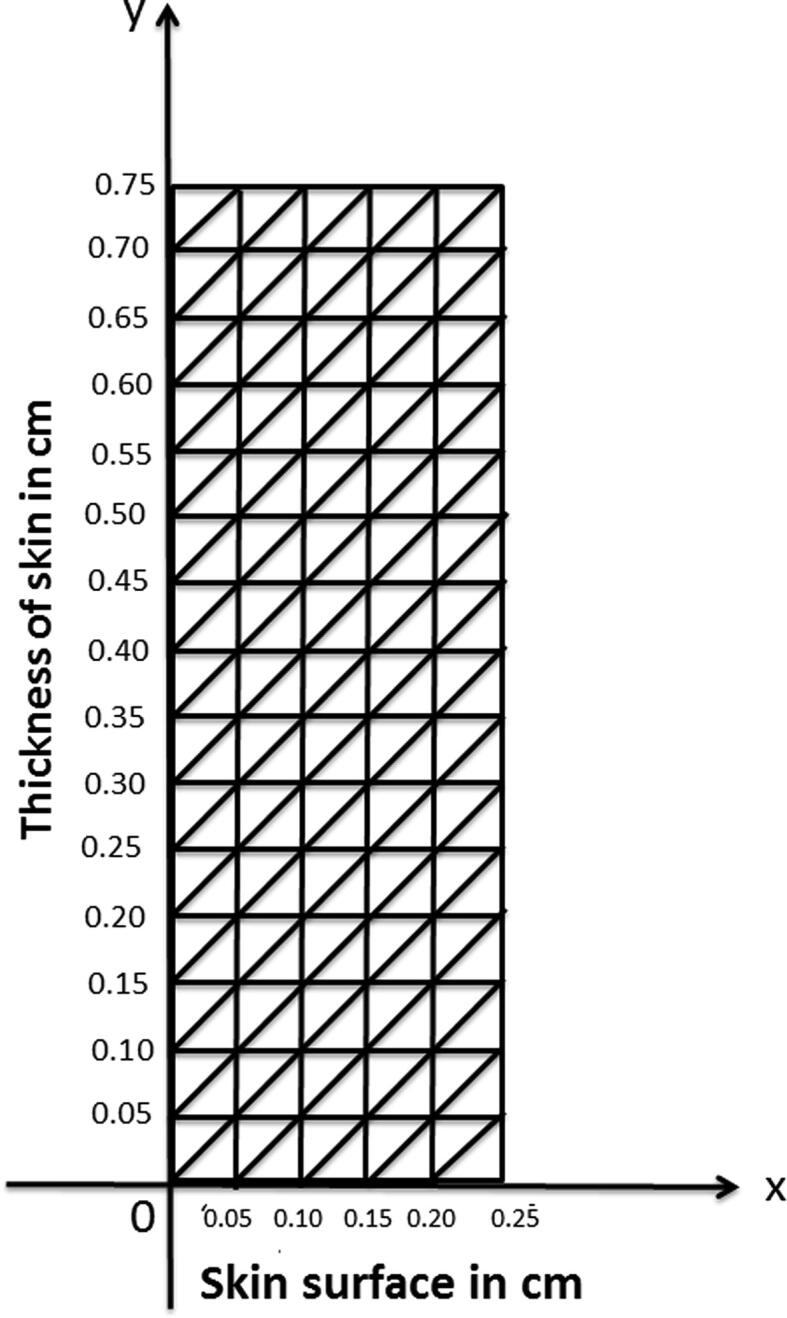
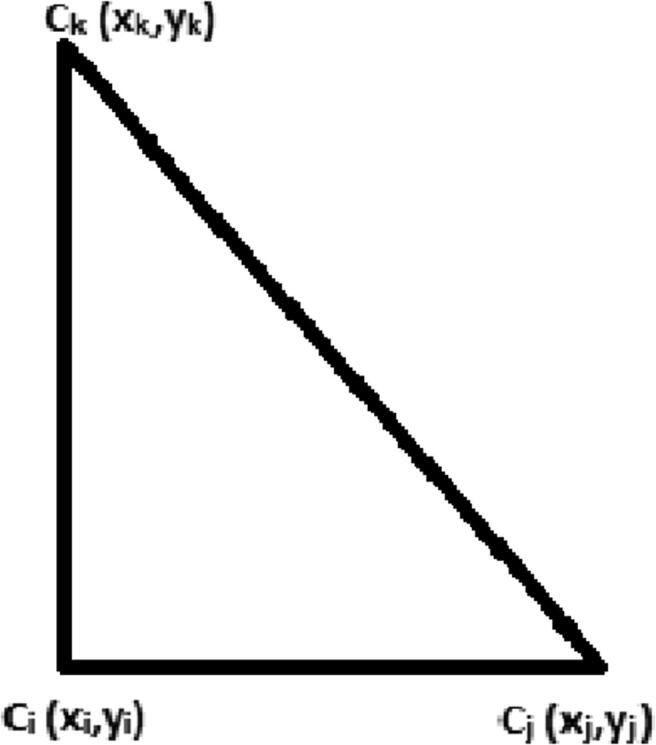
A mathematical model based on the two-dimensional diffusion equation, along with appropriate boundary conditions, has been formulated. The maximum of the relevant parameters, such as fluid regulation, transfer coefficient, evaporation rate, etc., influencing the fluid distribution, have been incorporated. The model has been solved by variational finite element method, and numerical results have been obtained by the Crank-Nicholson scheme.
The increase in fluid concentration due to treatment with cold and acute hot water immersion has been noted, and the role of water immersion in enhancing the recovery in exercise-induced muscular damage has been analyzed.
The paper addressed the issue of rate of water diffusion through human skin, which otherwise couldn't be drawn from the analogy of gas diffusion through the membrane due to the variation in permeabilities of the two processes. The paper has applications in water immersion therapies and other activities like monitoring swimming induced pulmonary edema, etc.
由于人体皮肤中的液体不断移动并参与众多生命过程,对其进行浓度分析本身就是一项挑战。液体浓度会受到液体透过皮肤扩散的影响,而皮肤是人体与外部环境之间的主要屏障。因此,研究液体透过皮肤扩散的过程及其影响就变得势在必行。当人体浸入水中时,这个问题就变得更有趣了。
本文研究人体皮肤浸入不同温度的水中时其液体分布的变化。本文的应用部分展示了物理治疗过程中通过水浸导致的各种血管功能受损和肌肉酸痛情况。
基于二维扩散方程并结合适当的边界条件建立了一个数学模型。纳入了影响液体分布的相关参数的最大值,如液体调节、传递系数、蒸发速率等。该模型通过变分有限元法求解,并采用克兰克 - 尼科尔森格式获得数值结果。
记录了因冷热水急性浸浴治疗导致的液体浓度增加情况,并分析了水浸在促进运动引起的肌肉损伤恢复中的作用。
本文探讨了水透过人体皮肤的扩散速率问题,由于这两个过程渗透率的差异,该问题无法从气体透过膜的扩散类比中得出。本文在水浸疗法以及其他活动中具有应用价值,如监测游泳引起的肺水肿等。