Wouters Hanneke J C M, van Zeventer Isabelle A, van der Klauw Melanie M, Wolffenbuttel Bruce H R, Huls Gerwin
Department of Hematology, University Medical Center Groningen, University of Groningen, Groningen, the Netherlands.
Department of Endocrinology, University Medical Center Groningen, University of Groningen, Groningen, the Netherlands.
Hemasphere. 2020 Dec 21;5(1):e503. doi: 10.1097/HS9.0000000000000503. eCollection 2021 Jan.
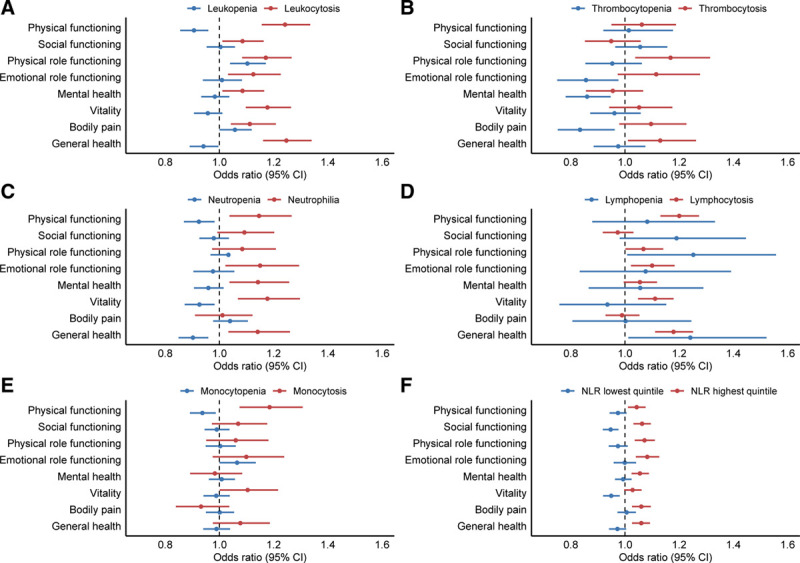
Complete blood cell counts, including differentials, are widely available and change on aging. Peripheral blood cell counts outside the normal range have previously been associated with increased mortality rates and a number of comorbid conditions. However, data about the association between blood cell count abnormalities, other than anemia, and health-related quality of life (HRQoL) are scarce. We investigated the association between abnormalities in (differential) blood cell counts and HRQoL in 143 191 community-dwelling individuals from the prospective population-based Lifelines cohort. HRQoL was measured using the RAND 36-Item Health Survey. Logistic regression analyses were used to determine the effect of blood cell count abnormalities on the odds of having a lower score than an age- and sex-specific reference value for each domain. Leukocytosis, neutrophilia, and a high neutrophil to lymphocyte ratio were associated with impaired HRQoL across multiple domains, both for younger and older (≥60 years) individuals. Using multivariable models, we confirmed that these associations were independent of the potential confounding factors obesity, smoking, alcohol use, number of medications (as a measure of comorbidity), anemia, and mean corpuscular volume. The impact on HRQoL was most pronounced for high neutrophil levels. Further, high white blood cell counts proved to be a better marker for inferior HRQoL as compared to elevated high-sensitivity C-reactive protein levels. Decreased HRQoL in several domains was also observed for individuals with monocytosis, lymphocytosis, and thrombocytosis. Taken together, the present study demonstrates an association between inflammatory and myeloid-skewed blood cell counts and inferior HRQoL in community-dwelling individuals.
全血细胞计数,包括分类计数,广泛可用且随年龄变化。此前,外周血细胞计数超出正常范围与死亡率增加及多种合并症相关。然而,关于除贫血外的血细胞计数异常与健康相关生活质量(HRQoL)之间关联的数据却很稀少。我们在基于人群的前瞻性生命线队列研究中的143191名社区居民中,调查了(分类)血细胞计数异常与HRQoL之间的关联。使用兰德36项健康调查来测量HRQoL。采用逻辑回归分析来确定血细胞计数异常对每个领域得分低于年龄和性别特异性参考值的几率的影响。白细胞增多、中性粒细胞增多以及高中性粒细胞与淋巴细胞比值与多个领域的HRQoL受损相关,无论对于年轻人还是老年人(≥60岁)都是如此。通过多变量模型,我们证实这些关联独立于潜在的混杂因素,如肥胖、吸烟、饮酒、用药数量(作为合并症的衡量指标)、贫血和平均红细胞体积。对HRQoL的影响在高中性粒细胞水平时最为明显。此外,与高敏C反应蛋白水平升高相比,高白细胞计数被证明是HRQoL较差的更好指标。单核细胞增多、淋巴细胞增多和血小板增多的个体在几个领域也观察到HRQoL下降。综上所述,本研究表明社区居民中炎症性和骨髓偏向性血细胞计数与较差的HRQoL之间存在关联。