Iida Yuko, Okamoto-Katsuyama Mayumi, Maruoka Shuichiro, Mizumura Kenji, Shimizu Tetsuo, Shikano Sotaro, Hikichi Mari, Takahashi Mai, Tsuya Kota, Okamoto Shinichi, Inoue Toshio, Nakanishi Yoko, Takahashi Noriaki, Masuda Shinobu, Hashimoto Shu, Gon Yasuhiro
Division of Respiratory Medicine, Department of Internal Medicine, Nihon University School of Medicine, Tokyo 173-8610, Japan.
Division of Oncologic Pathology, Department of Pathology and Microbiology, Nihon University School of Medicine, Tokyo 173-8610, Japan.
Oncol Lett. 2021 Jan;21(1):71. doi: 10.3892/ol.2020.12332. Epub 2020 Nov 25.
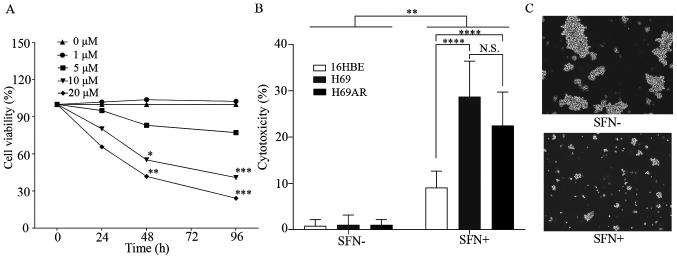
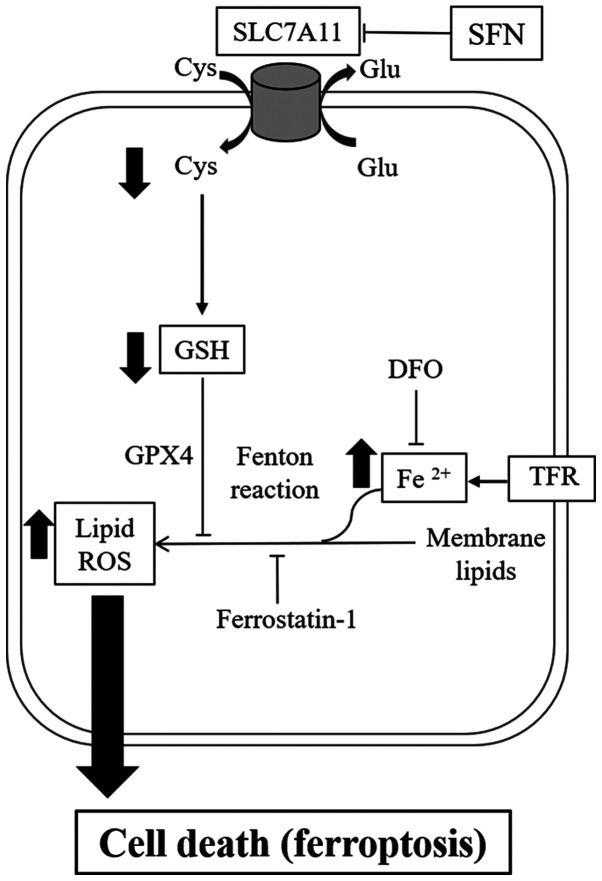
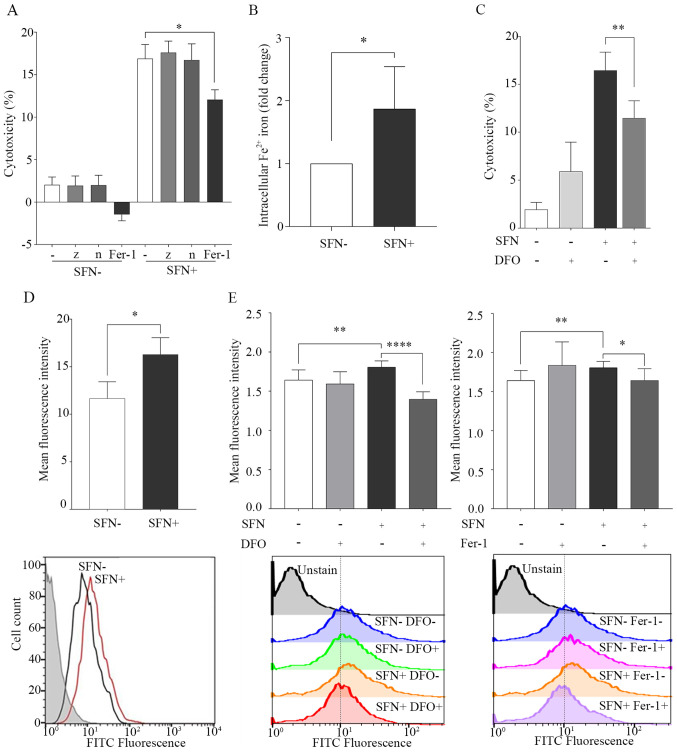
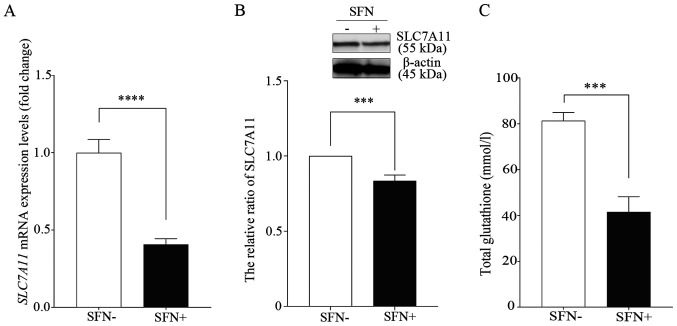
Small-cell lung cancer (SCLC) is a highly aggressive cancer with poor prognosis, due to a lack of therapeutic targets. Sulforaphane (SFN) is an isothiocyanate derived from cruciferous vegetables and has shown anticancer effects against numerous types of cancer. However, its anticancer effect against SCLC remains unclear. The present study aimed to demonstrate the anticancer effects of SFN in SCLC cells by investigating cell death (ferroptosis, necroptosis and caspase inhibition). The human SCLC cell lines NCI-H69, NCI-H69AR (H69AR) and NCI-H82 and the normal bronchial epithelial cell line, 16HBE14o- were used to determine cell growth and cytotoxicity, evaluate the levels of iron and glutathione, and quantify lipid peroxidation following treatment with SFN. mRNA expression levels of cystine/glutamate antiporter xCT , a key component of the cysteine/glutamate antiporter, were measured using reverse transcription-quantitative PCR, while the levels of SLC7A11 protein were measured using western blot analysis. Following the addition of SFN to the cell culture, cell growth was significantly inhibited, and cell death was shown in SCLC and multidrug-resistant H69AR cells. The ferroptotic effects of SFN were confirmed following culture with the ferroptosis inhibitor, ferrostatin-1, and deferoxamine; iron levels were elevated, which resulted in the accumulation of lipid reactive oxygen species. The mRNA and protein expression levels of SLC7A11 were significantly lower in SFN-treated cells compared with that in the control cells (P<0.0001 and P=0.0006, respectively). These results indicated that the anticancer effects of SFN may be caused by ferroptosis in the SCLC cells, which was hypothesized to be triggered from the inhibition of mRNA and protein expression levels of SLC7A11. In conclusion, the present study demonstrated that SFN-induced cell death was mediated via ferroptosis and inhibition of the mRNA and protein expression levels of SLC7A11 in SCLC cells. The anticancer effects of SFN may provide novel options for SCLC treatment.
小细胞肺癌(SCLC)是一种侵袭性很强且预后较差的癌症,原因是缺乏治疗靶点。萝卜硫素(SFN)是一种源自十字花科蔬菜的异硫氰酸盐,已显示出对多种癌症的抗癌作用。然而,其对小细胞肺癌的抗癌作用仍不清楚。本研究旨在通过研究细胞死亡(铁死亡、坏死性凋亡和半胱天冬酶抑制)来证明SFN对小细胞肺癌细胞的抗癌作用。使用人小细胞肺癌细胞系NCI-H69、NCI-H69AR(H69AR)和NCI-H82以及正常支气管上皮细胞系16HBE14o-来测定细胞生长和细胞毒性,评估铁和谷胱甘肽水平,并在SFN处理后定量脂质过氧化。使用逆转录定量PCR测量胱氨酸/谷氨酸反向转运体xCT(半胱氨酸/谷氨酸反向转运体的关键成分)的mRNA表达水平,同时使用蛋白质印迹分析测量SLC7A11蛋白的水平。在细胞培养物中添加SFN后,细胞生长受到显著抑制,并且在小细胞肺癌和多药耐药的H69AR细胞中出现细胞死亡。在用铁死亡抑制剂铁抑素-1和去铁胺培养后,证实了SFN的铁死亡作用;铁水平升高,导致脂质活性氧的积累。与对照细胞相比,SFN处理的细胞中SLC7A11的mRNA和蛋白质表达水平显著降低(分别为P<0.0001和P=0.0006)。这些结果表明SFN的抗癌作用可能是由小细胞肺癌细胞中的铁死亡引起的,推测这是由SLC7A11的mRNA和蛋白质表达水平受到抑制所触发的。总之,本研究表明SFN诱导的细胞死亡是通过铁死亡以及小细胞肺癌细胞中SLC7A11的mRNA和蛋白质表达水平受到抑制介导的。SFN的抗癌作用可能为小细胞肺癌的治疗提供新的选择。