Li Mingzhu, Zhao Yun, Qie Mingrong, Zhang Youzhong, Li Longyu, Lin Bei, Guo Ruixia, You Zhixue, An Ruifang, Liu Jun, Zhang Zhijun, Bi Hui, Hong Ying, Chang Shufang, He Guoli, Hua Keqin, Zhou Qi, Liao Qinping, Wang Yue, Wang Jianliu, Li Xiaoping, Wei Lihui
Department of Obstetrics and Gynecology, Peking University People's Hospital, Beijing, China.
Department of Obstetrics and Gynecology, West China Second Hospital of Sichuan University, Chengdu, China.
Front Med (Lausanne). 2020 Dec 7;7:538815. doi: 10.3389/fmed.2020.538815. eCollection 2020.
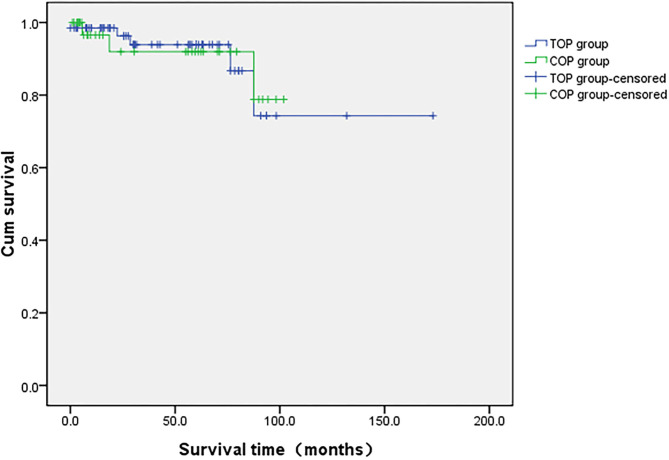
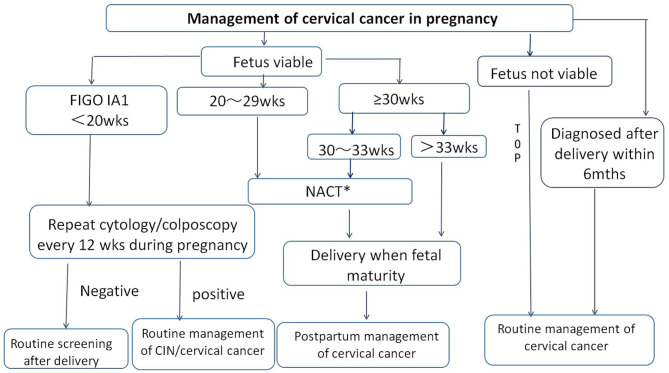
This retrospective multi-center study aimed to describe the epidemiological characteristics, clinical features, and management of patients with cervical cancer in pregnancy (CCIP) and evaluate maternal and infant outcomes. The data of patients with CCIP were retrospectively collected from those diagnosed and treated in 17 hospitals in 12 provinces in China between January 2009 and November 2017. The information retrieved included patients' age, clinical features of the tumor, medical management (during pregnancy or postpartum), obstetrical indicators (i.e., gestational age at diagnosis, delivery mode, and birth weight), and maternal and neonatal outcomes. Survival analyses were performed using Kaplan-Meier survival curves and log-rank tests that estimated the overall survival of patients. One-hundred and five women diagnosed with CCIP (median age = 35 years) were identified from ~45,600 cervical cancer patients (0.23%) and 525,000 pregnant women (0.020%). The median gestational age at cancer diagnosis was 20.0 weeks. The clinical-stage of 93.3% of the patients with CCIP was IB1, 81.9% visited the clinic because of vaginal bleeding during pregnancy, and 72.4% had not been screened for cervical cancer in more than 5 years. To analyze cancer treatments during pregnancy, patients were grouped into two groups, termination of pregnancy (TOP, = 67) and continuation of pregnancy (COP, = 38). Analyses suggested that the TOP group was more likely to be diagnosed at an earlier gestational stage than the COP group (14.8 vs. 30.8 weeks, < 0.001). The unadjusted hazard ratio for the COP group's overall survival was 1.063 times that of the TOP group (95% confidence interval = 0.24, 4.71). There were no significant differences between the TOP and COP groups in maternal survival ( = 0.964). Thirty-three of the infants of patients with CCIP were healthy at the end of the follow-up period, with a median age of 18 ± 2.8 months. Most patients with CCIP had not been screened for cervical cancer in over 5 years. The oncologic outcomes of the TOP and COP groups were similar. A platinum-based neoadjuvant chemotherapy regimen could be a favorable choice for the management of CCIP during the second and third trimesters of pregnancy.
这项回顾性多中心研究旨在描述妊娠合并宫颈癌(CCIP)患者的流行病学特征、临床特征及治疗情况,并评估母婴结局。回顾性收集了2009年1月至2017年11月期间在中国12个省份17家医院诊断和治疗的CCIP患者的数据。收集的信息包括患者年龄、肿瘤临床特征、医疗管理(孕期或产后)、产科指标(即诊断时的孕周、分娩方式和出生体重)以及母婴结局。采用Kaplan-Meier生存曲线和对数秩检验进行生存分析,以估计患者的总生存期。在约45600例宫颈癌患者(0.23%)和525000例孕妇(0.020%)中,确诊105例CCIP患者(中位年龄 = 35岁)。癌症诊断时的中位孕周为20.0周。93.3%的CCIP患者临床分期为IB1期,81.9%的患者因孕期阴道出血就诊,72.4%的患者超过5年未进行宫颈癌筛查。为分析孕期癌症治疗情况,将患者分为两组,即终止妊娠组(TOP,n = 67)和继续妊娠组(COP,n = 38)。分析表明,TOP组比COP组更可能在更早的孕周被诊断(14.8 vs. 30.8周,P < 0.001)。COP组总生存期的未调整风险比是TOP组的1.063倍(95%置信区间 = 0.24,4.71)。TOP组和COP组的孕产妇生存率无显著差异(P = 0.964)。随访期末,33例CCIP患者的婴儿健康,中位年龄为18 ± 2.8个月。大多数CCIP患者超过5年未进行宫颈癌筛查。TOP组和COP组的肿瘤学结局相似。铂类新辅助化疗方案可能是妊娠中晚期CCIP治疗的理想选择。