Centre for Statistics in Medicine, Nuffield Department of Orthopaedics, Rheumatology, and Musculoskeletal Sciences (NDORMS), University of Oxford, Oxford, UK.
Janssen Research and Development, Titusville, NJ, USA.
Rheumatology (Oxford). 2021 Jul 1;60(7):3222-3234. doi: 10.1093/rheumatology/keaa771.
Concern has been raised in the rheumatology community regarding recent regulatory warnings that HCQ used in the coronavirus disease 2019 pandemic could cause acute psychiatric events. We aimed to study whether there is risk of incident depression, suicidal ideation or psychosis associated with HCQ as used for RA.
We performed a new-user cohort study using claims and electronic medical records from 10 sources and 3 countries (Germany, UK and USA). RA patients ≥18 years of age and initiating HCQ were compared with those initiating SSZ (active comparator) and followed up in the short (30 days) and long term (on treatment). Study outcomes included depression, suicide/suicidal ideation and hospitalization for psychosis. Propensity score stratification and calibration using negative control outcomes were used to address confounding. Cox models were fitted to estimate database-specific calibrated hazard ratios (HRs), with estimates pooled where I2 <40%.
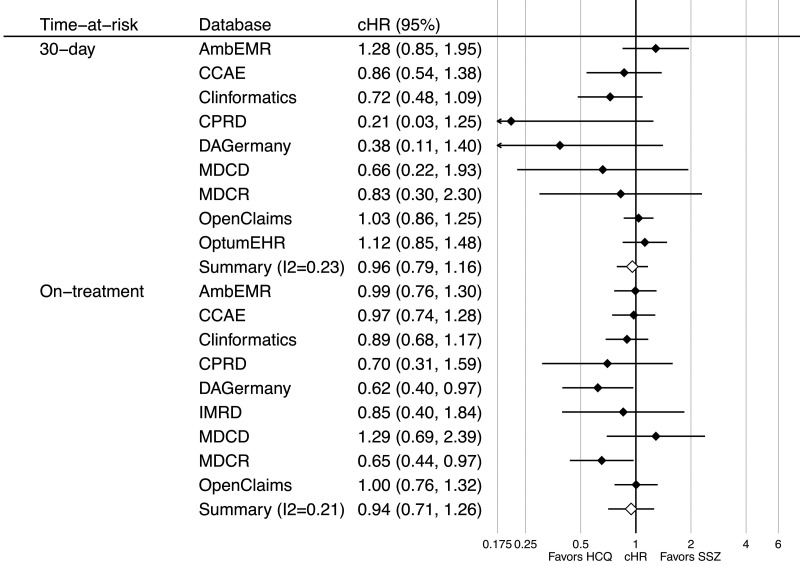
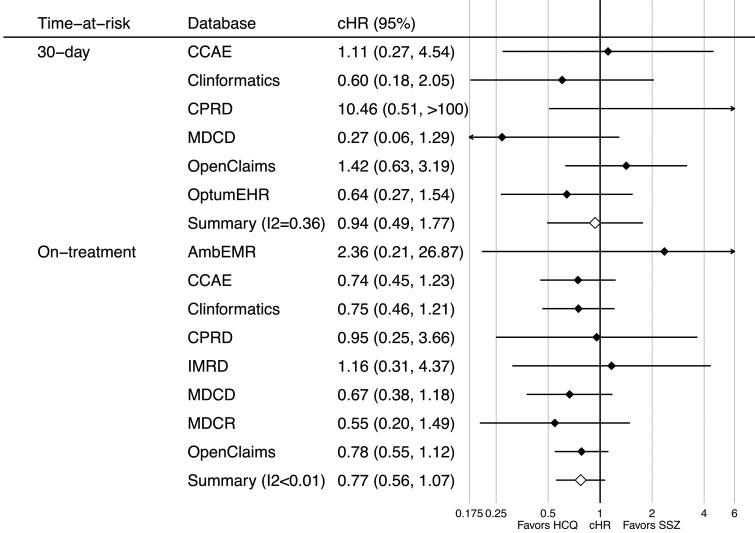
A total of 918 144 and 290 383 users of HCQ and SSZ, respectively, were included. No consistent risk of psychiatric events was observed with short-term HCQ (compared with SSZ) use, with meta-analytic HRs of 0.96 (95% CI 0.79, 1.16) for depression, 0.94 (95% CI 0.49, 1.77) for suicide/suicidal ideation and 1.03 (95% CI 0.66, 1.60) for psychosis. No consistent long-term risk was seen, with meta-analytic HRs of 0.94 (95% CI 0.71, 1.26) for depression, 0.77 (95% CI 0.56, 1.07) for suicide/suicidal ideation and 0.99 (95% CI 0.72, 1.35) for psychosis.
HCQ as used to treat RA does not appear to increase the risk of depression, suicide/suicidal ideation or psychosis compared with SSZ. No effects were seen in the short or long term. Use at a higher dose or for different indications needs further investigation.
Registered with EU PAS (reference no. EUPAS34497; http://www.encepp.eu/encepp/viewResource.htm? id=34498). The full study protocol and analysis source code can be found at https://github.com/ohdsi-studies/Covid19EstimationHydroxychloroquine2.
风湿病学界对最近的监管警告表示担忧,即用于 2019 年冠状病毒病大流行的羟氯喹可能导致急性精神事件。我们旨在研究羟氯喹用于治疗类风湿关节炎是否与抑郁、自杀意念或精神病的发病风险相关。
我们使用来自德国、英国和美国的 10 个来源和 3 个国家的索赔和电子病历进行了一项新用户队列研究。比较了年龄≥18 岁并开始使用羟氯喹的类风湿关节炎患者与开始使用柳氮磺胺吡啶(活性对照)的患者,并在短期(30 天)和长期(治疗期间)进行随访。研究结果包括抑郁、自杀/自杀意念和精神病住院。使用阴性对照结果进行倾向评分分层和校准,以解决混杂问题。使用 Cox 模型估计数据库特定的校准风险比(HR),当 I2<40%时进行合并估计。
共纳入 918144 例羟氯喹使用者和 290383 例柳氮磺胺吡啶使用者。短期使用羟氯喹(与柳氮磺胺吡啶相比)并未观察到精神事件的一致风险,抑郁的荟萃分析 HR 为 0.96(95%CI 0.79,1.16),自杀/自杀意念为 0.94(95%CI 0.49,1.77),精神病为 1.03(95%CI 0.66,1.60)。未观察到一致的长期风险,抑郁的荟萃分析 HR 为 0.94(95%CI 0.71,1.26),自杀/自杀意念为 0.77(95%CI 0.56,1.07),精神病为 0.99(95%CI 0.72,1.35)。
与柳氮磺胺吡啶相比,用于治疗类风湿关节炎的羟氯喹似乎不会增加抑郁、自杀/自杀意念或精神病的风险。短期或长期均未见影响。需要进一步研究更高剂量或不同适应症的使用。
在欧盟 PAS 中注册(参考编号 EUPAS34497;http://www.encepp.eu/encepp/viewResource.htm?id=34498)。完整的研究方案和分析源代码可在 https://github.com/ohdsi-studies/Covid19EstimationHydroxychloroquine2 上找到。