
慢性肌筋膜疼痛综合征患者拉伸运动的最佳持续时间:一项随机对照试验。
Optimal duration of stretching exercise in patients with chronic myofascial pain syndrome: A randomized controlled trial.
机构信息
Department of Physiotherapy, College of Health Sciences, University of Sharjah, Sharjah, United Arab Emirates.
出版信息
J Rehabil Med. 2021 Jan 11;53(1):jrm00142. doi: 10.2340/16501977-2781.
OBJECTIVE
To explore the effect of variable durations of stretching on neural function, pain, and algometric pressure in patients with chronic myofascial pain syndrome.
DESIGN
Randomized controlled trial.
PATIENTS
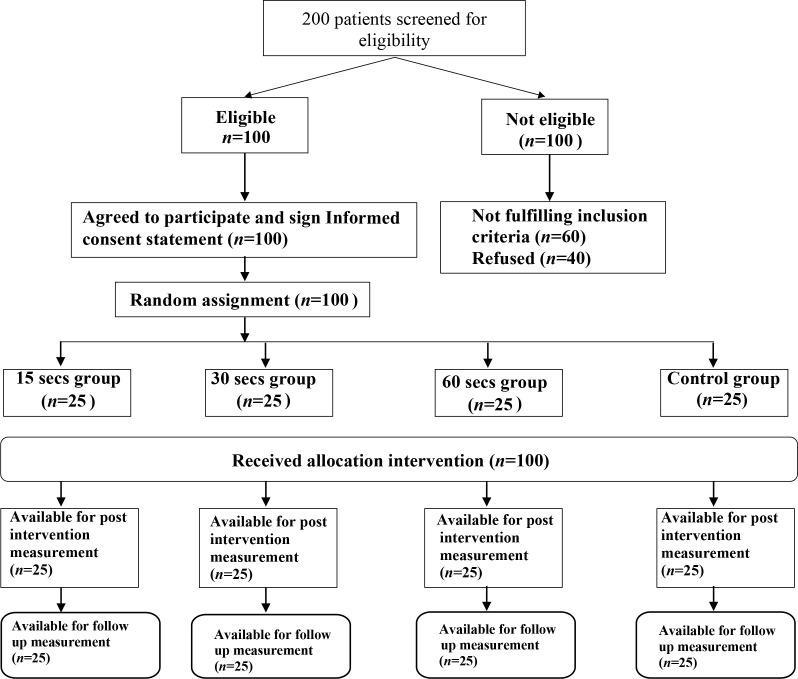
A total of 100 participants diagnosed with chronic myofascial pain syndrome were randomly assigned to a control group or 1 of 3 intervention groups.
METHODS
The 3 experimental groups received different durations of cervical spine stretching: 15, 30 or 60 s. The control group did not stretch. Primary outcome measures included peak-to-peak somatosensory-evoked potential for dermatomes C6, C7 and C8. Secondary outcome measures included central somatosensory conduction time (N13-N20), pain intensity, and pressure-pain threshold algometric measurements. All outcome measures were assessed immediately after and 2 h after the treatment session.
RESULTS
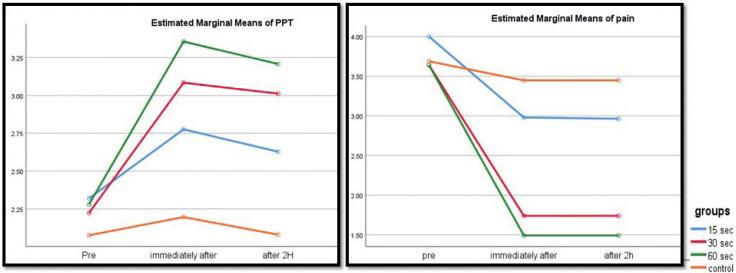
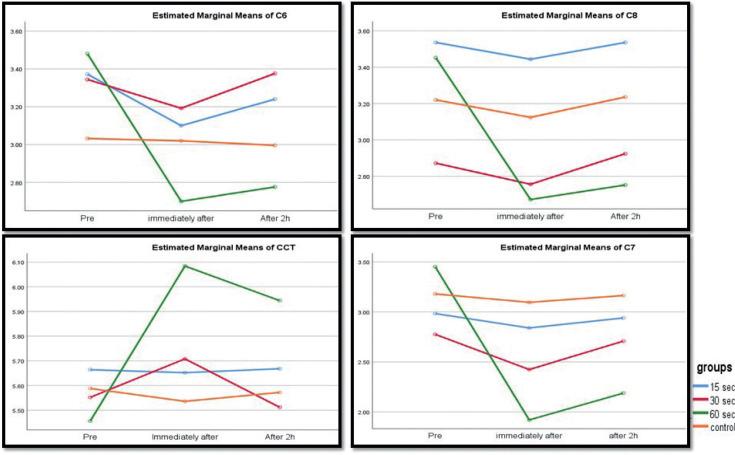
Post hoc analysis indicated that stretching for 60 s significantly decreased the dermatomal amplitude for C6, C7 and C8 (p < 0.001) and significantly increased the central conduction time, indicating negative effect (p < 0.001). Stretching for 30 and 60 s resulted in greater improvement in pain intensity and algometric pressure than stretching for 15 s or no stretch (control) p < 0.001.
CONCLUSION
Stretching cervical muscles involved in chronic myofascial pain syndrome for 30 s was optimal in achieving stretching benefits and minimizing the negative effects on the neural function of the involved nerve roots and central nervous system.
目的
探讨不同持续时间的伸展对慢性肌筋膜疼痛综合征患者神经功能、疼痛和压痛的影响。
设计
随机对照试验。
患者
共 100 名被诊断为慢性肌筋膜疼痛综合征的患者被随机分配到对照组或 3 个干预组之一。
方法
3 个实验组分别接受不同持续时间的颈椎伸展:15、30 或 60 秒。对照组不进行伸展。主要结局指标包括 C6、C7 和 C8 皮节的体感诱发电位峰峰值。次要结局指标包括中枢体感传导时间(N13-N20)、疼痛强度和压痛阈值压痛测量。所有结局指标均在治疗后立即和 2 小时后进行评估。
结果
事后分析表明,持续 60 秒的伸展显著降低了 C6、C7 和 C8 的皮节振幅(p<0.001),并显著增加了中枢传导时间,表明存在负面影响(p<0.001)。与 15 秒伸展或不伸展(对照组)相比,持续 30 秒和 60 秒的伸展可显著改善疼痛强度和压痛压力(p<0.001)。
结论
对慢性肌筋膜疼痛综合征相关颈椎肌肉进行 30 秒的伸展是获得伸展益处和最小化对受累神经根和中枢神经系统神经功能负面影响的最佳选择。
 Zotero 插件