National Engineering Research Center for Non-Food Biorefinery, State Key Laboratory of Non-Food Biomass and Enzyme Technology, Guangxi Biomass Engineering Technology Research Center, Guangxi Key Laboratory of Bio-Refinery, Guangxi Academy of Sciences, Nanning, China.
FASEB J. 2021 Jan;35(1):e21197. doi: 10.1096/fj.202002271.
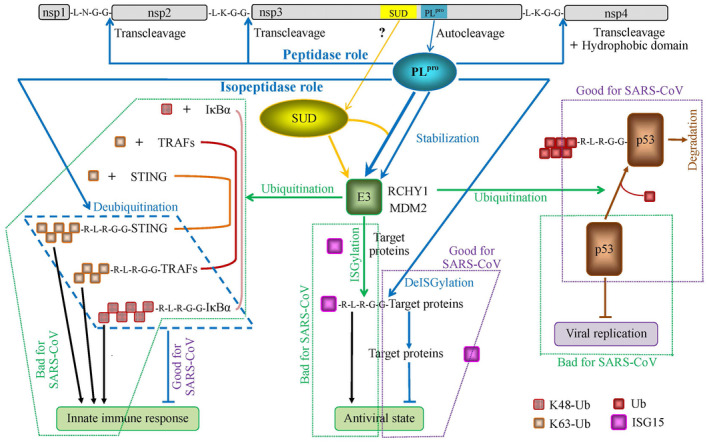
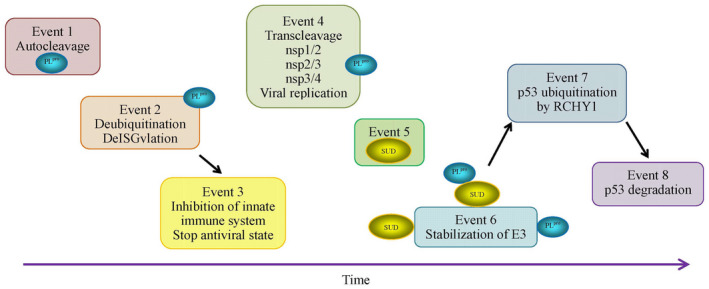
SARS-CoV and SARS-CoV-2 encode four structural and accessory proteins (spike, envelope, membrane and nucleocapsid proteins) and two polyproteins (pp1a and pp1ab). The polyproteins are further cleaved by 3C-like cysteine protease (3CL ) and papain-like protease (PL ) into 16 nonstructural proteins (nsps). PL is released from nsp3 through autocleavage, and then it cleaves the sites between nsp1/2, between nsp2/3 and between nsp3/4 with recognition motif of LXGG, and the sites in the C-terminus of ubiquitin and of protein interferon-stimulated gene 15 (ISG15) with recognition motif of RLRGG. Alone or together with SARS unique domain (SUD), PL can stabilize an E3 ubiquitin ligase, the ring-finger, and CHY zinc-finger domain-containing 1 (RCHY1), through domain interaction, and thus, promote RCHY1 to ubiquitinate its target proteins including p53. However, a dilemma appears in terms of PL roles. On the one hand, the ubiquitination of p53 is good for SARS-CoV because the ubiquitinated p53 cannot inhibit SARS-CoV replication. On the other hand, the ubiquitination of NF-κB inhibitor (IκBα), TNF receptor-associated factors (TRAFs), and stimulator of interferon gene (STING), and the ISGylation of targeted proteins are bad for SARS-CoV because these ubiquitination and ISGylation initiate the innate immune response and antiviral state. This mini-review analyzes the dilemma and provides a snapshot on how the viral PL smartly manages its roles to avoid its simultaneously contradictory actions, which could shed lights on possible strategies to deal with SARS-CoV-2 infections.
SARS-CoV 和 SARS-CoV-2 编码四个结构和辅助蛋白(刺突、包膜、膜和核衣壳蛋白)和两个多蛋白(pp1a 和 pp1ab)。多蛋白进一步被 3C 样半胱氨酸蛋白酶(3CL)和木瓜蛋白酶样蛋白酶(PL)切割成 16 个非结构蛋白(nsps)。PL 通过自身切割从 nsp3 中释放出来,然后用识别基序 LXGG 切割 nsp1/2 之间、nsp2/3 之间和 nsp3/4 之间的位点,用识别基序 RLRGG 切割泛素和干扰素刺激基因 15(ISG15)的 C 端的位点。单独或与 SARS 独特结构域(SUD)一起,PL 可以通过结构域相互作用稳定 E3 泛素连接酶,环指和 CHY 锌指结构域包含蛋白 1(RCHY1),从而促进 RCHY1 泛素化其靶蛋白,包括 p53。然而,PL 的作用存在一个困境。一方面,p53 的泛素化对 SARS-CoV 有利,因为泛素化的 p53 不能抑制 SARS-CoV 的复制。另一方面,NF-κB 抑制剂(IκBα)、肿瘤坏死因子受体相关因子(TRAFs)和干扰素基因刺激蛋白(STING)的泛素化以及靶蛋白的 ISG 化对 SARS-CoV 不利,因为这些泛素化和 ISG 化引发先天免疫反应和抗病毒状态。本综述分析了这一困境,并提供了一个快照,说明病毒 PL 如何巧妙地管理其作用,以避免其同时矛盾的作用,这可能为应对 SARS-CoV-2 感染提供可能的策略。