di Flora Daniele Castro, Lara João Paulo Zanardini, Dionizio Aline, Buzalaf Marília Afonso Rabelo
Department of Biological Sciences, Bauru School of Dentistry, University of São Paulo, Bauru 17012-901, Brazil.
Cells. 2025 Feb 28;14(5):362. doi: 10.3390/cells14050362.
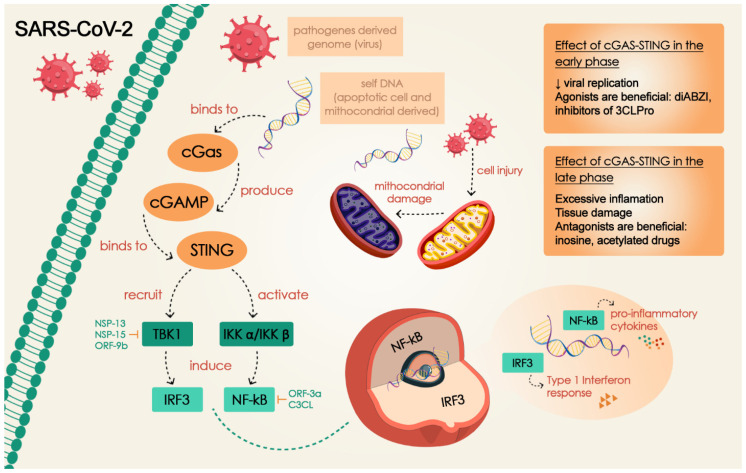
The progression of COVID-19 involves a sophisticated and intricate interplay between the SARS-CoV-2 virus and the host's immune response. The immune system employs both innate and adaptive mechanisms to combat infection. Innate immunity initiates the release of interferons (IFNs) and pro-inflammatory cytokines, while the adaptive immune response involves CD4+ Th lymphocytes, B lymphocytes, and CD8+ Tc cells. Pattern recognition receptors (PRRs) recognize pathogen-associated molecular patterns (PAMPS) and damage-associated molecular patterns (DAMPs), activating the cyclic guanosine monophosphate-adenosine monophosphate synthase-stimulator of interferon genes (cGAS-STING) signaling pathway, a crucial component of the innate immune response to SARS-CoV-2. This pathway fulfills a dual function during infection. In the early phase of infection, the virus can suppress cGAS-STING signaling to avoid immune detection. However, in the late stages, the activation of this pathway may trigger excessive inflammation and tissue damage, exacerbating disease severity. Modulating the cGAS-STING pathway, whether through agonists like dimeric amidobenzimidazole (diABZI) or inhibitors targeting viral proteins, such as 3CLpro, for example, offers a promising approach for personalized therapy to control the immune response and mitigate severe inflammation, ultimately improving clinical outcomes in patients with severe COVID-19.
新型冠状病毒肺炎(COVID-19)的病程涉及严重急性呼吸综合征冠状病毒2(SARS-CoV-2)病毒与宿主免疫反应之间复杂而精细的相互作用。免疫系统利用先天性和适应性机制来对抗感染。先天性免疫引发干扰素(IFN)和促炎细胞因子的释放,而适应性免疫反应涉及CD4 + T淋巴细胞、B淋巴细胞和CD8 + Tc细胞。模式识别受体(PRR)识别病原体相关分子模式(PAMP)和损伤相关分子模式(DAMP),激活环磷酸鸟苷-磷酸腺苷合酶-干扰素基因刺激物(cGAS-STING)信号通路,这是对SARS-CoV-2先天性免疫反应的关键组成部分。该信号通路在感染过程中发挥双重作用。在感染的早期阶段,病毒可以抑制cGAS-STING信号传导以避免免疫检测。然而,在后期,该信号通路的激活可能引发过度炎症和组织损伤,加剧疾病的严重程度。调节cGAS-STING信号通路,无论是通过二聚体氨基苯并咪唑(diABZI)等激动剂还是靶向病毒蛋白(如3CLpro)的抑制剂,都为个性化治疗提供了一种有前景的方法,以控制免疫反应并减轻严重炎症,最终改善重症COVID-19患者的临床结局。