Pfizer Japan Inc., Tokyo, Japan.
Pfizer R&D Japan G.K., Tokyo, Japan.
J Clin Hypertens (Greenwich). 2021 Mar;23(3):646-655. doi: 10.1111/jch.14151. Epub 2020 Dec 26.
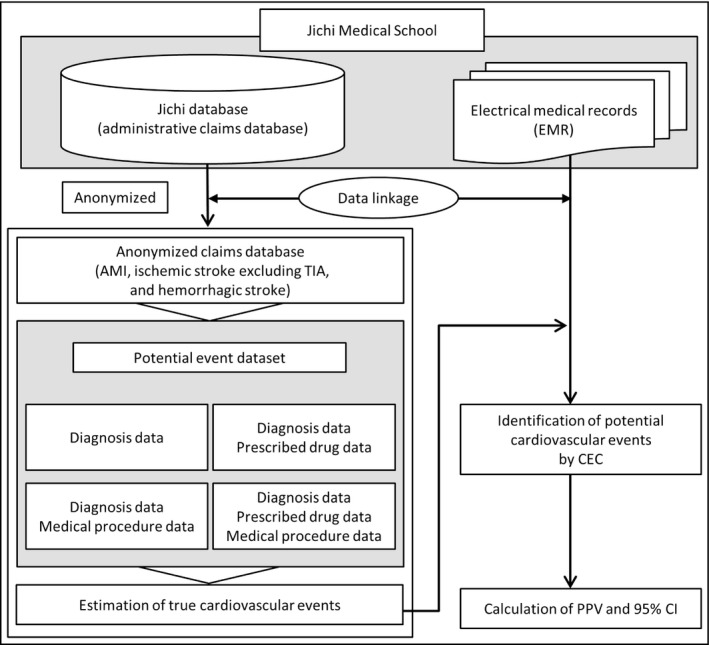
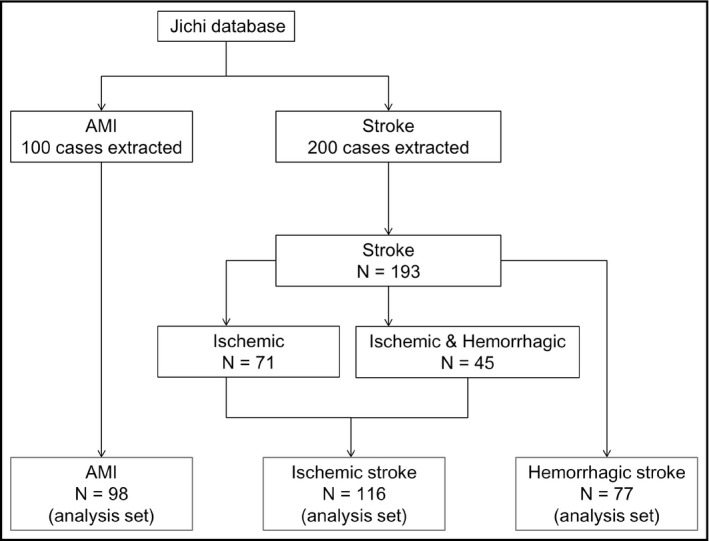
Predicting clinical outcomes can be difficult, particularly for life-threatening events with a low incidence that require numerous clinical cases. Our aim was to develop and validate novel algorithms to identify major adverse cardiovascular events (MACEs) from claims databases. We developed algorithms based on the data available in the claims database International Classification of Diseases, Tenth Revision (ICD-10), drug prescriptions, and medical procedures. We also employed data from the claims database of Jichi Medical University Hospital, Japan, for the period between October 2012 and September 2014. In total, we randomly extracted 100 potential acute myocardial infarction cases and 200 potential stroke cases (ischemic and hemorrhagic stroke were analyzed separately) based on ICD-10 diagnosis. An independent committee reviewed the corresponding clinical data to provide definitive diagnoses for the extracted cases. We then assessed the algorithms' accuracy using positive predictive values (PPVs) and apparent sensitivities. The PPVs of acute myocardial infarction, ischemic stroke, and hemorrhagic stroke were low only by diagnosis (81.6% [95% CI 72.5-88.7]; 31.0% [95% CI 22.8-40.3]; and 45.5% [95% CI 34.1-57.2], respectively); however, the PPVs were elevated after adding the prescription and procedure data (87.0% [95% CI 78.3-93.1]; 44.4% [95% CI 32.7-56.6]; and 46.1% [95% CI 34.5-57.9], respectively). When we added event-specific prescription and procedure data to the algorithms, the PPVs for each event increased to 70%-98%, with apparent sensitivities exceeding 50%. Algorithms that rely on ICD-10 diagnosis in combination with data on specific drugs and medical procedures appear to be valid for identifying MACEs in Japanese claims databases.
预测临床结果可能具有挑战性,特别是对于发病率低且需要大量临床病例的危及生命的事件。我们的目的是开发和验证从索赔数据库中识别主要不良心血管事件(MACE)的新算法。我们根据索赔数据库中的数据开发了算法国际疾病分类,第十版(ICD-10),药物处方和医疗程序。我们还利用了日本顺天堂大学医院索赔数据库的数据,时间为 2012 年 10 月至 2014 年 9 月。总共,我们根据 ICD-10 诊断随机提取了 100 例潜在急性心肌梗死病例和 200 例潜在中风病例(分别分析缺血性和出血性中风)。一个独立的委员会审查了相应的临床数据,为提取的病例提供了明确的诊断。然后,我们使用阳性预测值(PPV)和明显敏感性来评估算法的准确性。仅通过诊断,急性心肌梗死,缺血性中风和出血性中风的 PPV 较低(分别为 81.6%[95%CI 72.5-88.7%]; 31.0%[95%CI 22.8-40.3%];和 45.5%[95%CI 34.1-57.2%]);但是,添加处方和程序数据后,PPV 升高(分别为 87.0%[95%CI 78.3-93.1%]; 44.4%[95%CI 32.7-56.6%];和 46.1%[95%CI 34.5-57.9%])。当我们将特定于事件的处方和程序数据添加到算法中时,每个事件的 PPV 增加到 70%-98%,明显敏感性超过 50%。依赖 ICD-10 诊断结合特定药物和医疗程序数据的算法似乎可用于识别日本索赔数据库中的 MACE。