Division of Clinical Immunology and Rheumatology, Department of Medicine, University of Alabama at Birmingham, Birmingham, AL, USA.
Division of Gynecology Oncology, Department of Obstetrics and Gynecology, University of Alabama at Birmingham, Birmingham, AL, USA.
Cancer Med. 2021 Jan;10(2):709-717. doi: 10.1002/cam4.3337. Epub 2020 Dec 24.
Patients with epithelial ovarian cancer (EOC) typically present with late-stage disease, posing a significant challenge to treatment. Although taxane and platinum-based chemotherapy plus surgical debulking are initially effective, EOC is marked by frequent recurrence with resistant disease. Immunotherapy represents an appealing treatment paradigm given the ability of immune cells to engage metastatic sites and impede recurrence; however, response rates to checkpoint blockade in ovarian cancer have been disappointing. Here, we tested whether class I HDAC inhibition can promote anti-tumor T cell responses in a spontaneous and nonspontaneous murine model of EOC.
We used the spontaneous Tg-MISIIR-Tag and nonspontaneous ID8 models of murine ovarian cancer to test this hypothesis. Whole tumor transcriptional changes were assessed using the nCounter PanCancer Mouse Immune Profiling Panel. Changes in select protein expression of regulatory and effector T cells were measured by flow cytometry.
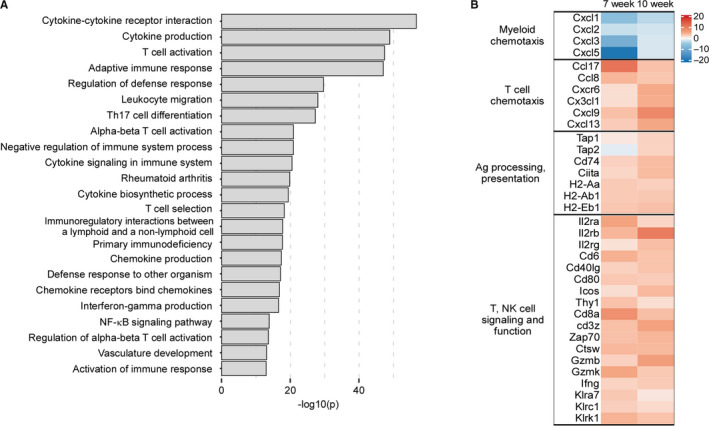
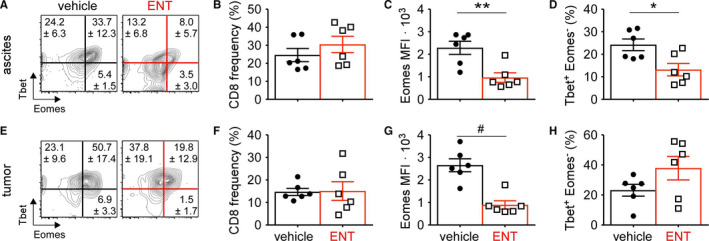
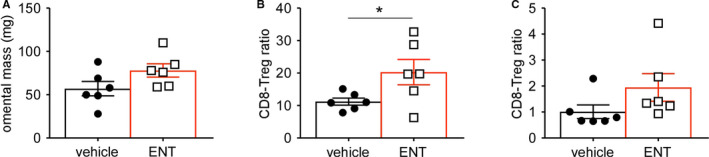
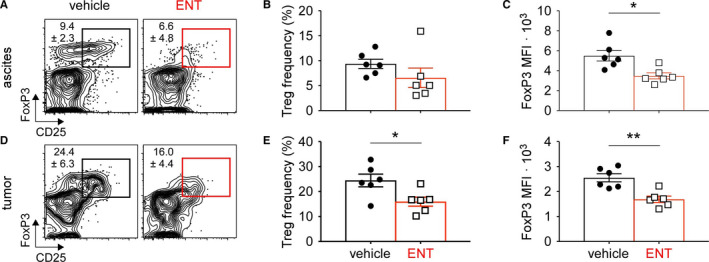
We found that treatment with the class I HDAC inhibitor entinostat upregulated pathways and genes associated with CD8 T cell cytotoxic function, while downregulating myeloid derived suppressor cell chemoattractants. Suppressive capacity of regulatory T cells within tumors and associated ascites was significantly reduced, reversing the CD8-Treg ratio.
Our findings suggest class I HDAC inhibition can promote activation of intratumoral CD8 T cells, potentially by compromising suppressive networks within the EOC tumor microenvironment. In this manner, class I HDAC inhibition might render advanced-stage EOC susceptible to immunotherapeutic treatment modalities.
上皮性卵巢癌(EOC)患者通常表现为晚期疾病,这对治疗构成了重大挑战。尽管紫杉烷和铂类化疗加手术去负荷最初是有效的,但 EOC 经常复发且具有耐药性。鉴于免疫细胞能够参与转移部位并阻止复发,免疫疗法代表了一种有吸引力的治疗模式;然而,卵巢癌中检查点阻断的反应率令人失望。在这里,我们测试了 I 类组蛋白去乙酰化酶(HDAC)抑制是否可以在自发性和非自发性 EOC 小鼠模型中促进抗肿瘤 T 细胞反应。
我们使用自发性 Tg-MISIIR-Tag 和非自发性 ID8 小鼠卵巢癌模型来检验这一假设。使用 nCounter PanCancer Mouse Immune Profiling Panel 评估全肿瘤转录变化。通过流式细胞术测量调节性和效应性 T 细胞的选择蛋白表达变化。
我们发现,用 I 类 HDAC 抑制剂恩替诺司他治疗可上调与 CD8 T 细胞细胞毒性功能相关的途径和基因,同时下调髓样来源抑制细胞趋化因子。肿瘤内和相关腹水中调节性 T 细胞的抑制能力显著降低,逆转了 CD8-Treg 比值。
我们的研究结果表明,I 类 HDAC 抑制可以促进肿瘤内 CD8 T 细胞的激活,可能通过破坏 EOC 肿瘤微环境中的抑制性网络。通过这种方式,I 类 HDAC 抑制可能使晚期 EOC 对免疫治疗方法敏感。