Behavior Change Institute.
Stanford University School of Medicine.
J Appl Behav Anal. 2021 Jan;54(1):87-102. doi: 10.1002/jaba.803. Epub 2020 Dec 28.
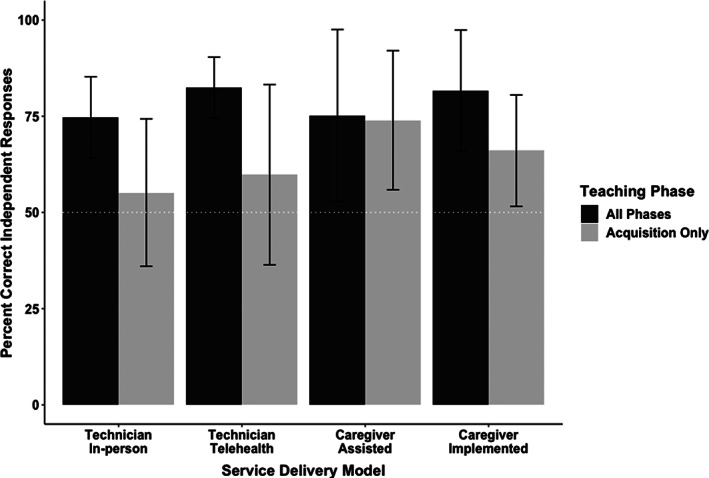
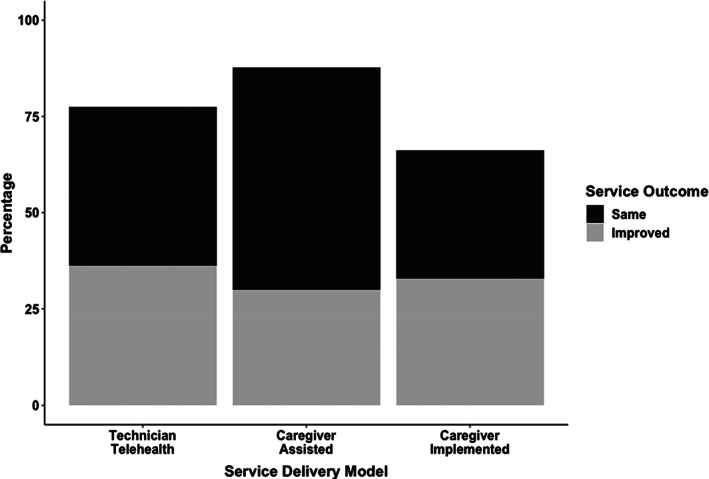
Telehealth delivery of applied behavior analysis treatment has focused on supervision or staff and parent training, rather than the direct delivery of treatment to clients. The novel coronavirus (COVID-19) crisis had the potential to significantly disrupt access to direct treatment for individuals with autism. We report a sample of 17 cases that transitioned from in-person to telehealth delivery of treatment when shelter-in-place orders were issued. Of these cases, 76% of participants transitioned to technician-delivered telehealth services whereas the rest transitioned to a caregiver-implemented telehealth model. Participants continued to access a similar dosage of treatment hours per week in spite of the treatment model transition (in-person M = 12; telehealth M = 11) and maintained or improved correct independent responding across all targets from in-person treatment (M = 75%) to telehealth treatment (M = 80%). These findings provide initial evidence that some clients with autism benefit from technician-delivered telehealth services.
远程医疗在提供应用行为分析治疗方面主要集中在监督或员工和家长培训方面,而不是直接向客户提供治疗。新型冠状病毒(COVID-19)危机有可能严重破坏自闭症患者获得直接治疗的机会。我们报告了 17 例案例,这些案例在发布就地避难命令时从面对面治疗转为远程医疗治疗。在这些案例中,76%的参与者转为技术人员提供的远程医疗服务,而其余的参与者转为护理人员实施的远程医疗模式。尽管治疗模式发生了转变(面对面治疗 M = 12;远程医疗 M = 11),但参与者每周仍继续接受类似剂量的治疗时间,并且在所有目标上保持或提高正确的独立反应能力,从面对面治疗(M = 75%)到远程治疗(M = 80%)。这些发现初步证明,一些自闭症患者从技术人员提供的远程医疗服务中受益。