Institute for Medical Research, National Institutes of Health, Shah Alam, Selangor, Malaysia.
Department of Biological Sciences and Biotechnology, Faculty of Science and Technology, Universiti Kebangsaan Malaysia, Bangi, Selangor, Malaysia.
PLoS Negl Trop Dis. 2020 Dec 28;14(12):e0008979. doi: 10.1371/journal.pntd.0008979. eCollection 2020 Dec.
Melioidosis is a neglected tropical disease with rising global public health and clinical importance. Melioidosis is endemic in Southeast Asia and Northern Australia and is of increasing concern in Malaysia. Despite a number of reported studies from Malaysia, these reports are limited to certain parts of the country and do not provide a cohesive link between epidemiology of melioidosis cases and the nation-wide distribution of the causative agent Burkholderia pseudomallei.
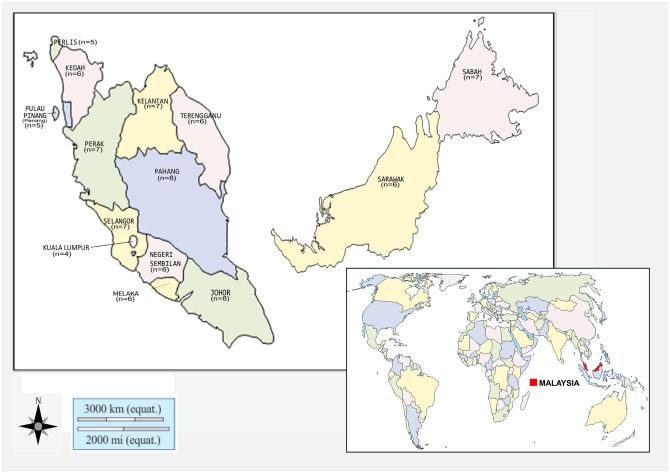
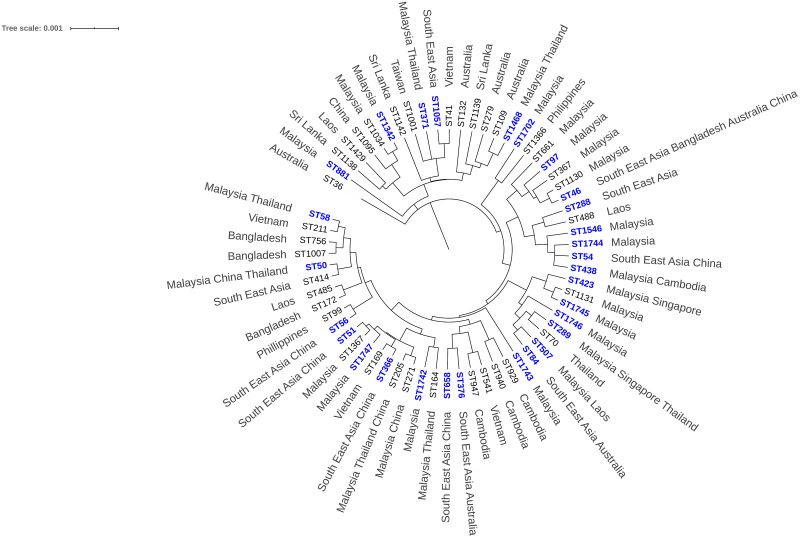
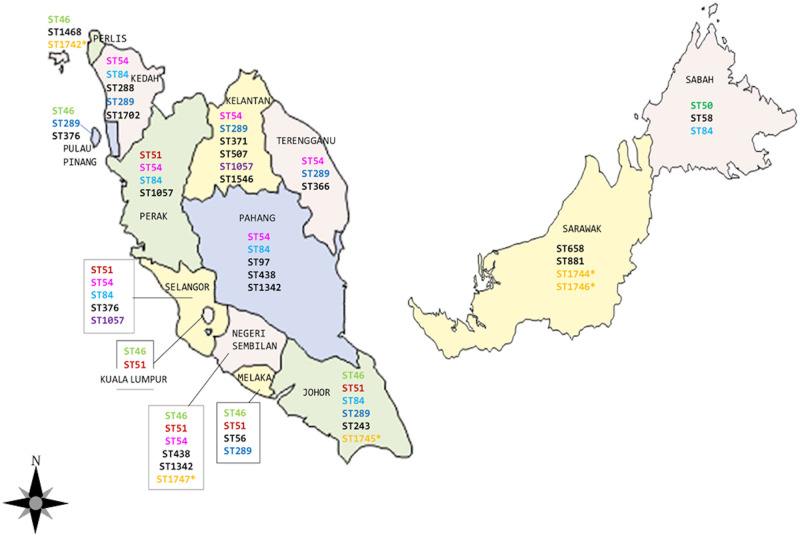
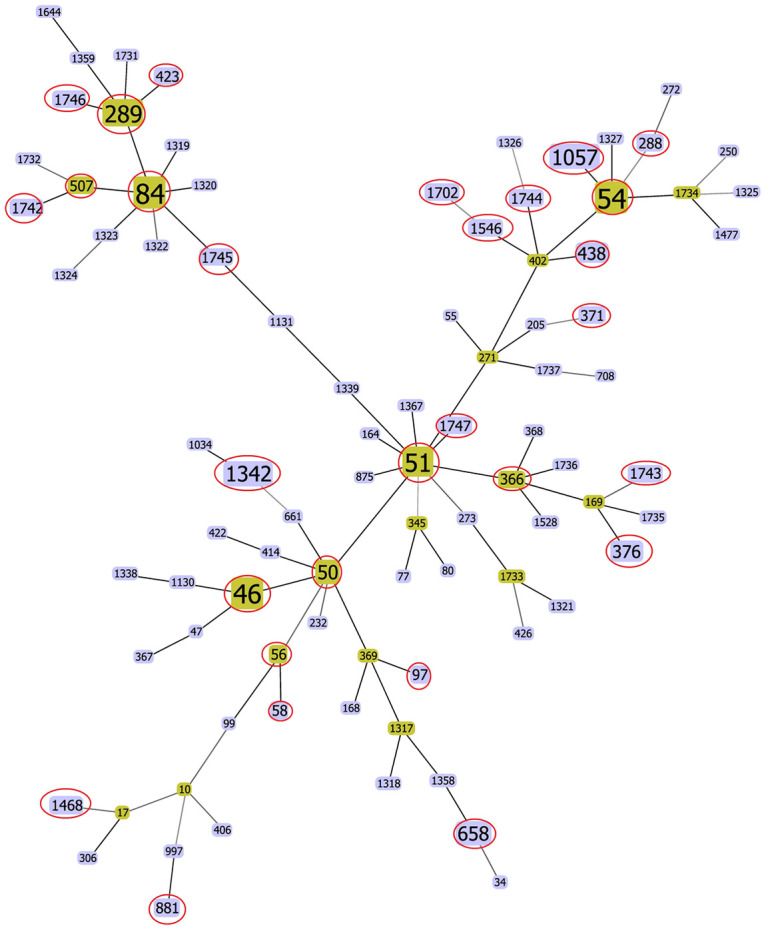
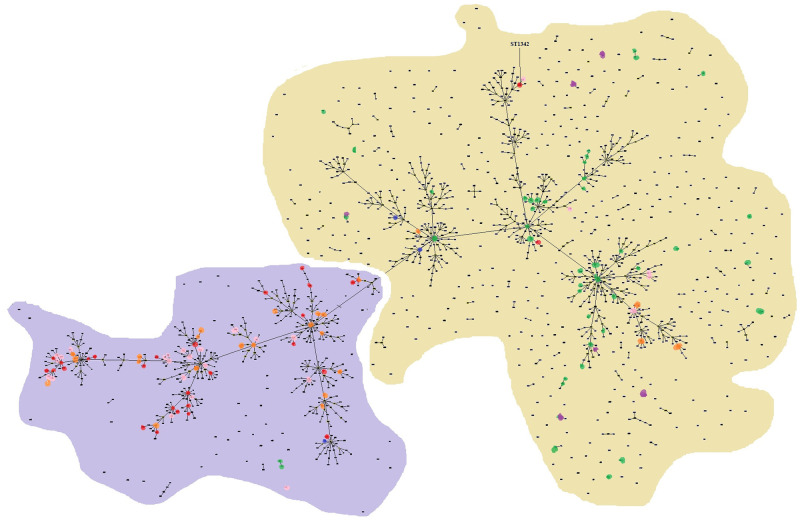
METHODOLOGY/PRINCIPLE FINDINGS: Here we report on the distribution of B. pseudomallei sequence types (STs) in Malaysia and how the STs are related to STs globally. We obtained 84 culture-confirmed B. pseudomallei from confirmed septicaemic melioidosis patients from all over Malaysia. Prior to performing Multi Locus Sequence Typing, the isolates were subjected to antimicrobial susceptibility testing and detection of the YLF/BTFC genes and BimA allele. Up to 90.5% of the isolates were sensitive to all antimicrobials tested while resistance was observed for antimicrobials typically administered during the eradication stage of treatment. YLF gene cluster and bimABp allele variant were detected in all the isolates. The epidemiological distribution patterns of the Malaysian B. pseudomallei isolates were analysed in silico using phylogenetic tools and compared to Southeast Asian and world-wide isolates. Genotyping of the 84 Malaysian B. pseudomallei isolates revealed 29 different STs of which 6 (7.1%) were novel. ST50 was identified as the group founder followed by subgroup founders ST376, ST211 and ST84. A low-level diversity is noted for the B. pseudomallei isolates described in this study while phylogenetic analysis associated the Malaysian STs to Southeast Asian isolates especially isolates from Thailand. Further analysis also showed a strong association that implicates agriculture and domestication activities as high-risk routes of infection.
CONCLUSIONS/SIGNIFICANCE: In conclusion, MLST analysis of B. pseudomallei clinical isolates from all states in Malaysia revealed low diversity and a close association to Southeast Asian isolates.
类鼻疽是一种被忽视的热带病,其在全球范围内的公共卫生和临床重要性日益增加。类鼻疽在东南亚和澳大利亚北部流行,在马来西亚也越来越受到关注。尽管马来西亚已经有许多报道的研究,但这些报告仅限于该国的某些地区,并且不能在全国范围内将类鼻疽病例的流行病学与导致该病的病原体伯克霍尔德菌假单胞菌的分布情况联系起来。
方法/原理发现:在这里,我们报告了马来西亚境内伯克霍尔德菌假单胞菌序列型(ST)的分布情况,以及这些 ST 与全球 ST 的关系。我们从马来西亚各地确诊的败血症类鼻疽患者中获得了 84 株经培养证实的伯克霍尔德菌假单胞菌。在进行多位点序列分型之前,对分离株进行了药敏试验以及 YLF/BTFC 基因和 BimA 等位基因的检测。多达 90.5%的分离株对所有测试的抗菌药物均敏感,而在治疗根除阶段通常使用的抗菌药物则观察到耐药性。在所有分离株中均检测到 YLF 基因簇和 bimABp 等位基因变体。使用系统发育工具对马来西亚伯克霍尔德菌假单胞菌分离株的流行病学分布模式进行了分析,并与东南亚和全球分离株进行了比较。对 84 株马来西亚伯克霍尔德菌假单胞菌分离株进行基因分型,发现了 29 种不同的 ST,其中 6 种(7.1%)为新 ST。ST50 被鉴定为群体创始人,其次是亚群创始人 ST376、ST211 和 ST84。本研究中描述的伯克霍尔德菌假单胞菌分离株的多样性较低,系统发育分析将马来西亚 ST 与东南亚分离株特别是泰国分离株联系在一起。进一步的分析还表明,农业和驯化活动作为高感染风险途径存在很强的关联。
结论/意义:总之,对来自马来西亚所有州的伯克霍尔德菌假单胞菌临床分离株进行 MLST 分析显示,多样性较低,与东南亚分离株密切相关。