Food Security Initiative and Centre for Complex Systems in Transition, Stellenbosch University, Stellenbosch, South Africa.
Regional Institute for Population Studies, University of Ghana, Accra, Ghana.
PLoS One. 2020 Dec 28;15(12):e0244362. doi: 10.1371/journal.pone.0244362. eCollection 2020.
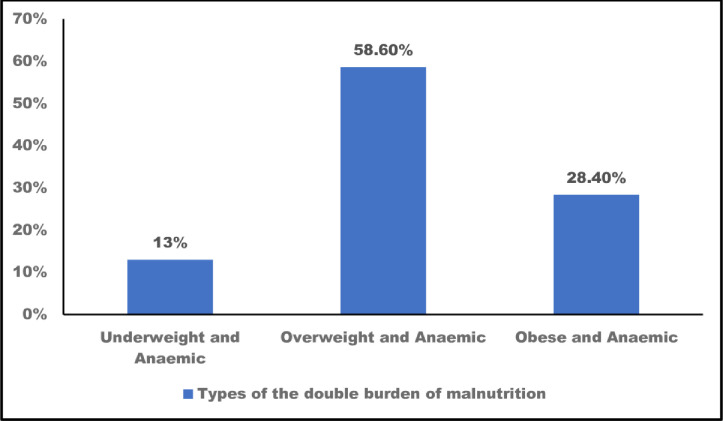
Anaemia and underweight or overweight/obesity are major public health problems driving maternal and child mortality in low- and middle-income countries. While the burden of these conditions is recognised, the evidence for the co-occurrence of these conditions is fragmented and mixed, especially at the individual level. Further, many studies have focused on families and communities. The different pathways for the occurrence of anaemia and BMI challenges indicate that an individual can potentially live with both conditions and suffer the complications. This study examined the prevalence and factors associated with the co-occurrence of anaemia and BMI challenges among a cohort of women in Ghana. Data from the 2014 Ghana Demographic and Health Survey were used. The sample size was 4 337 women aged 15-49 years who were not pregnant during the survey. Women who suffered simultaneously from underweight or overweight/obesity and anaemia were considered as having the double burden of malnutrition. The data were analysed using descriptive statistics, Chi-square test and logistic regression in STATA. One-fifth of the participants were overweight (21%), 4% were underweight and about one-tenth were obese (12%). The prevalence of anaemia was 41%. Only one in three women had normal weight and was not anaemic (34%). About 14% of the women experienced the double burden of malnutrition. Being overweight and anaemic (57%) was the most common form of this double burden. Age, marital status, parity, and wealth were t key risk factors associated with the double burden of malnutrition. The findings from this study show that women experience multiple nutritional challenges concurrently and that only a few women had healthy nutritional status. This information is particularly important and can be introduced into health education programmes to help address misconceptions about body weight and health.
贫血和体重不足或超重/肥胖是中低收入国家导致母婴死亡的主要公共卫生问题。尽管这些情况的负担是公认的,但这些情况同时发生的证据是分散和混合的,特别是在个人层面上。此外,许多研究都集中在家庭和社区。贫血和 BMI 挑战发生的不同途径表明,一个人可能同时患有这两种疾病,并遭受并发症的困扰。本研究调查了加纳一组妇女中贫血和 BMI 挑战同时发生的流行率和相关因素。使用了 2014 年加纳人口与健康调查的数据。样本量为 4337 名年龄在 15-49 岁之间、调查期间未怀孕的妇女。同时患有体重不足或超重/肥胖和贫血的妇女被认为同时患有营养不良的双重负担。数据使用 STATA 中的描述性统计、卡方检验和逻辑回归进行分析。五分之一的参与者超重(21%),4%体重不足,约十分之一肥胖(12%)。贫血的患病率为 41%。只有三分之一的妇女体重正常且不贫血(34%)。约 14%的妇女经历了营养不良的双重负担。超重和贫血(57%)是这种双重负担最常见的形式。年龄、婚姻状况、生育次数和财富是与营养不良的双重负担相关的关键风险因素。本研究的结果表明,妇女同时面临多种营养挑战,只有少数妇女具有健康的营养状况。这些信息尤为重要,可以纳入健康教育计划,以帮助纠正对体重和健康的误解。