Department of Materials and Environmental Chemistry, Stockholm University, Stockholm 10691, Sweden.
J Phys Chem B. 2021 Jan 14;125(1):416-430. doi: 10.1021/acs.jpcb.0c08622. Epub 2020 Dec 29.
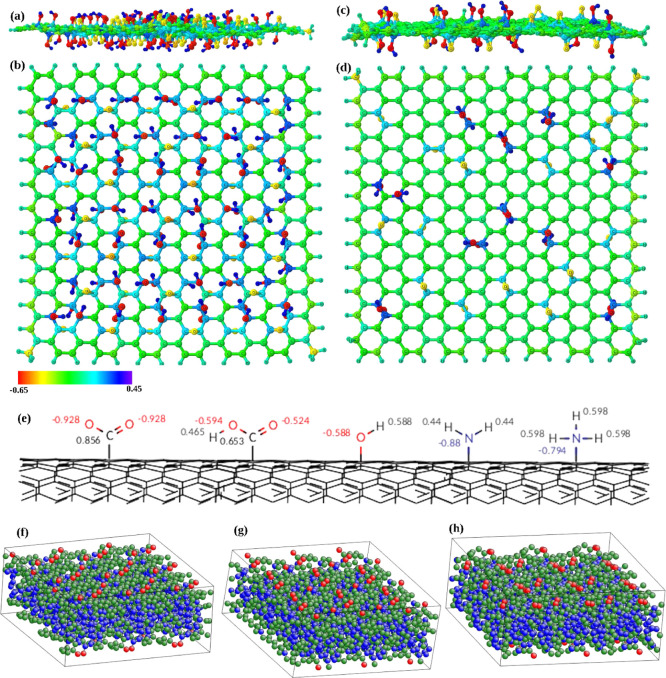
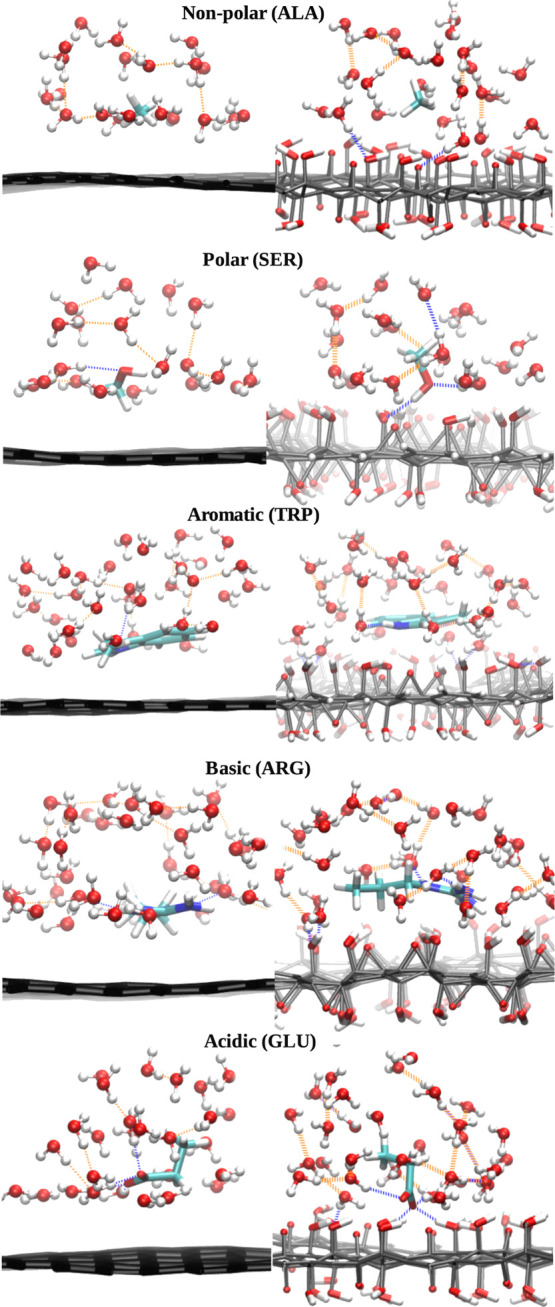
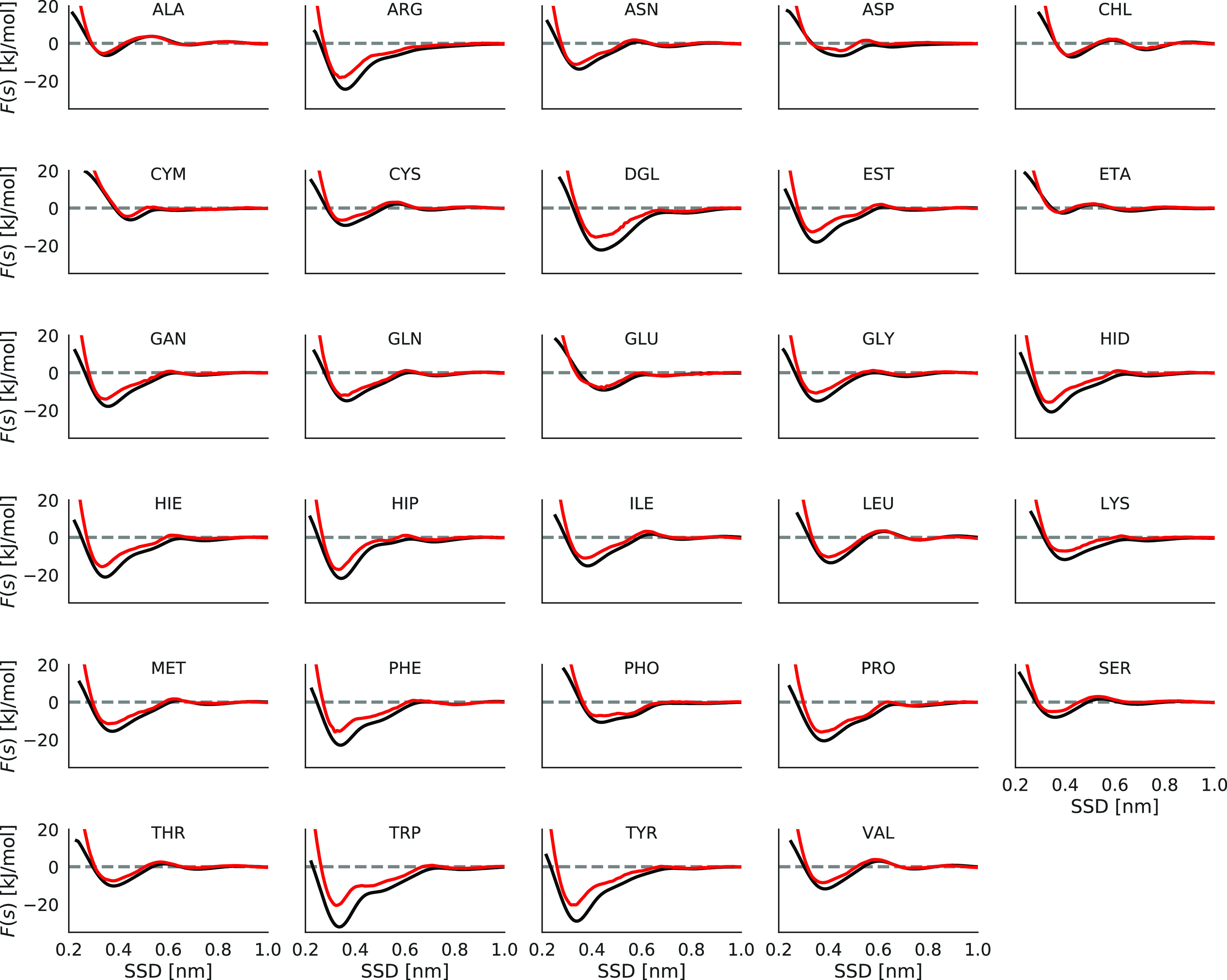
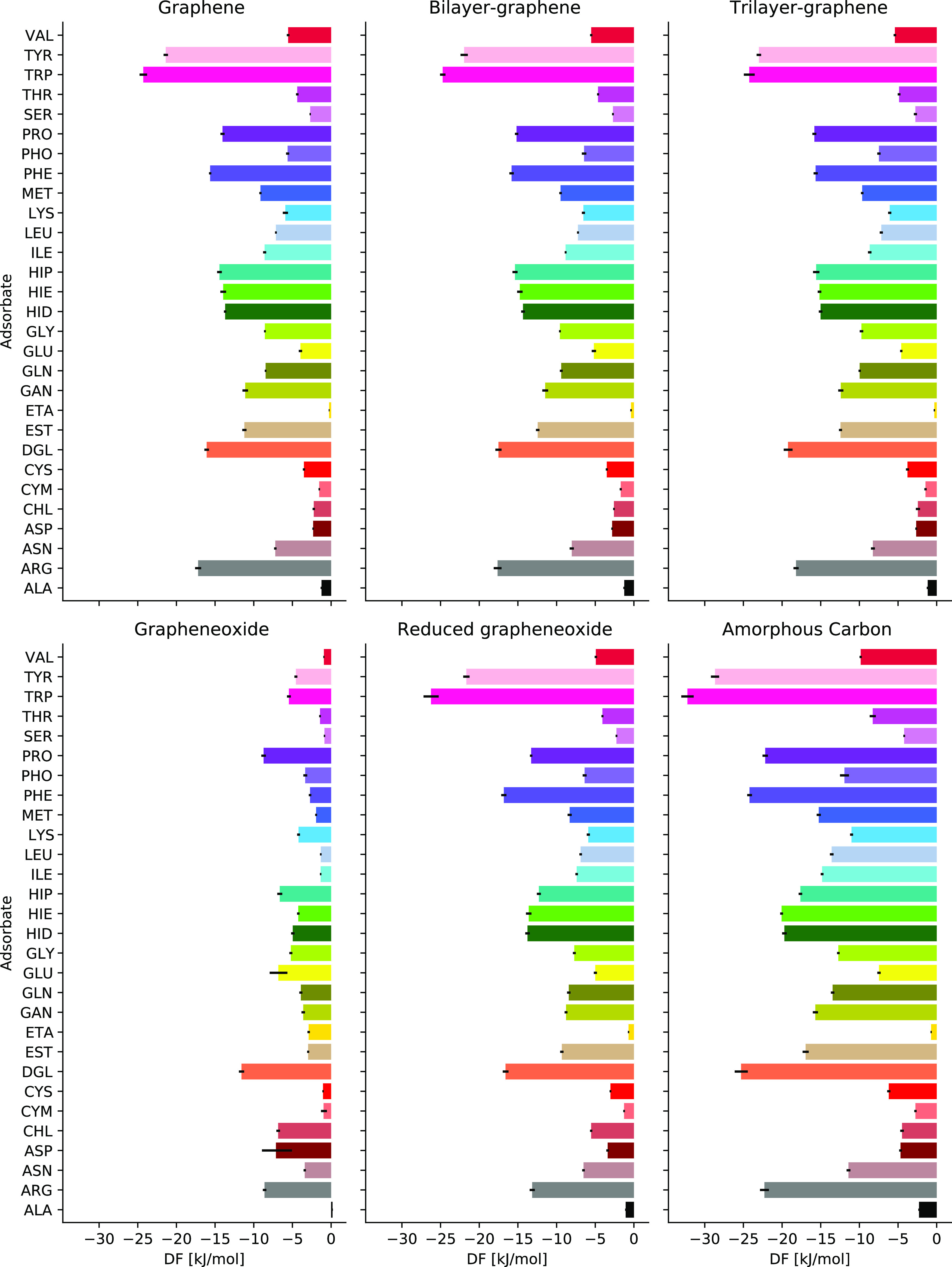
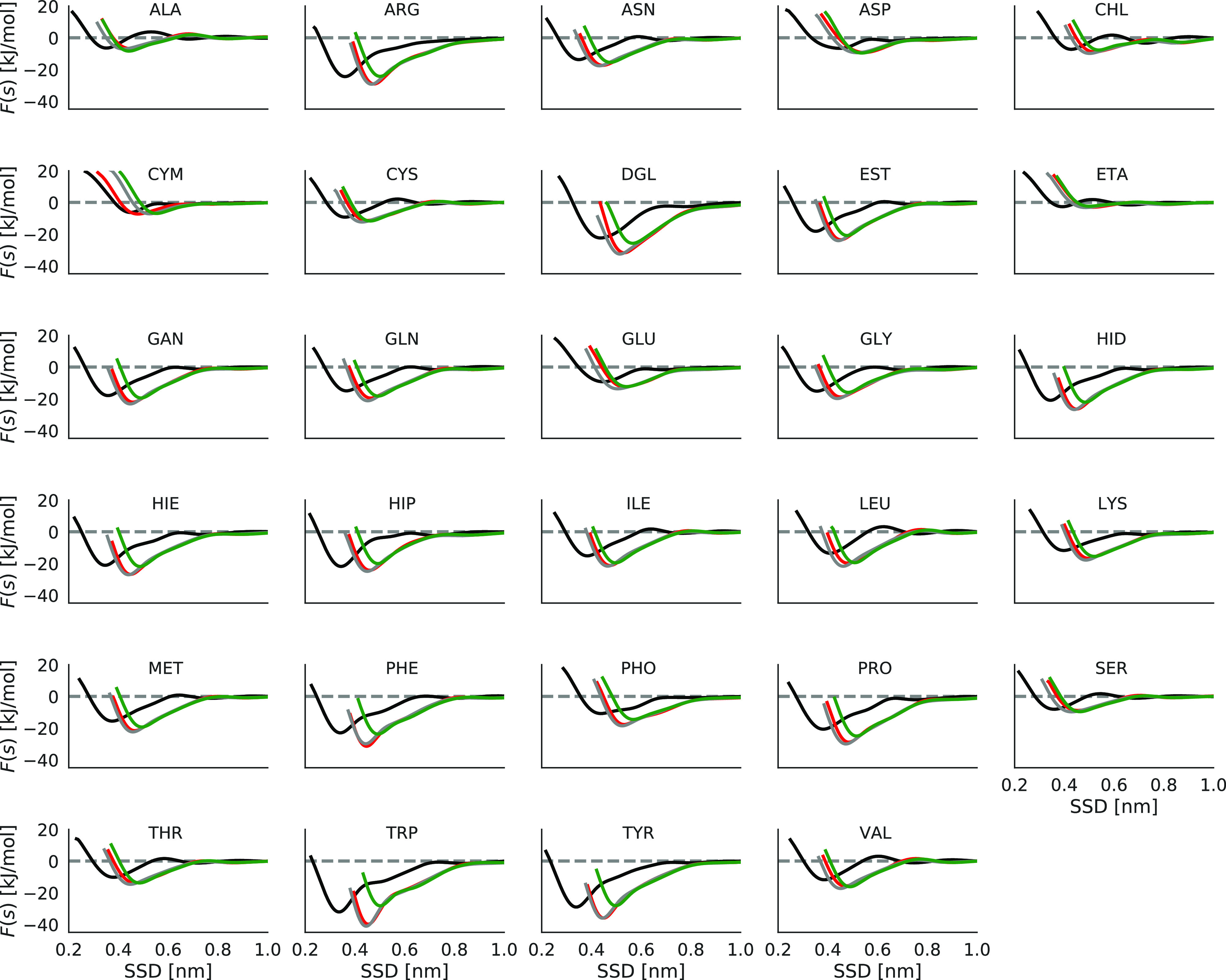
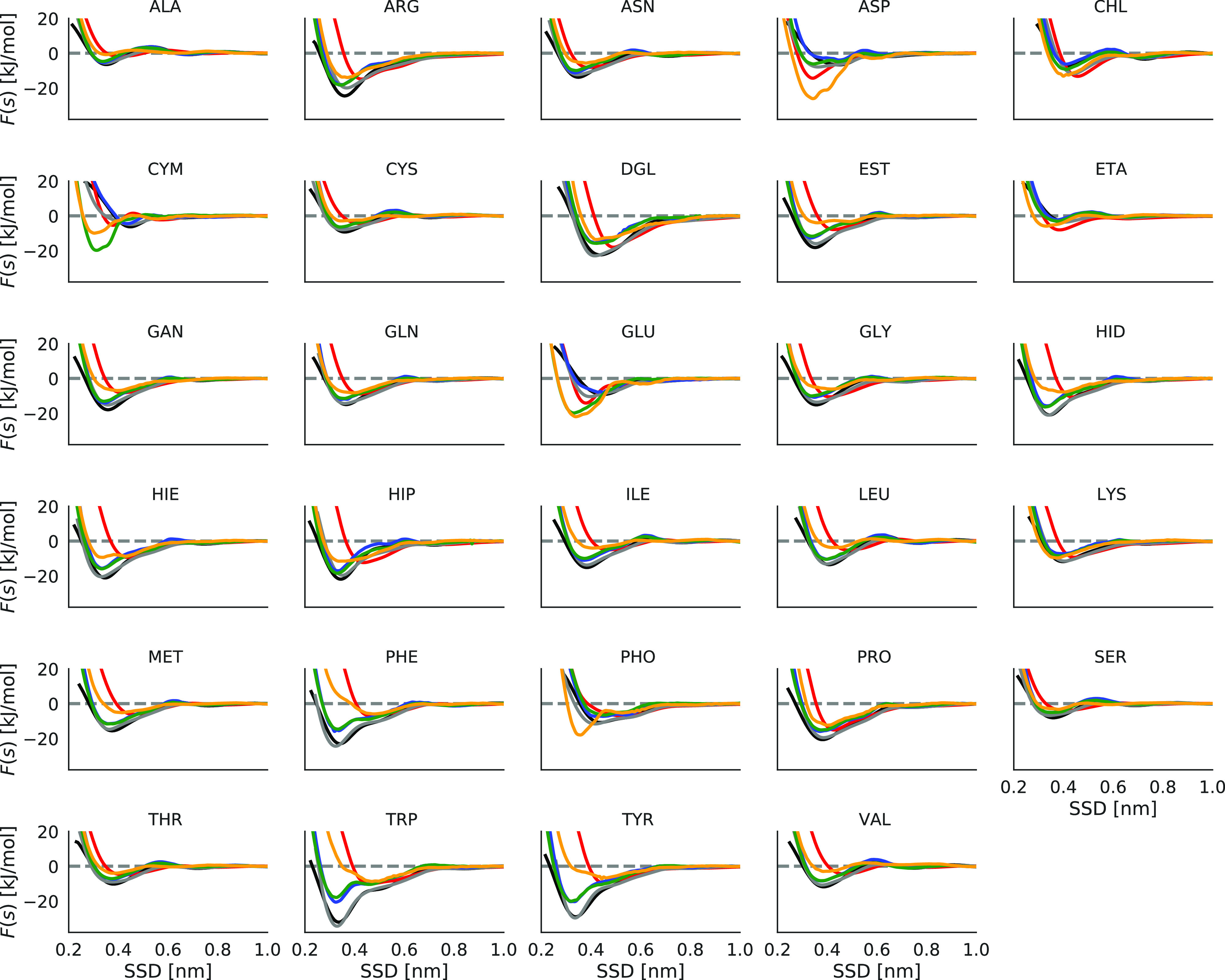
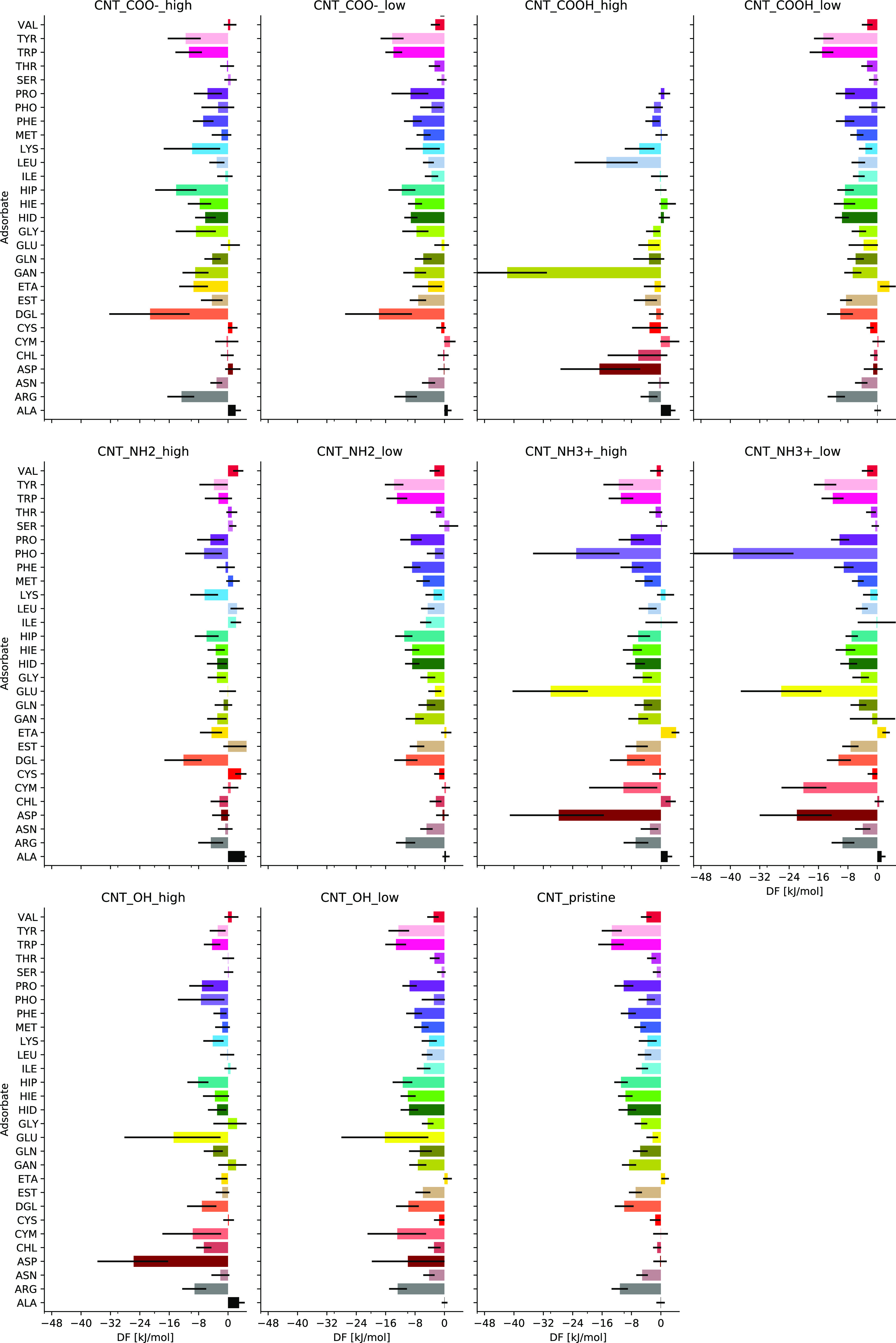
The use of carbon-based nanomaterials is tremendously increasing in various areas of technological, bioengineering, and biomedical applications. The functionality of carbon-based nanomaterials can be further broadened chemical functionalization of carbon nanomaterial surfaces. On the other hand, concern is rising on possible adverse effects when nanomaterials are taken up by biological organisms. In order to contribute into understanding of interactions of carbon-based nanomaterials with biological matter, we have investigated adsorption of small biomolecules on nanomaterials using enhanced sampling molecular dynamics. The biomolecules included amino acid side chain analogues, fragments of lipids, and sugar monomers. The adsorption behavior on unstructured amorphous carbon, pristine graphene and its derivatives (such as few-layer graphene, graphene oxide, and reduced graphene oxide) as well as pristine carbon nanotubes, and those functionalized with OH, COOH, COO, NH, and NH groups was investigated with respect to surface concentration. An adsorption profile, that is, the free energy as a function of distance from the nanomaterial surfaces, was determined for each molecule and surface using the Metadynamics approach. The results were analyzed in terms of chemical specificity, surface charge, and surface concentration. It was shown that although morphology of the nanomaterial has a limited effect on the adsorption properties, functionalization of the surface by various molecular groups can drastically change the adsorption behavior that can be used in the design of nanosurfaces with highly selective adsorption properties and safe for human health and environment.
碳基纳米材料在技术、生物工程和生物医学应用的各个领域中的应用正在迅速增加。通过对碳纳米材料表面进行化学功能化,可以进一步拓宽碳基纳米材料的功能。另一方面,人们越来越担心纳米材料被生物机体吸收时可能产生的不良影响。为了有助于理解碳基纳米材料与生物物质的相互作用,我们使用增强采样分子动力学研究了小分子生物分子在纳米材料上的吸附。所研究的生物分子包括氨基酸侧链类似物、脂质片段和糖单体。研究了无定形碳、原始石墨烯及其衍生物(如少层石墨烯、氧化石墨烯和还原氧化石墨烯)以及原始碳纳米管的吸附行为,以及那些用 OH、COOH、COO、NH 和 NH 基团功能化的纳米管的吸附行为,研究了表面浓度对吸附行为的影响。对于每个分子和表面,使用元动力学方法确定了吸附曲线,即自由能随距纳米材料表面距离的函数。结果从化学特异性、表面电荷和表面浓度方面进行了分析。结果表明,尽管纳米材料的形态对吸附性质有一定的影响,但通过各种分子基团对表面进行功能化可以显著改变吸附行为,从而可以设计出具有高选择性吸附性质、对人类健康和环境安全的纳米表面。